DNA (Role in Inheritance) — Overview & Importance

Before this, knowChromosomes (Role in Inheritance) — Overview & Importance

Illustrated · 1 min

DNA helix with orange, green, red, and yellow nitrogenous bases smiling and joining hands

Image source: By Gabi Slizewska

DNA (deoxyribonucleic acid) is a molecule vital to the survival of all organisms. It holds the instructions that are needed for normal cell function, growth, and reproduction. Our DNA dictates how we develop and function throughout our lives.

The structure of DNA was established by Watson and Crick in 1953. The basic structure is called a double helix. It consists of two strands, and each strand is made up of nucleotides. Each nucleotide is made of a nitrogenous base, a phosphate group, and a five-carbon sugar. Specific sequences of nucleotides make up genes, which contain instructions for cells. The amount of A bases in DNA equals the amount of T bases, and the amount of G bases equals the amount of C bases.

Ribonucleic acid (RNA) is made of a single strand of nucleotides. Deoxyribonucleic acid (DNA) is made of two strands of nucleotides in a double helix shape.

Image source: By Sponk CC BY-SA 3.0, via Wikimedia Commons

DNA contains a ton of information and is actually very long. If you took all the DNA out of one of your cells and stretched it out, it would be about six feet long. This is why DNA condenses into chromosomes to fit inside the cell.

Chromosomes are made of DNA bundled around histones and then condensed.

Image source: By Gabi Slizewska

Video

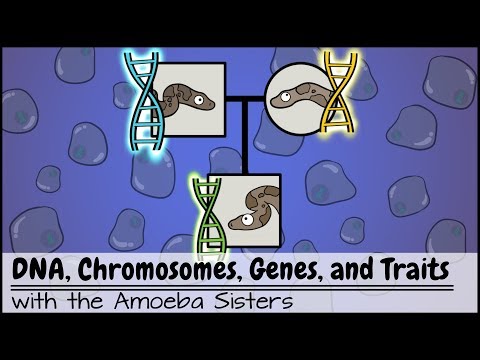
(Video) DNA, Chromosomes, Genes, and Traits: An Intro to Heredity

by Amoeba Sisters

DNA is the master code for all organisms. In this video, the Amoeba Sisters explain the structure of DNA and its function in inheritance.

Illustrated · 1 min

What Is DNA's Role in Inheritance?

DNA is the genetic information used to make proteins, and it contains the hereditary traits of organisms. There are two types of DNA: mitochondrial DNA, which you can only get from your mother, and nuclear DNA, which is a combination of both your ancestors' DNA.

You are who you are because of your DNA; the smallest change to it would make you a completely different person. DNA is what makes your dog a dog and not a wolf.

Nuclear DNA is inherited from all ancestors, but mitochondrial DNA is inherited from a single lineage. It is passed down through women.

Image source: By University of California Museum of Paleontology (UCMP) and the National Center for Science Education CC BY-SA 3.0, via Wikimedia Commons

What Is the Structure of DNA?

Deoxyribonucleic acid (DNA) is a type of nucleic acid. You're probably familiar with DNA and can recognize its famous double helix shape. DNA is a polymer of nucleotides that each contain a five-carbon sugar, a phosphate group, and a nucleobase (nitrogenous base).

DNA has the five-carbon sugar deoxyribose, hence its name. It has the nucleobases cytosine, guanine, adenine, and thymine. The nucleobases in DNA have preferred partners to form hydrogen bonds with. Cytosine pairs with guanine, while adenine pairs with thymine. This means that the number of C bases will always equal the number of G bases. Likewise, the number of A bases will equal the number of T bases.

The ordering of these nucleobases is the code for all genetic information. It gives instructions about how to build and maintain an organism. Humans have about three billion DNA bases connected together. They are all stored in just 23 pairs of chromosomes.

DNA is a polymer of nucleotides that each contain a sugar-phosphate backbone and nucleobase.  DNA has four possible nucleobases: cytosine, guanine, adenine, and thymine. The bonding of these monomers is what causes the double-helix shape.

Image source: By Magladem96 CC BY-SA 3.0, via Wikimedia Commons

Vocabulary Review:\color{#8925AE}{\text{Vocabulary Review:}}

Chromosome\color{#8925AE}{\text{Chromosome}} : A chromosome is a long, single, coiled piece of DNA

DNA\color{#8925AE}{\text{DNA}} : The macromolecule that stores all of an organism's genetic information

Gene\color{#8925AE}{\text{Gene}} : A segment of DNA that codes for a specific trait or protein

Allele\color{#8925AE}{\text{Allele}} : Genes of the same type that contain different kinds of information

Illustrated · 1 min

Summary of DNA

DNA is the nucleic acid that contains the blueprints for making an organism. Chromosomes are made up of DNA.

DNA is what makes a person a person. The order of nucleotides in an organism's DNA results in the physical and even some behavioral characteristics of an organism. It could determine:

  • Whether you have brown eyes or blue eyes

  • How tall you will be

  • How likely you are to develop certain diseases

By passing along DNA to an offspring through sexual reproduction, you are helping create an organism that will be genetically 50% identical to you. The transmission of genetic code to create new life is the entire reason behind reproduction.

DNA contains genes, which express genetic information. DNA gives the blueprints for proteins to be produced.

Image source: By Thomas Shafee CC BY 4.0, via Wikimedia Commons

DNA is one of the most important molecules on the planet. It makes up everything that's alive including plants, animals, fungi, and bacteria. Every living thing exists to ensure that its genetic information will continue to exist in the future. This means that all that living things are moving, breathing vehicles for DNA.

The only thing that separates humans from a slug is the number and order of the four nucleotide bases. They are adenine, guanine, cytosine, and thymine. These four nucleotide bases control everything about an organism, from hair color to the number of legs. All aspects of biology such as anatomy, ecology, and neurology are entirely dependent on DNA.

DNA is made of two strands of nucleotides hydrogen bonded together in a double helix shape.

Image source: By ClkerFree-VectorImages CC0, via pixabay.com

The mechanisms that are in place to copy and pass on DNA exist to create the fittest individual possible. Errors in DNA replication usually produce negative effects. Therefore, the method known as sexual reproduction evolved to get around that. Because errors in DNA cannot always be detected and fixed, sexual reproduction (heredity) arose as a way to provide offspring with a choice. The choice is to pick between two sets of DNA to use in creating itself.

Type a concept, like “slope” or “photosynthesis”.

↑ ↓ to choose · Enter to openSearch explanations and problems