Illustrated · 2 min

+3 contributors



Structure of DNA
DNA is central to all life on Earth. The general structure was first discovered by an awesome scientist, Rosalind Franklin, and also by Maurice Wilkins. It is made up of basic molecules called nucleotides. A nucleotide is made up of a sugar (specifically a 5-carbon sugar in this case), a phosphate group, and a nitrogenous base.
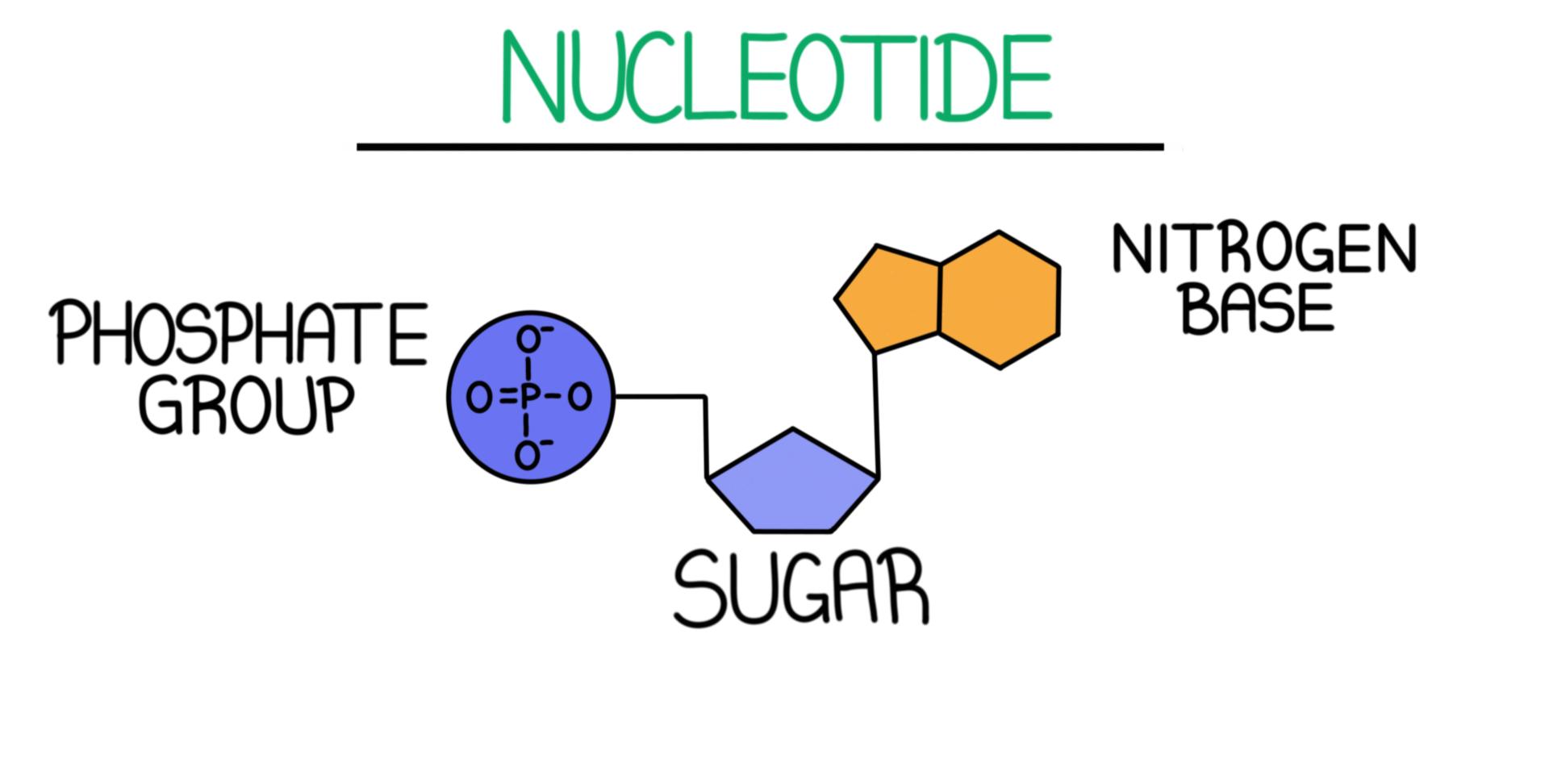
Image source: By Gabi Slizewska
There are four possible nitrogenous bases that can be found in a DNA sequence. They are adenine (A), thymine (T), guanine (G), and cytosine (C).
Adenine and guanine are classified as purines because they contain two rings in their structures. Thymine and cytosine are classified as pyrimidines because they only contain one ring.
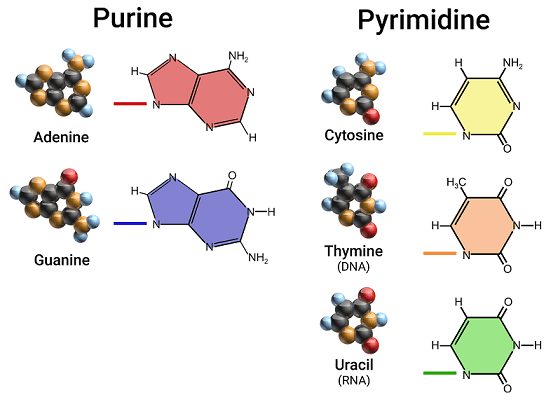
Image source: By Blausen CC BY-SA 4.0, via Wikimedia Commons
Nucleotides bind to one another to create nucleic acids (such as DNA). The sugar of one nucleotide binds to the phosphate of another nucleotide via a covalent bond. This creates a sugar-phosphate backbone.
How Do Base Pairs Form Bonds with Each Other?
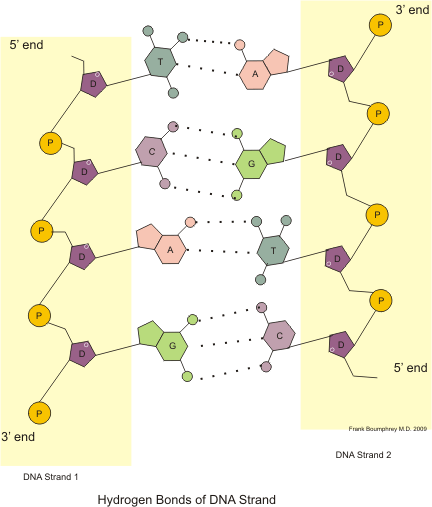
The nitrogenous bases form hydrogen bonds with one another, but in very specific ways. The bases must follow complementary base pairing rules. According to these rules, A will only bind to T, and G will only bind to C. This is important because it allows for the creation of a double helix, or the winding staircase shape of DNA. This pairing can be explained by several observations. Purines are larger than pyrimidines, and base pairing rules maintain the uniform shape of the double helix. This means that adenine and guanine can bind to thymine and cytosine, but not to each other. Furthermore, thymine and adenine form two hydrogen bonds, while cytosine and guanine form three bonds. This explains why G pairs with C and A pairs with T.

Image source: By Madprime (talk · contribs) [CC0], via Wikimedia Commons
The bonding pattern of nucleotides creates two strands which are connected in the middle by the bases. Each strand has a 3' end and a 5' end. The two strands are antiparallel to each other, which means one strand runs 3' to 5' while the other runs 5' to 3'.