DNA Structure — Overview & Diagrams

Illustrated · 2 min

Structure of DNA

DNA is central to all life on Earth. The general structure was first discovered by an awesome scientist, Rosalind Franklin, and also by Maurice Wilkins. It is made up of basic molecules called nucleotides. A nucleotide is made up of a sugar (specifically a 5-carbon sugar in this case), a phosphate group, and a nitrogenous base.
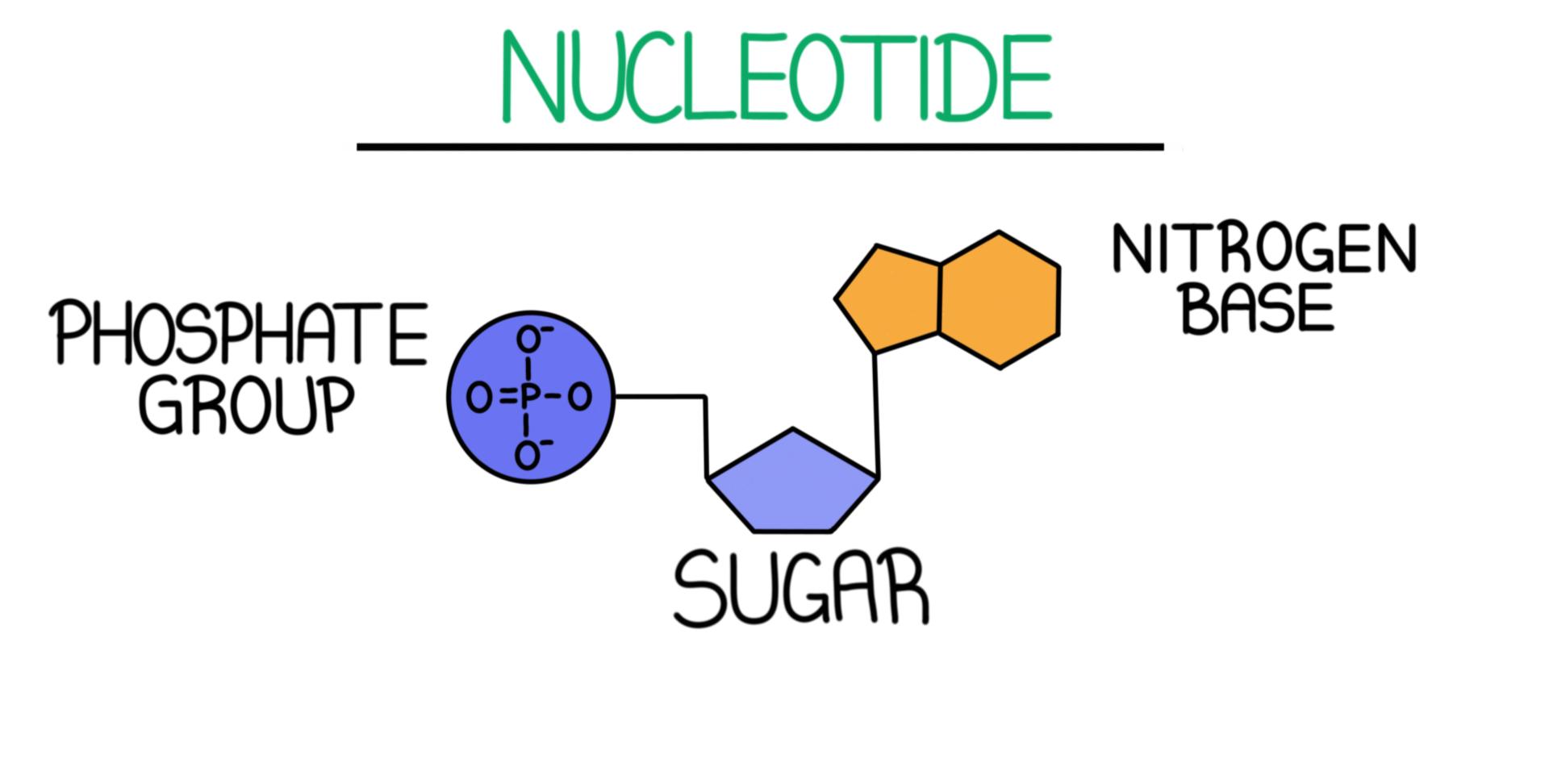
The three components of a nucleotide are a phosphate group, a sugar, and a nitrogen base.

Image source: By Gabi Slizewska

There are four possible nitrogenous bases that can be found in a DNA sequence. They are adenine (A), thymine (T), guanine (G), and cytosine (C).

Adenine and guanine are classified as purines because they contain two rings in their structures. Thymine and cytosine are classified as pyrimidines because they only contain one ring.
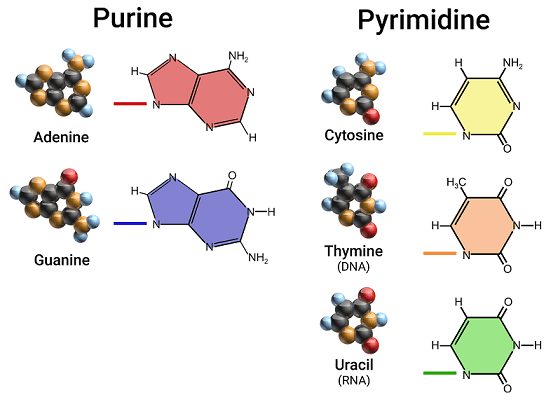
A diagram of the structures of purines and pyrimidines

Image source: By Blausen CC BY-SA 4.0, via Wikimedia Commons

Nucleotides bind to one another to create nucleic acids (such as DNA). The sugar of one nucleotide binds to the phosphate of another nucleotide via a covalent bond. This creates a sugar-phosphate backbone.

How Do Base Pairs Form Bonds with Each Other?

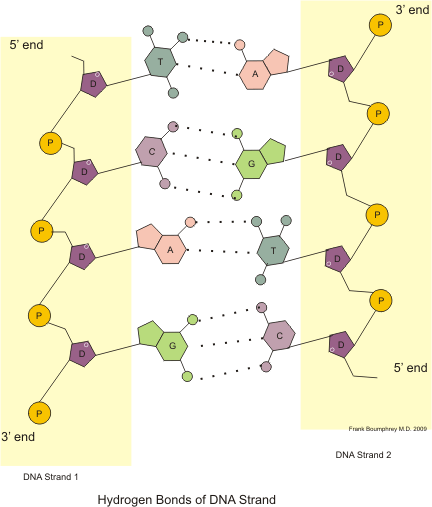
The nitrogenous bases form hydrogen bonds with one another, but in very specific ways. The bases must follow complementary base pairing rules. According to these rules, A will only bind to T, and G will only bind to C. This is important because it allows for the creation of a double helix, or the winding staircase shape of DNA. This pairing can be explained by several observations. Purines are larger than pyrimidines, and base pairing rules maintain the uniform shape of the double helix. This means that adenine and guanine can bind to thymine and cytosine, but not to each other. Furthermore, thymine and adenine form two hydrogen bonds, while cytosine and guanine form three bonds. This explains why G pairs with C and A pairs with T.

A diagram of DNA base pairing.

Image source: By Madprime (talk · contribs) [CC0], via Wikimedia Commons

The bonding pattern of nucleotides creates two strands which are connected in the middle by the bases. Each strand has a 3' end and a 5' end. The two strands are antiparallel to each other, which means one strand runs 3' to 5' while the other runs 5' to 3'.
Illustrated · 2 min

What Makes Up DNA?

You're probably a bit familiar with deoxyribonucleic acid (DNA) and can recognize its famous double helix shape. DNA stores the genetic code in the cell nucleus and is a polymer made of nucleotides. Each nucleotide contains a 5-carbon sugar, a phosphate group, and a nucleobase (nitrogenous base). The sugars and phosphates form a backbone for the nitrogenous bases to attach to. There are over a billion bases in the human genome.

DNA has the 5-carbon sugar deoxyribose, hence its name. The nitrogenous bases it contains are cytosine, guanine, thymine, and adenine. Adenine and guanine are called purines, while cytosine and thymine are called pyrimidines. An easy way to remember which bases are which is cytosine and thymine have the letter y in common with pyrimidine, so they are in the same group.

The nucleobases have preferred partners to form hydrogen bonds with: Cytosine pairs with guanine, while adenine pairs with thymine. There are two hydrogen bonds between A and T, but there are three hydrogen bonds between G and C.

Hydrogen bonds are what help DNA keep its unique shape.

Image source: By Boumphreyfr CC BY-SA 3.0, via Wikimedia Commons

The Double Helix

The double helix shape of the DNA molecule has a constant diameter, which means it is always the same width throughout the entire molecule.

The two strands are called complementary, meaning that you only need to know the sequence of a single strand to know the sequence of the other. The second strand is the exact opposite of the first. For example, if one strand has the sequence ATT GCA\text{ATT GCA}, the other strand must have the sequence TAA CGT\text{TAA CGT}.

Strands of DNA are also anti-parallel, meaning both strands are side-by-side, but they run in opposite directions. Think of it as a two-lane road with cars going in both directions.

There's a special way to name the direction of each strand though. One strand runs from 3' to 5' (said "three prime to five prime") and the other runs in the 5' to 3' direction. The easiest way to tell them apart is to look at the oxygen on the sugar molecule; it points from the 3' to the 5' direction. In the picture above, the sugars are colored purple.

Vocabulary Review:\color{#8925AE}{\text{Vocabulary Review:}}

Monomer\color{#8925AE}{\text{Monomer}} : Any molecule that can react with other molecules of the same or different makeup to form a chain, or polymer

Polymer\color{#8925AE}{\text{Polymer}} : A chain of monomers made of a specific type of compound

Macromolecule\color{#8925AE}{\text{Macromolecule}} : A polymer that has a large (macro) molecular mass. There are four main types in organisms: carbohydrates, proteins, lipids, and nucleic acids

Nucleotides\color{#8925AE}{\text{Nucleotides}} : The monomers of nucleic acids. Made up of a nitrogen group, a phosphorus group, and a 5-carbon ring

Nucleic Acid\color{#8925AE}{\text{Nucleic Acid}} : Complex polymer that stores information in a cell in the form of a code. DNA and RNA

Video

(Video) DNA Structure

by Teacher's Pet

The human genome consists of a vast amount of genetic code. You might know it as DNA (deoxy-ribonucleic acid). In this video, Teacher's Pet explains the molecular structure of DNA.

Type a concept, like “slope” or “photosynthesis”.

↑ ↓ to choose · Enter to openSearch explanations and problems

