Dominant (Genetics) — Alleles, Genes & Traits

Before this, knowPhenotype — Definition & OverviewGenotype — Definition & Overview

Illustrated · 1 min

What Is a Dominant Allele?

Humans have two sets of chromosomes, one from each parent. Since your parents have different DNA, you get two different variations of each gene. Variations of a gene are called alleles.

When an individual has two copies of an identical allele, there is only one possible phenotype. But what happens when you have two different alleles for a gene?

Inheritance patterns define how certain alleles interact with one another. They are often very complicated. The most simple pattern is seen when one allele is dominant and the other is recessive.

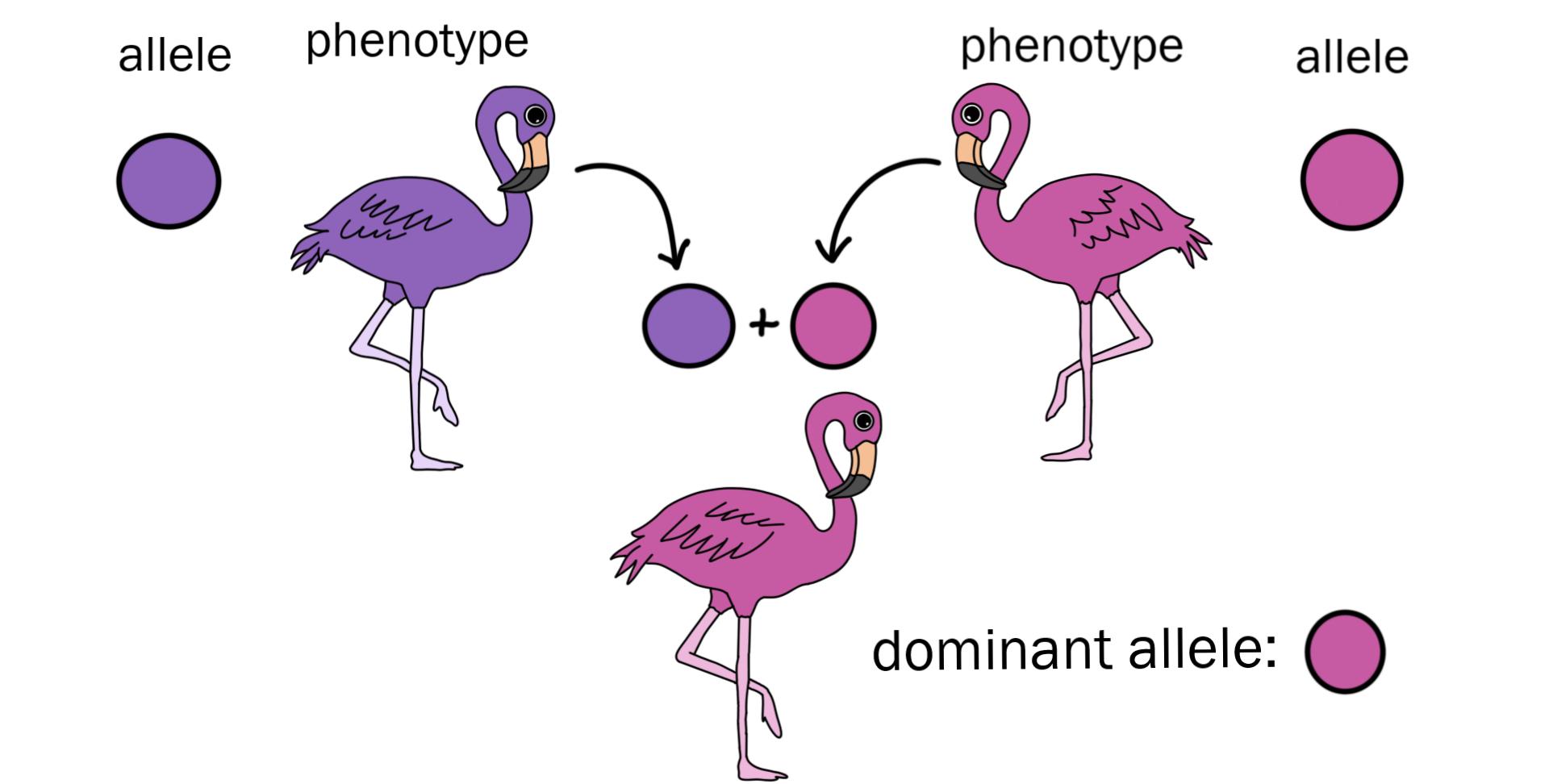
A purple allele results in a purple flamingo. A pink allele results in a pink flamingo. When both the purple and pink alleles are present, the flamingo is pink. The pink allele is dominant.

Image source: By Gabi Slizewska

In this simple relationship only one allele, the dominant one, will result in a visible trait. The recessive allele will not produce a phenotype. This concept is also called the Law of Dominance and was established by a man named Gregor Mendel.

In the example above, the pink allele\color{#E1528D}{\text{pink allele}} is dominant, which is why when a flamingo has a pink allele\color{#E1528D}{\text{pink allele}} and a purple allele\color{#574FB9}{\text{purple allele}} we only see the pink phenotype.

When writing a genotype, the dominant allele is usually represented by a capital letter, while the recessive allele has a lowercase letter. Let's say that the gene for flamingo color is represented by the letter P. The pink allele is dominant, so it would get a capital P, but the purple allele is recessive, so it would get a lowercase p.

Illustrated · 2 min

Let's Review Traits, Genes, and Alleles

To begin, let's refresh our memories about the difference between genes, traits, and alleles.

  • A trait is a specific characteristic that is different from one individual to another. For example, hair and eye colors are traits.

  • Genes are the DNA sequences that determine what traits you have.

  • Alleles are different versions of a gene.

A diagram showing a chromosome uncoiling into a nucleosome, then DNA, and then a gene with exons and introns.

Image source: By Thomas Splettstoesser (www.scistyle.com) CC BY-SA 4.0, via Wikimedia Commons

We'll look at freckles as a trait. To have this trait, you have to have the gene for freckles. But there are two forms of the gene for freckles: one "functional" allele that produces proteins for freckles and one allele that doesn't let you have freckles. So basically, to have freckles as a trait you need to have the allele for freckles.

So What Are Dominant Alleles?

Now that we have a solid foundation to work from, we can begin discussing alleles. Because alleles are different forms of a gene, you can inherit different alleles from each of your parents. Each allele will give you a different form of a trait, like the freckles or no freckles alleles from the example above.

So which do you get, freckles or no freckles? One of these alleles is dominant. That is, if you have the dominant form of the allele, you will have that trait. So, if having freckles is a dominant trait and you inherited both versions of the allele from your parents, you will have freckles.

How Can We Figure Out What Allele Will Be Inherited?

The picture below is called a Punnett square and is used to figure out the probability of inheriting a trait.

Let's break down how it's set up.

The left-hand and top sides show which alleles each parent has. Capital A is the dominant trait, which in this case is a yellow color. Lowercase a is a recessive trait for green coloring. The two parents can make one offspring with just dominant alleles, two offspring with one dominant and one recessive allele, and one offspring with just recessive alleles.

A Punnett square showing a parent with the genotype capital A lowercase A being crossed with a parent with the genotype capital A lowercase a. The possible offspring are one child with two capital A alleles, two offspring with a capital A and a lowercase a genotype, or one child with two lowercase a alleles.

Image source: By Miguelferig [CC0], via Wikimedia Commons

Keep in mind that just because you can physically see a trait doesn't mean that it's dominant. Many traits, and even genetic disorders, are recessive. This means they will only show up if two recessive alleles are inherited.

Vocabulary Review:\color{#8925AE}{\text{Vocabulary Review:}}

Chromosome\color{#8925AE}{\text{Chromosome}} : A chromosome is a long, single, coiled piece of DNA

Trait\color{#8925AE}{\text{Trait}} : A specific characteristic that is different from one individual to another

Gene\color{#8925AE}{\text{Gene}} : A segment of DNA that codes for a specific trait or protein

Allele\color{#8925AE}{\text{Allele}} : Genes of the same type that contain different kinds of information. Alleles can be dominant or recessive

Dominant\color{#8925AE}{\text{Dominant}} : The stronger of two expressed genes

Recessive\color{#8925AE}{\text{Recessive}} : The weaker of two expressed genes. Only shown if a gene is homozygous recessive

Heterozygous\color{#8925AE}{\text{Heterozygous}} : Two different kinds of allele, one dominant and one recessive

Homozygous\color{#8925AE}{\text{Homozygous}} : Two of the same type of allele, both dominant or both recessive

Punnet Square\color{#8925AE}{\text{Punnet Square}} : A method of determining the probabilities of which traits the offspring of two organisms will inherit

Sex-Linked Traits\color{#8925AE}{\text{Sex-Linked Traits}} : Traits caused by alleles located on a sex chromosome

Illustrated · 1 min

Dominant

When an organism is developing, it has to activate and use a bunch of different genes. An offspring of sexual reproduction has genes from both of its parents, and when one gene has two different forms it is said to have two alleles.

Alleles can interact in a bunch of different ways. The most simple interaction of two alleles is a dominant/recessive relationship. When one allele is chosen to be expressed and the other allele is not expressed at all, the allele that is being visibly expressed is said to be dominant. The allele that does not show up is called recessive.

A Punnett square for pea color. The first parent pea is green and has two lowercase y's as its genotype. The second parent pea is yellow and has one capital Y and one lowercase y as its genotype. When crossed, the offspring are two yellow plants with the genotype capital Y and lowercase y, and two green plants with the genotype lowercase y and lowercase y.

Image source: By Pbroks13 CC BY-SA 3.0, via Wikimedia Commons

What Is an Example?

The two alleles present in this Punnett square are the (Y) yellow allele and the (y) green allele. The parent plant on the left looks yellow because it contains the dominant Y allele, but it also contains a recessive green allele. We call this a heterozygous individual. The parent plant on top contains two recessive alleles and is said to be homozygous recessive. An allele that is dominant is always shown to be a capital letter and a recessive allele is shown to be the lowercase version of that same letter.

In a simple dominant/recessive relationship, any organism that receives a dominant allele will only visibly express that allele. But keep in mind that this is not always the case. There are some cool examples of traits being blended together. When neither trait is dominant, it's called incomplete dominance. When both are dominant, it's called codominance.

Video

(Video) Dominant vs. Recessive Traits

by ScienceGonnaGetYou

In this video, ScienceGonnaGetYou explains why we don't look exactly like our parents by talking about dominant and recessive traits.

Type a concept, like “slope” or “photosynthesis”.

↑ ↓ to choose · Enter to openSearch explanations and problems