
Illustrated · 1 min

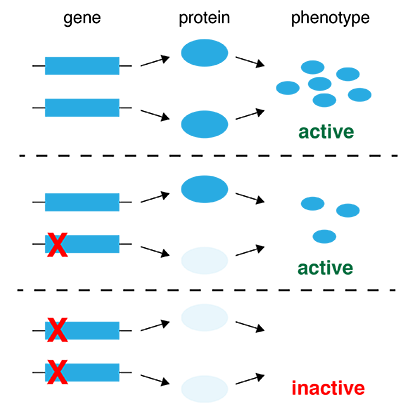
Two dominant alleles will produce two functioning proteins and the normal phenotype. One dominant allele will produce one functioning protein, but it will still result in a normal phenotype. Two non-functioning, recessive, alleles will not produce any functioning proteins and will result in an alternate phenotype.
Genes encode proteins and other products which go on to produce an observable phenotype in an organism. Alleles are variations of the same gene with a slightly different DNA sequence. Often, one allele is said to be wildtype, or normal, and the other is a mutation. A diploid organism (like humans) will have two alleles for every gene. One allele is found on each homologous chromosome. When meiosis occurs, the alleles are distributed into gametes and will randomly come together again during fertilization. The alleles are then passed on to offspring and will determine the offspring's phenotype.
Different alleles for the same gene can produce different phenotypes for a trait. For example, one allele of a gene can produce green eyes while another can produce brown eyes (in reality this is more complex). These alleles can be dominant (usually depicted with an upper case letter, such as A) or recessive (usually depicted with a lower case, such as a). Dominant alleles produce a functional protein, while recessive alleles produce proteins or enzymes that cannot perform their job. In a heterozygous organism (genotype Aa), allele A will encode a functional protein while allele a will produce a non-functional protein. Usually, one allele for the functioning protein will be enough to result in normal function or normal phenotype (see diagram above). Therefore, dominant is the term for the allele which will produce a phenotype in a heterozygous organism. Dominant does not always mean more common. An organism that is homozygous for a certain trait will have the genotype AA or aa.