
Interactive · 1 question
Electric flux is amount of electric field that perpendicularly flow through a certain area. The electric flux, usually written as , is directly proportional the number of electric field lines that go through a certain area perpendicularly.
where is the uniform electric field, is the area and being the angle of the electric field to the perpendicular.
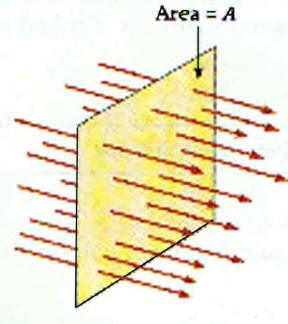
Electric Fields penetrating an area A.
In the case of a non-linear electric field, then Gauss's Law is used.
Now let's test your understanding of electric flux. Let's say you have a spherical charge in space with charge . The charge is then enclosed at the center with a plastic sphere of radius . A scientist wants to know what is the electric flux through the sphere is. Let be