Illustrated · 1 min

What Is Molten Salt Electrolysis?

Salts are found typically as solids under standard conditions. However, when salts are heated they can change into a liquid state. Salts in their liquid states are known as molten salts. When salts are in their molten state they can undergo electrolysis.

Sodium Chloride Example

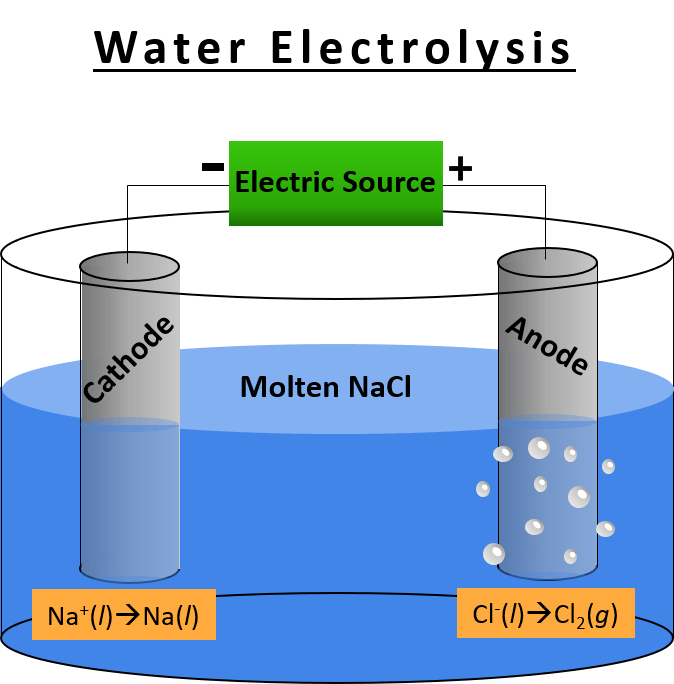
Sodium chloride is a salt which will melt into it's liquid state above 801∘^{\circ}C. Oxidation of the chloride anion occurs at the anode and reduction of the sodiun cation occurs at the cathode

At the anode: 2Cl−(l)→Cl2(g) +2e−2Cl^-(l) \rightarrow Cl_2(g)\ + 2e^-

At the cathode: 2Na+(l) + 2e−→2Na(l)2Na^+(l)\ +\ 2e^- \rightarrow 2Na(l)

Total cell reaction: 2Na+(l) + 2Cl−→2Na(l) + Cl2(g)2Na^+(l)\ +\ 2Cl^- \rightarrow 2Na(l)\ +\ Cl_2(g)

The electrolysis of molten sodium chloride

Molten sodium chloride can undergo electrolysis. Evidence can be seen at the anode where chlorine gas evolves.

Image source: By Cassie Gates
Video

(Video) GCSE Chemistry - Electrolysis Part 1 - Basics and Molten Compounds #40

by Cognito

In this video, Cognito explains the electrolysis of molten salts. They explain how we set up molten electrolysis. Then they walk you through the example of lead bromide step-by-step. After watching this video, you have an excellent understanding of molten electrolysis!

Type a concept, like “slope” or “photosynthesis”.

↑ ↓ to choose · Enter to openSearch explanations and problems