
Illustrated · 1 min
Water Electrolysis Importance
Electrolysis is the process in which an electric current is applied to a system to create a chemical change. Often, electrolysis experiments are carried out in aqueous electrolyte solutions. The electrolytes are present to carry the electric charge. However, if the electrolytes are less reactive or less likely to undergo oxidation/reduction than water, the water will undergo electrolysis.
Electrolysis of water
In an electrolytic cell, water or will undergo oxidation at the anode and reduction at the cathode.
At the anode:
At the cathode:
Total cell reaction:
During this process water decomposes into hydrogen and oxygen gas. Because gases are formed, the reaction is indicated by bubbles forming at the electrodes.
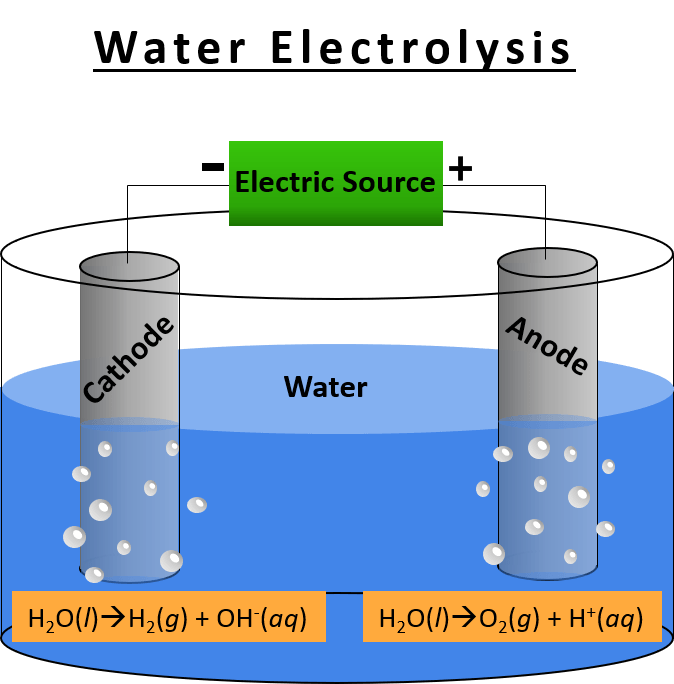
As electrolysis proceeds bubbles can be seen from the decomposition of water into oxygen and hydrogen gas.
Image source: By Cassie Gates
