What did Schrodinger Actually Do?
We know that Erwin Schrodinger redefined physics. He developed an entirely new system for describing the mechanics of subatomic particles. We creatively called it quantum mechanics. But what was the reasoning that led him there? His foundation was the wave-particle duality and de Broglie's equation. He knew that all matter has wave-like and particle-like properties. But, at the time, the current atomic model was the Bohr model. It only treated electrons as particles. They circled in a fixed orbit. Schrodinger wondered how to treat electrons as waves.
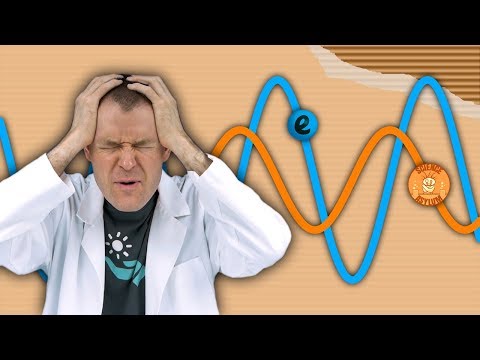
An excellent analogy for electrons is a guitar string. Plucking it creates an oscillating wave pattern. That's common knowledge. But remember, guitar strings get held by the bridge and head. So, it has two boundaries. We are creating a point where the wave stops. We've created a standing wave.
But there's something else interesting about stringed instruments. When you pluck a string, it oscillates in a variety of ways. The sound you hear is the lowest frequency. But if you listen closely, you'll hear higher pitches too. They're called overtones. The string creates overtones by oscillating in multiple ways at the same time. But here's the catch. Overtones are integers multiples of the lowest frequency. Where have we seen that before? Its quantization!
Schrodinger treated electrons as three-dimensional standing waves. So, an electron's total energy is the sum of its kinetic and potential energy and is quantized. He combined the conservation of energy with de Broglie's equation. The result was a wavefunction (Ψ). But what did it actually mean?
Schrodinger didn't actually know what all his math meant. The problem is that the math is complicated. For example, it has complex numbers. So, it doesn't have a clear interpretation. The most common understanding is that the square of the wavefunction (Ψ2) is the probability space. Notice that by squaring it, we get rid of the complex numbers.
Orbitals (Electron Clouds)
First, know that we are using the most basic system. That's the hydrogen atom. So, it only has one proton and one electron. Other chemists did develop math for multiple electron systems. But it's even more complicated! So, what happens when we square the position wavefunction? We can define the most likely area where our electron resides. We call the region an atomic orbital. The orbitals have different shapes and sizes based on their energy levels. We'll explore them more when we study quantum numbers. But overall, the orbital tells us the most probable region for finding our electron. What if we calculated the probability at each specific point around the nucleus? We could create a scatter plot. The darkest zone would convey the highest odds of finding our electron. The lightest area would represent a lesser possibility. We call the scatter plot an electron cloud diagram.
Why do we Care?
At this point, are you wondering why any of this matters? Maybe physical chemistry is too complicated. We should ignore it! But, the core of chemistry is bonding. Ionic and covalent bonds are all about electrons. So, we need to know how electrons behave. The development of the quantum mechanical model jumpstarted our knowledge. Soon, chemists developed rules about how orbitals fill. That's Hund's rule, the Pauli exclusion principle, and the Aufbau principle. These rules combine to help us understand electron configurations and valence electrons. If we put it all together, we can model atomic bonds. It turns out that bonds form when orbitals overlap. We have two unique models: valence bond theory and molecular orbital theory. We'll explore them more in future lessons. But for now, know that orbitals combine to generate molecules.