Electron Configuration — Overview & Examples

Illustrated · 3 min

###What Is An Electron Configuration?

Each element has electrons and orbitals with varying energies. An electron configuration is used to describe the energy of the orbitals and location of electrons among those orbitals in each element. The orbitals are distinguished by type and energy level. Then the electrons are placed in these orbitals based of the aufbau principle. The electron configuration created using this principle is the lowest energy configuration or ground-state configuration.

How To Determine Electron Configurations

The best resource to writing an electron configuration from scratch is the periodic table of elements. All electron configurations build off of the elements proceeding them. Let's consider hydrogen, HH:

Electron configuration: H:1s1H: 1s^1

The value, 1, denotes the energy level and it is the lowest energy level. Then the type of orbitals is ss. The exponent denotes the number of electrons. All together this is the first energy level ss orbital with one electron. As we move to the right of the periodic table the number of electrons increases. So, the electron configuration of helium is:

He:1s2He: 1s^2

Now, as we move down the periodic table, more energy levels are added. If we move to lithium the electron configuration is:

Li:1s22s1Li: 1s^22s^1

Notice how the the electron configuration contains the electrons that He did, plus additional ones. The orbitals are always written with the lowest energy level or lowest numbered orbitals first. The energy levels increase down the periodic table. So, far we've seen just ss type orbitals, but the other types of orbitals are also present. The periodic table can be broken down into orbitals types and energy levels.
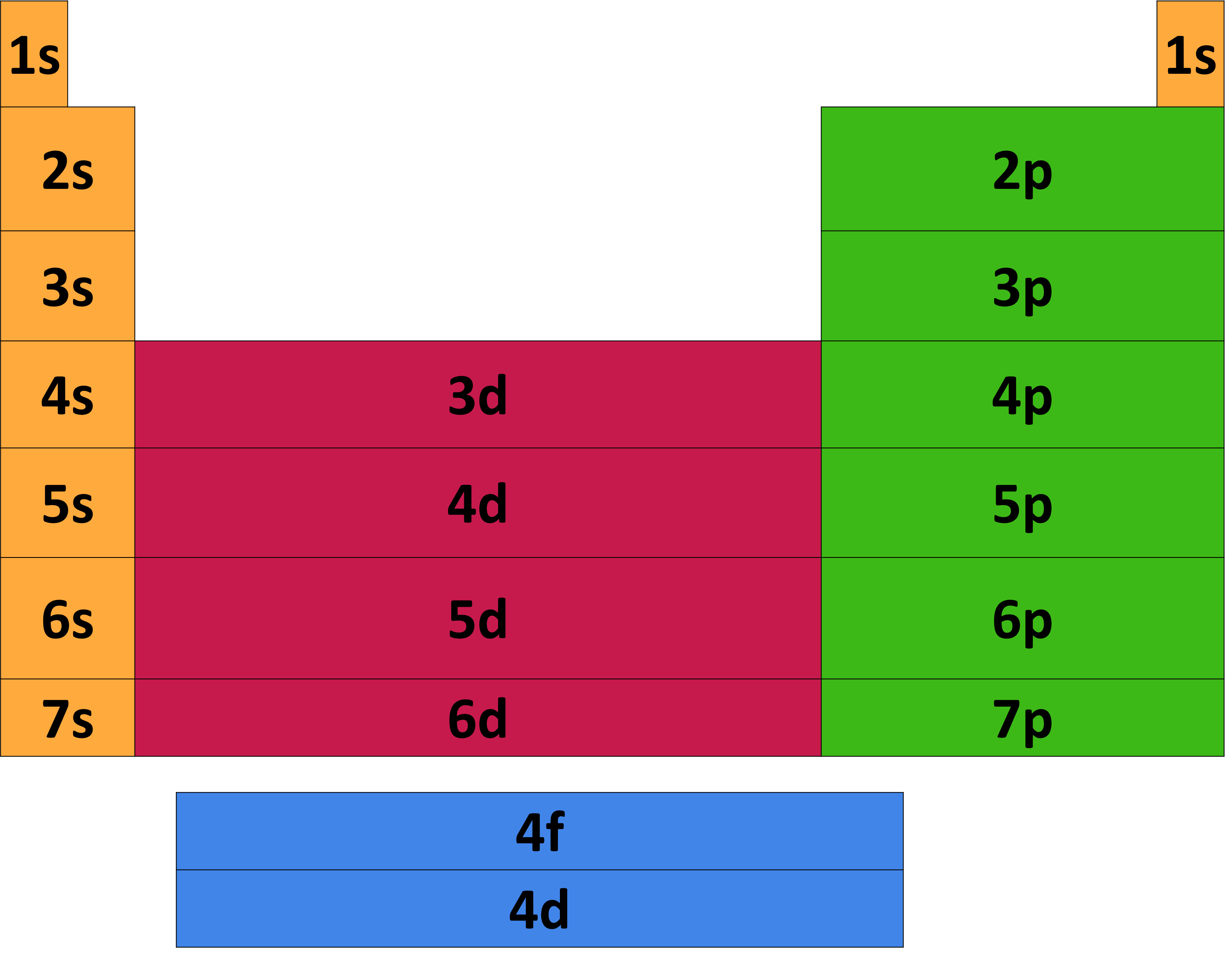
Periodic table broken down into energy levels and orbital types.

Periodic table with different energy levels and orbital types

Image source: By Cassie Gates

Keep in mind that some orbitals are degenerate or contain subshells of equal energies. Each subshell contains up to two electrons. The s-orbitals are not degenerate, having no subshells and containing up to two electrons. The degenerate orbitals are:

  • p-orbitals: 3 subshells, up to 6 electrons total

  • d-orbitals: 5 subshells, up to 10 electrons total

  • f-orbitals: 7 subshells, up to 14 electrons total

If we consider sulfur, SS, the electron configuration would be: S:1s22s22p63s24p4S: 1s^22s^22p^63s^24p^4

If we were to draw the valence electrons and fill the subshells the 3s orbital would be filled. The 4p orbital would have one full subshell and two half-filled subshells.

Sulfur electron configuration. The subshells the 3s orbital would be filled. The 4p orbital would have one full subshell and two half filled subshells.

One electron fills up each of the subshells first, then additional electrons are paired.

Image source: By Cassie Gates

You might have noticed with sulfur that writing the full electron configuration is much longer than that of H and He. Well, imagine writing out a full electron configuration for radium, it would be very long! So one way to deal with this is to write electron configuration with abbreviations. This is done by putting the noble gas from the previous row in brackets and then writing the subsequent orbitals and electrons. The abbreviated configuration for sulfur and radium would be:

S:[Ne]3s33p4Ra:[Rn]7s2S: [Ne]3s^33p^4\\ Ra: [Rn]7s^2

The abbreviations make it a lot easier to write electron configurations! In the periodic table below all electron configurations are included in the abbreviated form.

Periodic table of elements including the electron configuations for each element.

This periodic table shows the electron configuration for each element. The electrons configuration is read top to bottom in this image and with short-hand notation. For example, chlorine's electron configuration would be written as [Cl]: (Ne)3s23p53s^23p^5 horizontally.

Image Source: By Cassie Gates

Electron Configuration Exceptions

You'll notice that common elements used in introductory chemistry have normal electron configurations. Some elements in the transition metals, lanthanides, and actinides have unusual configurations. This has to do with the element's characteristics and the lowest-energy electron configurations.

For example, molybdenum (Mo) is a transition metal and the correct electron configuration is:

Mo:[Kr]4d55s1Mo: [Kr] 4d^55s^1

This seems unusual because you might expect for the electron configuration to be:

Mo:[Kr]4d45s2Mo: [Kr] 4d^45s^2

This is not the lowest energy electron configuration. It is much more stable for the lower energy 4d orbitals to be half filled and the higher energy 5s orbital to have no paired electrons. In the Mo atom, the 4d and 5s orbitals are similar in energy, so this can occur.
Read · 4 min

We know, from quantum mechanics, that electrons occupy atomic orbitals. We also know that electrons pair in a spin-up and spin-down configuration. That's the Pauli Exclusion Principle. But, how do we know what orbitals get filled for each element? We write the element's electron configuration! It is a written representation of an element's filled orbitals. How do we determine the electron configuration? We look at the periodic table.

How Many Electrons Are in Each Energy Level?

The quantum numbers describe atomic orbitals. The principal quantum number (nn) determines the energy level or electron shell. The angular momentum quantum number (ll) determines the orbitals' shapes. The angular momentum quantum number gives us the electron sub-shells (s, p, d, or f). The magnetic quantum number (mlm_{l}) tells us the orientations of the orbitals. The s sub-shell has one orbital, p has three orbitals, d has five, and f has seven. Each orbital can only hold two electrons. So, each s-orbital holds two electrons. Each set of p-orbitals can contain up to six electrons. Each collection of d-orbitals can have up to ten electrons. Each grouping of f-orbitals can hold up to fourteen electrons.

How do Electrons Fill the Energy Levels and Orbitals?

The Aufbau principle tells us that electrons fill the lowest energy levels first. For the tiny elements, this is easy. 1s fills first, then 2s, then 2p, then 3s, and finally 3p. Beyond 3p, things begin to get more complicated. The s-orbital of the higher energy level has less energy than the d-orbitals of the previous energy level. For example, the 4s orbital fills before the 3d orbital. How do we know which orbitals have lower energies? We use the n+ln+l rule. The 4s orbital is n=4n=4 and l=0l=0, so n+l=4n+l=4. For the 3d orbital, n=3n=3 and l=2l=2. So, n+l=5n+l=5. If the n+ln+l rule produces the same value, the orbital with the lower nn fills first. For example, 6d is before 7p. This rule also explains why there is no g-orbital for the known elements.

Electrons also obey Hund's rule. It states that orbitals maximize the number of electrons with the same spin. For example, let's look at the p-orbitals. We know there are three p-orbitals. One electron will fill each p-orbital before the electrons begin to pair. The first three electrons will have the same spin. Why? The electrons lessen the repulsive forces by filling each orbital before pairing.

Determining Orbitals and Electrons From the Periodic Table

We can deduce an atom's electron configuration from the periodic table's arrangement. How? By using the period and group numbers. The period is the highest energy level. That's the same as the principal quantum number! The group number tells us the number of electrons. The main group elements fill the s and p orbitals. So, the alkali and alkaline earth metals correspond the s-orbital. Groups three through eight (metalloids and nonmetals) are the p-orbitals. You will notice periods one through three only have s and p orbitals. The transition metals begin filling the d-orbitals. Remember that the d-orbitals are filling the electron shell from the previous period. For example, the period four transition metals equal the 3d-orbitals. The transition metal group number tells you the number of d-orbital electrons. On a few periodic tables, the group number may be the total of s-orbital and d-orbital electrons. The lanthanides and actinides start the f-orbitals. Remember that even though they are in groups six and seven, they fill the 4f and 5f orbitals.

Writing Electron Configurations

So how do we write an electron configuration? First, we have to find our element on the periodic table. Why? We need the atomic number! Typically, the atomic number tells us the number of protons. But, for any neutral atom, the protons and electrons are equal. So, the atomic number tells us the total number of electrons. Ions have their own rules for electron configurations. What do we do after we know the total number of electrons? We determine the energy levels and sub-levels. We just learned that we can do that from the periodic table! Finally, we'll fill each energy level and sublevel until we've used all the electrons.

But, what do I actually write on the page? We start with the atomic symbol. Next, add each energy level and sub-shell for that element. Finally, we write the number of electrons filling each sub-shell in superscript.

For example, the electron configuration of Nitrogen is N: 1s2s^{2} 2s2s^{2} 2p3p^{3}.

  1. We write our atomic symbol. N:
  2. We write the shells and sub-shells. So, N: 1s 2s 2p
  3. We add the electrons for each sub-shell. N: 1s2s^{2} 2s2s^{2} 2p3p^{3}

For large atoms, writing out the whole electron configuration would be tedious. So, we use a condensed electron configuration. To write it, you use the noble gas. First, you place the preceding noble gas in brackets. Next, you write the remaining electron configuration.

For example, Radium has the condensed electron configuration Rd: [Rn] 7s2s^{2}.

  1. Radon is the preceding noble gas. We write Rd: [Rn].
  2. Radium completely fills the 7s orbital. So we write, Rd: [Rn] 7s2s^{2}.

Unusual Electron Configurations

A few elements have unusual electron configurations. For example, Niobium has the condensed electron configuration Nb: [Kr] 5s1s^{1} 4d4d^{4}. We expect it to be Nb: [Kr] 5s2s^{2} 4d3d^{3}. Hund's rule causes this difference. By promoting an electron to the 4d orbital, we maximize the number of electrons with the same spin. We also lessen the repulsive forces between electrons. The unusual electron configuration does not change the reactivity of these elements. Unfortunately, the best way to learn the exceptions is to memorize them.

Video

(Video) Electron Configuration - Basic introduction

by The Organic Chemistry Tutor

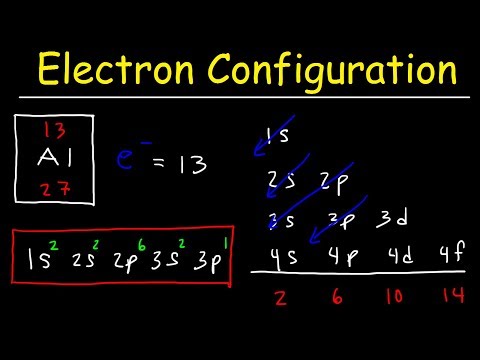
In this practical video, The Organic Chemistry Tutor walks you through the basics of writing an electron configuration. He provides four examples: nitrogen, aluminum, iron ion, and chloride ion. The iron and chloride examples are very insightful because they are ions. Furthermore, iron gives you an example of filling d-orbitals. If you're looking for more worked examples of electron configurations, this video is for you!

Type a concept, like “slope” or “photosynthesis”.

↑ ↓ to choose · Enter to openSearch explanations and problems