Illustrated · 1 min
By Gabi Slizewska

+1 contributors
Contributors

Cellular Respiration: Electron Transport Chain

Image source: By Gabi Slizewska

Image source: By Gabi Slizewska

Before this, knowKrebs Cycle (Citric Acid Cycle) — Steps & Diagram
Illustrated · 1 min
Image source: By Gabi Slizewska
Image source: By Gabi Slizewska
Illustrated · 1 min
The last step of cellular respiration is the electron transport chain. This is sometimes abbreviated as ETC.
The ETC requires oxygen, which means that it is an aerobic process. It takes place in the folds of the inner membrane of the mitochondria. These folds are called cristae.

Image source: By Charlie Jones CC0, via pixabay.com
In this step of cellular respiration, electron carriers NADH and FADH drop off the electrons they've carried from the citric acid cycle.
This drop-off allows a large number of ATP molecules to form. In fact, 34 ATP are produced.
The ETC is directly aerobic because it uses oxygen and converts it into water.
Here's a short summary for the electron transport chain:

Image source: By Hannah Bonville
Illustrated · 3 min
The electron transport chain (ETC) is a collection of proteins arranged in groups, called complexes. They are responsible for the creation of the vast majority of ATP in a cell. The process is also known as oxidative phosphorylation.
The electron transport chain occurs across the inner mitochondrial membrane. Its main function is to build an electrochemical gradient across the inner membrane using protons. The ETC pumps hydrogen ions out of the matrix of the mitochondria and into the intermembrane space. This gives the intermembrane space a high concentration of hydrogen ions. Those ions really want to move back into the matrix. When they do return to the inner matrix, they are forced to go through a protein called ATP synthase, generating ATP. This is an example of facilitated diffusion.
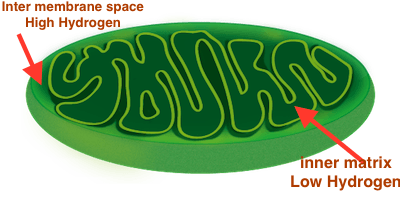
Image source: By DBCLS 統合TV CC BY 4.0, via Wikimedia Commons
A bunch of different protein complexes which pump hydrogen ions create the proton gradient. These complexes can pump hydrogen against its electrochemical gradient thanks to the energy molecules NADH and FADH that were made during glycolysis and the citric acid cycle. This is an example of active transport.
- In the first step of the ETC, an NADH molecule arrives at protein Complex I, also called NADH dehydrogenase. Complex I receives two electrons from NADH, oxidizing it to NAD. One hydrogen is pumped into the intermembrane space for each electron. This yields a total of two hydrogens per NADH molecule.
- In the second step, Complex II receives electrons from FADH, oxidizing it to FAD.
- In the third step, electrons from Complex I and Complex II are transferred to an electron carrier called ubiquinone.
- In the fourth step, the ubiquinone carrier protein drops electrons off at Complex III. Complex III also pumps one hydrogen ion out of the matrix per electron.

Image source: By Uf.hun2201 CC BY-SA 4.0, via WIkimedia Commons
- The electrons pass from Complex III to another electron carrier protein called Cytochrome C. Cytochrome C carries the electrons to the final protein in the ETC called, surprise, Complex IV.
- In Complex IV, oxygen is the final electron acceptor. The complex requires four electrons to function. It forms a reaction between the four electrons it gets from Cytochrome C with two oxygen molecules and eight hydrogen ions. The protein shoves the two oxygen molecules, four of the hydrogen ions, and the four electrons together, creating two molecules of water (). The remaining four hydrogen ions are pumped out into the intermembrane space.
- The final step isn't really a part of the electron transport chain because it does not actually transport any electrons. The ATP synthase protein is part of a process called chemiosmosis. The ETC uses the energy from NADH and FADH to pump a bunch of hydrogen ions out of the matrix and into the intermembrane space. Now, they want to diffuse back into the matrix, but they can't pass through the phospholipid bilayer. They are forced to go through ATP synthase. As the hydrogen ions go through ATP synthase, they create enough energy to bond an extra phosphate onto ADP, creating ATP. This is where most of the ATP in a cell is produced.

Image source: By CNX OpenStax CC BY 4.0, via WIkimedia Commons
The reason that the inner mitochondrial membrane is so funky and folded is so that the ETC and chemiosmosis can occur at a bunch more locations than if it was just smooth. Having a lot of these complexes is important for maintaining the electrochemical gradient.
Illustrated · 2 min
The electron transport chain (ETC) is the final step of cellular respiration and takes place in the mitochondrion. During this stage, the high-energy electrons gathered by NAD and FAD from the previous stages are used to convert ADP into ATP.
Remember how we said ATP is like money? Well, this step of cellular respiration is the real money maker.

Image source: By Bdesham [Public domain], via Wikimedia Commons
The process takes place in the inner mitochondrial membrane. NADH and FADH, generated by glycolysis and the Kreb's cycle, deposit their electrons into the transport chain. They can then go gather more electrons.
The deposited electrons are transported to different carriers. Their energy is used to create an electrochemical gradient (a proton gradient) by pumping protons across the membrane.
There are four major complexes in the chain. The electrons are passed through Complex I and II first. As this happens, protons are pumped across the inner mitochondrial membrane and into the intermembrane space.
A carrier called Ubiquinone Q picks up the electrons and takes them to Complex III. When the complex accepts the electrons, it is able to pump more protons across the membrane.
Next, another carrier, Cytochrome C, picks up the electrons and takes them to Complex IV. In this complex, oxygen becomes the last electron acceptor. The reaction between the oxygen and electrons creates water and pumps more hydrogen ions across the inner membrane.

Image source: By User:Rozzychan CC BY-SA 2.5, via Wikimedia Commons
The intermembrane space gains a positive charge from all the hydrogen ions, while the matrix gains a negative charge.

Image source: By OpenStax College CC BY 3.0, via Wikimedia Commons
So now you're probably wondering, "Where's all the ATP?" Eventually, the charge difference between the intermembrane space and the matrix becomes too large. The protons have to cross back over the membrane to even things out. The positively charged hydrogen ions are forced through channels in the ATP synthase. This causes the enzymes to spin, grab onto ADP molecules, and stick another phosphate group onto them, creating ATP.

Image source: By OpenStax College CC BY 3.0, via Wikimedia Commons
Each pair of high-energy electrons in the electron transport chain can yield three ATP molecules. Overall, this step of cellular respiration can make up to 36 molecules of ATP per glucose molecule. All those ATP molecules can be used to keep tissues, organs, and systems functioning the way they need to.
: A process that converts glucose molecules into usable energy
: A set of complex chemical reactions that provides a cell with energy
: A molecule that stores energy in its bonds. The cell is able to break these bonds to release energy
: Enzymes are able to break a bond between phosphate groups on ATP, turning it into ADP molecule. This releases energy that the cell can use
: A reaction that needs oxygen to occur
: The first main part of cellular respiration where high energy electrons are moved to the ETC
: The final step of cellular respiration where 34 ATP molecules are made
Video
by ndsuvirtualcell
This video from North Dakota State University goes through the steps of the electron transport chain.
This process occurs inside the mitochondria.
The chain consists of four complexes within the membrane. Electrons are passed from one complex to the next until they react with oxygen in the last complex, Complex IV.
As this happens, the complexes are able to pump hydrogen ions across the inner membrane and into the intermembrane space of the mitochondria. This creates a proton gradient.
Once the gradient is strong enough, protons can cross back over the membrane and into the mitochondrial matrix using ATP Synthase. As the ions move through this pump, it is able to synthesize ATP molecules for the cell to use.

