Read · 2 min
Electrons and protons are the building blocks of what we know as atoms. When they are organized in various combinations of numbers, different elements with different properties are formed. However, leaving aside their macroscopic effects, let us take a closer look into the particles themselves.
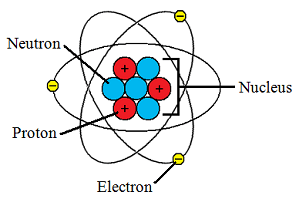
Electrons are particles that possess an innately negative() charge as we say, while protons on the other hand, possess an innately positive() charge. The combination of these two particles, along with neutrons (which we haven't talked about), form our conventional understanding of an atom.
Protons are found in the nucleus of an atom and, along with neutrons, make up essentially all of the mass of an atom. A proton is approximately 0.84-0.87 femtometers () in length. Many famous scientists such as Ernest Rutherford and William Prout postulated the existence of a proton and conducted experiments to prove so. Rutherford's famous gold foil experiment confirmed the existence of a very small atomic nucleus, and led to further predictions on the composition of such a nucleus. A proton has a mass of 1 amu, which is approximately . Furthermore, the proton is known to consist of smaller particles called "quarks," but we don't want to delve too deep into quantum theory.
Electrons, unlike protons are not found in the nucleus of an atom, but are found in orbiting regions around an atom that are defined by probabilistic distribution functions. One of the most defining experiments leading to the discovery of the electron is J. J. Thompson's experiment with cathode rays, and the postulation of a new particle that came afterwards. The mass of an electron is quite negligible compared to that of a proton, as it is . Also, unlike the proton, the electron is one of the fundamental particles that is predicted by the Standard Model of quantum mechanics. The electron exhibits properties of both a wave and a particle, and this corresponds with the term "wave-particle duality."
There are almost an innumerable number of other characteristics of electrons and protons that exist and that can be taken deeper into quantum mechanics and other fields of science, but these are some of the most basic and notable properties of electrons and protons as we know today.