Interactive · 1 question

+2 contributors


Nonlinear Systems: Elimination
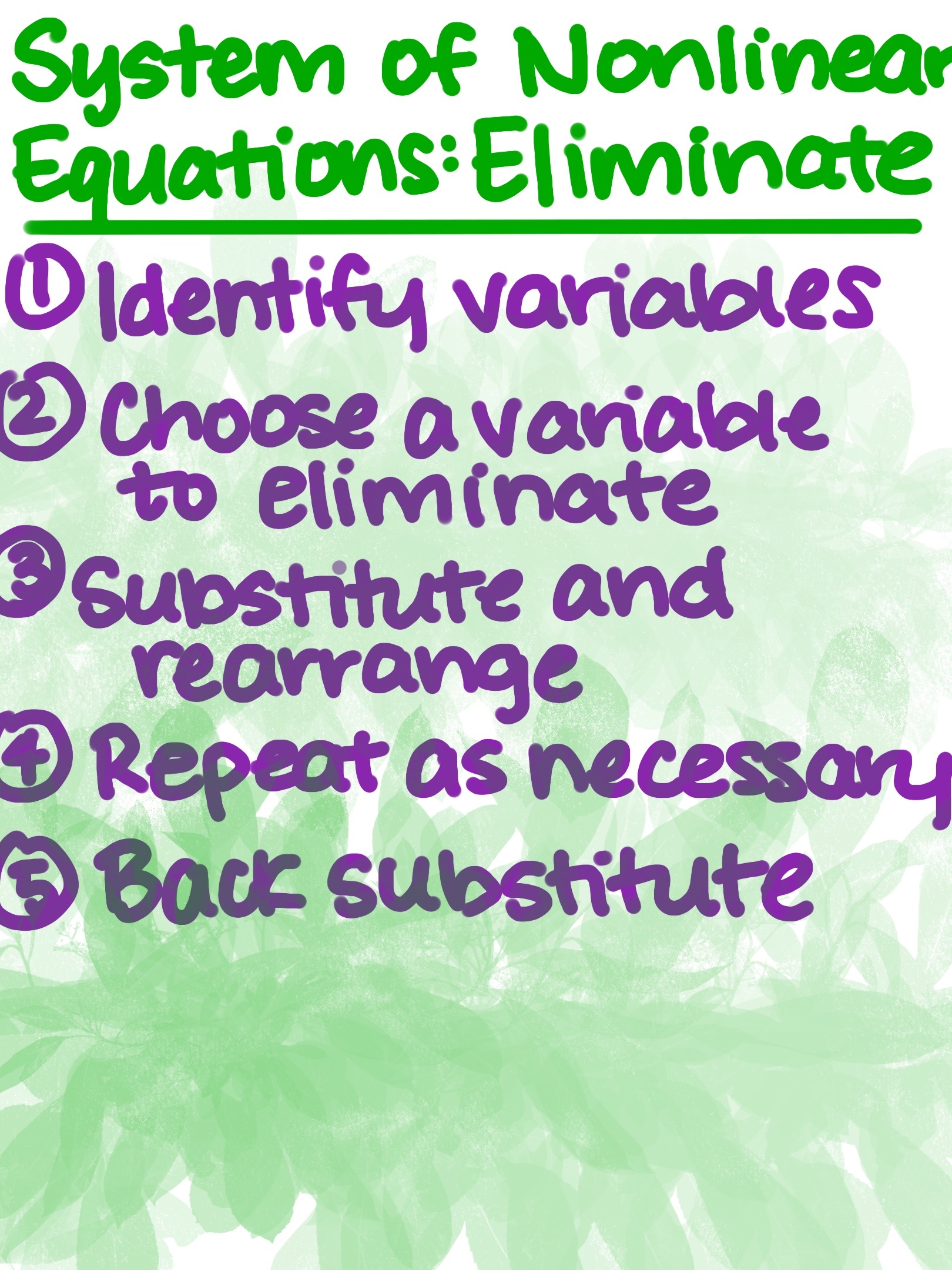
We've learned how to use substitution to solve nonlinear systems. We can also use elimination, just like we do with linear systems. We will learn about the intersection of nonlinear equations using elimination.
Let's look at an example.
We need to find a way to change one of our equations so we can eliminate one of our variables. We're going to multiply the top equation by . Now we can subtract the second equation from the first eliminate .
Now that we have a value for , we can plug it into one of our original equations to find our -values.
We have solutions at and . Let's check this on a graph.

Made with Desmos
The solution set includes the points of intersections.
Remember that the first step in solving any system with elimination is to adjust one of your equations until a variable is ready for elimination.
Here's a practice problem:
Find the solution(s) to the following system:
We need to manipulate both equations to solve this. First, we're going to multiply the top equation by to make the equation easier to work with.
Now, we're going to change the second equation for easier eliminating by multiplying it by .
The next step is to subtract the first equation from the second equation to eliminate .
We can plug these -values into one of our equations to find the -values.
When , . When , we get an imaginary -value, which means that won't be a solution to this system. Our final answers as points are and .
Wrap-Up
The process for solving nonlinear systems with elimination is the exact same as solving linear systems. You need to manipulate your equations to get an equal or opposite term, then add or subtract the two equations to eliminate a variable. The trickiest part here is keeping track of multiple solutions.