Illustrated · 2 min
+5 contributors





What Is Endocytosis?
It is a form of active transport. This means that it requires energy to occur. It doesn't just happen on its own.
The best way to remember what this word means is to break it down. Cyto means having to do with cells, and endo means inside.
So, endocytosis involves bringing stuff from the extracellular fluid to the inside of the cell that is generally too large to cross the cell membrane on its own. This is a very important concept in cell biology.

Image source: By OpenStax CC BY 3.0, via Wikimedia Commons
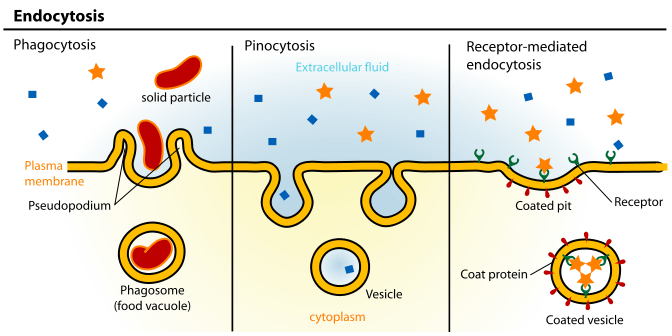
There are three types of endocytosis:

Image source: By Hannah Bonville
Phagocytosis
In phagocytosis, the cell brings in solid particles. This is often referred to as cellular eating.
Phagocytosis always makes me think of the cell like Pac-Man, eating his way along.

Think of phagocytosis as the cell's way of nom-nom-nomming its way along.
In phagocytosis, a solid particle approaches the cell. This can include nutrients, proteins, and even bacteria. The cell membrane begins to indent.
It keeps indenting and indenting until it surrounds the solid particle.
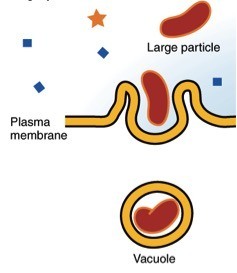
Image source: By OpenStax CC BY 3.0, via Wikimedia Commons
Eventually, the cell membrane pinches off, forming a little bubble around the solid particle (shown in red in the image above). This bubble is called an endocytic vesicle, vacuole, or phagosome.
The food particle is surrounded by a phospholipid bilayer (since it was pinched off from the cell membrane). This is an example of the fluidity of the cell membrane. Parts can pinch off, and no harm is done.
The solid particle is eventually digested (broken down) by the cell, and the waste products and remaining phospholipids are sent back to the cell surface.

In phagocytosis, the solid particle is taken in by the cell (1) and digested (2). Then, the leftovers are sent back out (3). Image source: By Mango Slices CC BY-SA 4.0, via Wikimedia Commons
Pinocytosis
The overall process of pinocytosis is really similar to phagocytosis. There's the same pinching in of the membrane, only this time it's around a liquid particle.
Pinocytosis is often called cellular drinking.

Image source: By OpenStax CC BY 3.0, via Wikimedia Commons
To remember that pinocytosis is cellular drinking, I think of piña coladas. Piña coladas are drinks, and pino sounds like piña.

Image source: By David Joyce CC BY-SA 2.0, via flickr.com
Receptor-Mediated Endocytosis
Luckily, receptor-mediated endocytosis (RME) isn't too different from phagocytosis and pinocytosis. The difference, though, is that RME is a much more specific process.
There are receptors on the outside of the cell membrane specifically designed to recognize and bind to certain substances.
Once this binding occurs, the cell membrane indents and it's the same old story as before.

Image source: By OpenStax CC BY 3.0, via Wikimedia Commons
The key with RME is that the substance (called a ligand in this case) matches the receptors. The receptors don't bond to just any old thing. They recognize a specific ligand and bring it into the cell in vesicles formed from the membrane.
In the picture above, the receptors are shown in green. These receptors are specific to the star-shaped ligand. They do not match up with the blue square ligands.
This vesicle is still made of the cell membrane, but in addition to phospholipids it now includes the receptors, as shown in the image above.