Endocytosis — Definition & Types

Illustrated · 2 min

What Is Endocytosis?

It is a form of active transport. This means that it requires energy to occur. It doesn't just happen on its own.

The best way to remember what this word means is to break it down. Cyto means having to do with cells, and endo means inside.

So, endocytosis involves bringing stuff from the extracellular fluid to the inside of the cell that is generally too large to cross the cell membrane on its own. This is a very important concept in cell biology.

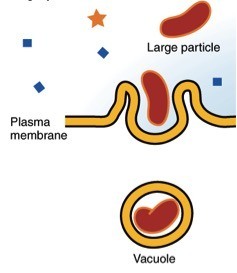
This picture shows an example of endocytosis. First, the plasma membrane indents itself to form around large particles. It then closes around the particle, trapping it inside. The particle then moves inside of the cell in a vacuole.

Image source: By OpenStax CC BY 3.0, via Wikimedia Commons

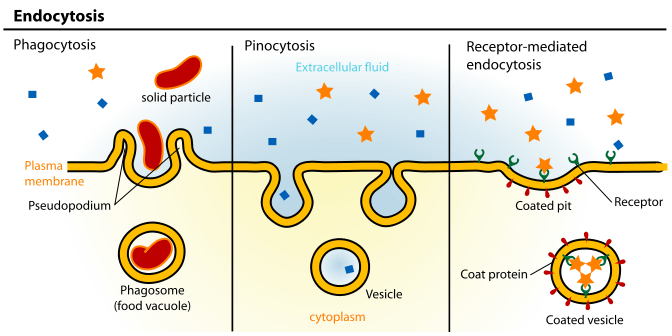
There are three types of endocytosis:

Phagocytosis: Bringing solid particles into the cell. Pinocytosis: Bringing liquid particles into the cell. Receptor-mediated endocytosis: Bringing in particles attached to receptors on the cell membrane.

Image source: By Hannah Bonville

Phagocytosis

In phagocytosis, the cell brings in solid particles. This is often referred to as cellular eating.

Phagocytosis always makes me think of the cell like Pac-Man, eating his way along.

Phagocytosis is like Pac-Man eating pellets.

Think of phagocytosis as the cell's way of nom-nom-nomming its way along.

Image source: By OpenClipart-Vectors CC0, via Pixabay

In phagocytosis, a solid particle approaches the cell. This can include nutrients, proteins, and even bacteria. The cell membrane begins to indent.

It keeps indenting and indenting until it surrounds the solid particle.
This is a diagram showing the process of phagocytosis.

Image source: By OpenStax CC BY 3.0, via Wikimedia Commons

Eventually, the cell membrane pinches off, forming a little bubble around the solid particle (shown in red in the image above). This bubble is called an endocytic vesicle, vacuole, or phagosome.

The food particle is surrounded by a phospholipid bilayer (since it was pinched off from the cell membrane). This is an example of the fluidity of the cell membrane. Parts can pinch off, and no harm is done.

The solid particle is eventually digested (broken down) by the cell, and the waste products and remaining phospholipids are sent back to the cell surface.

This is a diagram showing phagocytosis.

In phagocytosis, the solid particle is taken in by the cell (1) and digested (2). Then, the leftovers are sent back out (3). \\ Image source: By Mango Slices CC BY-SA 4.0, via Wikimedia Commons

Pinocytosis

The overall process of pinocytosis is really similar to phagocytosis. There's the same pinching in of the membrane, only this time it's around a liquid particle.

Pinocytosis is often called cellular drinking.

This is a diagram showing the process of pinocytosis.

Image source: By OpenStax CC BY 3.0, via Wikimedia Commons

To remember that pinocytosis is cellular drinking, I think of piña coladas. Piña coladas are drinks, and pino sounds like piña.

A piña colada

Image source: By David Joyce CC BY-SA 2.0, via flickr.com

Receptor-Mediated Endocytosis

Luckily, receptor-mediated endocytosis (RME) isn't too different from phagocytosis and pinocytosis. The difference, though, is that RME is a much more specific process.

There are receptors on the outside of the cell membrane specifically designed to recognize and bind to certain substances.

Once this binding occurs, the cell membrane indents and it's the same old story as before.

This is a diagram showing receptor-mediated endocytosis.

Image source: By OpenStax CC BY 3.0, via Wikimedia Commons

The key with RME is that the substance (called a ligand in this case) matches the receptors. The receptors don't bond to just any old thing. They recognize a specific ligand and bring it into the cell in vesicles formed from the membrane.

In the picture above, the receptors are shown in green. These receptors are specific to the star-shaped ligand. They do not match up with the blue square ligands.

This vesicle is still made of the cell membrane, but in addition to phospholipids it now includes the receptors, as shown in the image above.

Video

(Video) Active Transport

by Teacher's Pet

Do cells eat? Sort of. Endocytosis is when the plasma membrane is used to bring substances into the cell, as if the cell were eating. This video explains the specifics and shows how it works.

Summary

Endocytosis is one type of vesicle movement, which is a type of active transport. This process is how cells ingest external fluid, macromolecules, or other large particles (like other cells). Phagocytosis is like when a cell eats. Pinocytosis is like when a cell drinks. The cell membrane pinches around the substances it wants to take in, forming a transport vesicle. This vesicle can then go anywhere it's needed in the cell.

Video

(Video) In Da Club - Membranes and Transportation

by CrashCourse

Watch this video to learn how cells devour molecules and liquid. There are three specific ways cells do this: phagocytosis, pinocytosis, and receptor-mediated endocytosis.

Illustrated · 1 min

Three Types of Endocytosis

Active transport is any activity that moves molecules and requires energy. Most active transport is used to move molecules against their concentration gradient. Active transport moves ions from areas of low concentration to areas of high concentration.

Endocytosis is a form of active transport that is used to bring large molecules into the cell. There are three kinds, which we will explore below.

Phagocytosis

Phagocytosis is when a cell surrounds an incoming particle with its plasma membrane. This form of active transport can be used to bring large particles of food into the cell and is used by white blood cells to surround harmful bacteria so that they can be destroyed. The plasma membrane is fluid and stretchy, so when a cell senses an incoming particle, the plasma membrane engulfs it. It then pinches closed around the particle. This leaves the particle in a plasma membrane sac called a phagosome inside of the cell. The phagosome then attaches to lysosomes within the cell so that the digestive enzymes within the lysosome digest the particle.

This is an image showing the process of phagocytosis.

Image source: By Rlawson at en.wikibooks CC BY-SA 3.0, via Wikimedia Commons

Pinocytosis

Pinocytosis is entirely identical to phagocytosis, except that it is not specific to what it absorbs. It is used to engulf liquids and small, already broken down food particles into the cell.

This is a diagram showing the process of pinocytosis. It is also called cellular drinking.

Image source: By Jacek FH [Public domain], via Wikimedia Commons

Receptor-mediated Endocytosis

Receptor-mediated endocytosis is used for the absorption of very specific molecules. On the surface of the cell, you can find receptors. When these receptors bind to their specific signal protein, they will cause a folding of the plasma membrane to absorb proteins, steroids, and cholesterol.

Interactive · 1 question

Transport Into the Cell

Endocytosis is the cell's way of capturing macromolecules and particles outside the cell and engulfing them with their cell membrane. In other words, it's how the cell eats and drinks. This is a critical process for living cells. It is a kind of active transport, so it requires energy input in the form of ATP.

Endocytosis brings substances inside the cell.

Image source: By Jacek FH [Public domain], via Wikimedia Commons

In less technical terms, this is the process of transporting substances into the cell inside of bubbles formed from the plasma membrane. There are three different types of endocytosis, but they all function in basically the same way.

Let's break down the parts of the word since it might make it easier to remember. The prefix endo- means within, absorbing, or containing. The middle part, -cyto- means cell, while the suffix -sis means the process of doing something. So, the endocytic pathway brings things into the cell.

Endocytosis is the transport of particles and liquids woah‾\underline{\phantom{woah}} the cell.

Choose one answer

Type a concept, like “slope” or “photosynthesis”.

↑ ↓ to choose · Enter to openSearch explanations and problems