Illustrated · 1 min

Here's an overview of the reactions that take place during glycolysis:
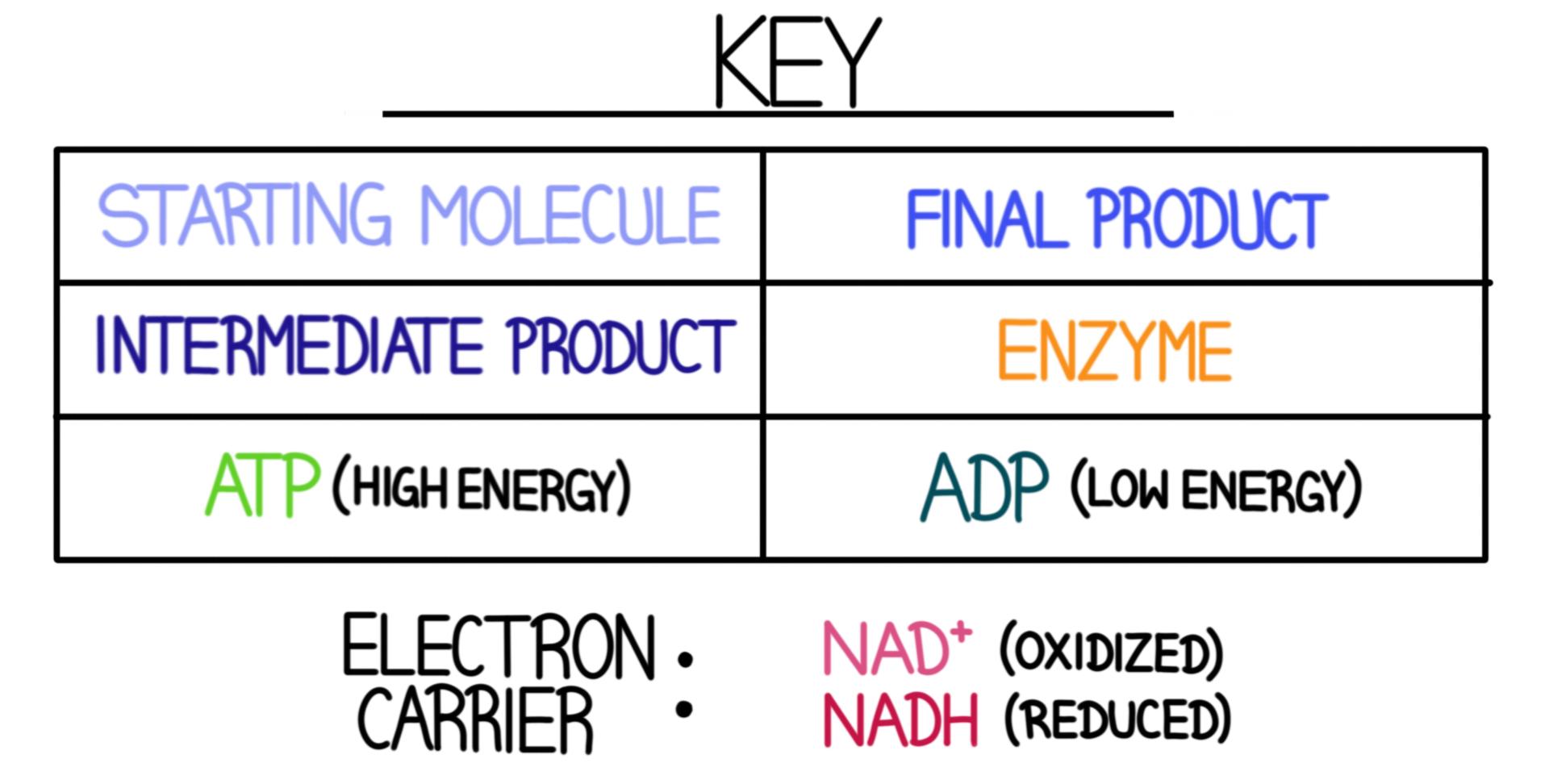
This is a key which goes with the diagram below it.
A diagram showing the reactions and energy balance in glycolysis.

Image by: Gabi Slizewska for expii

Illustrated · 1 min
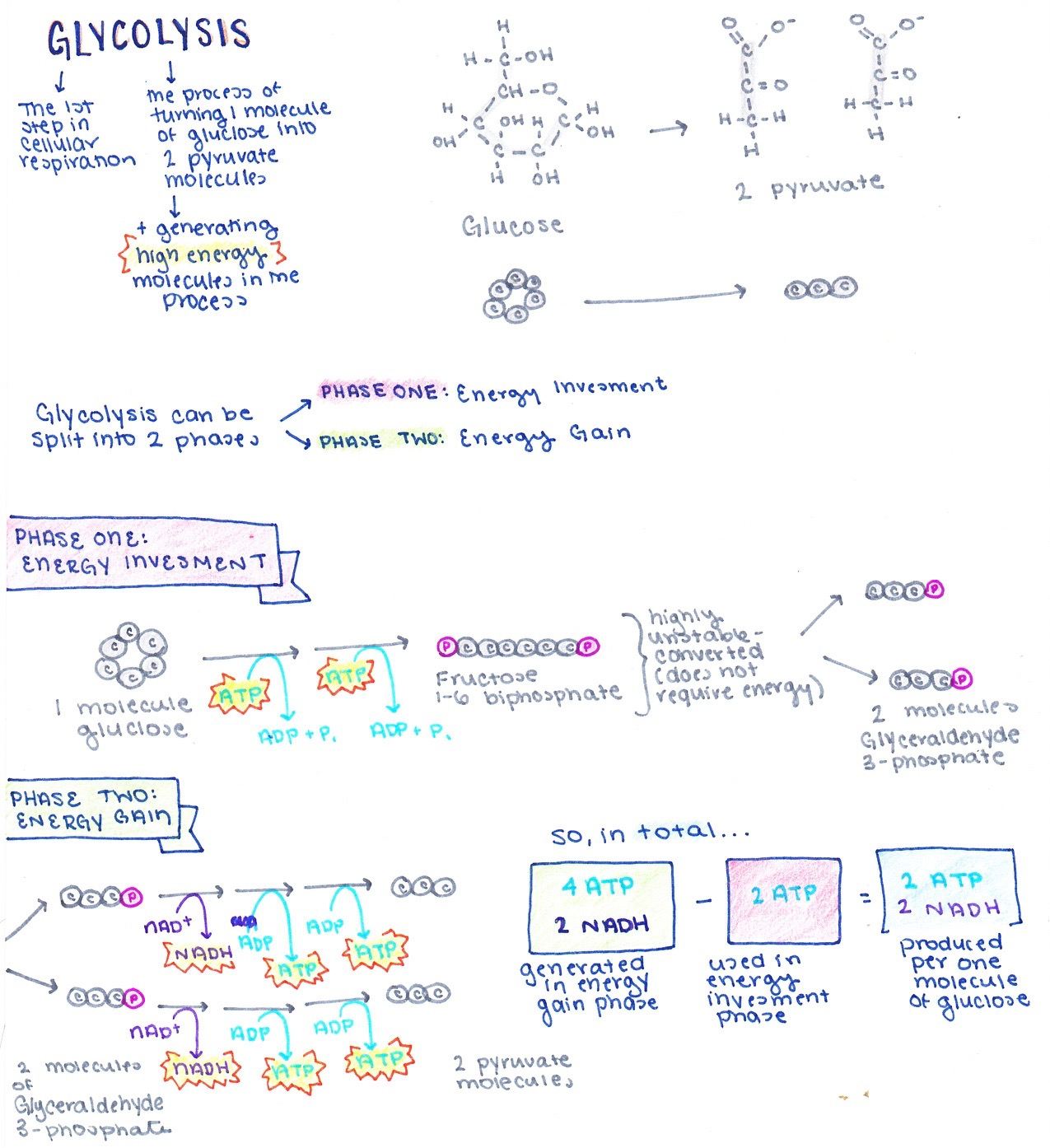
Glycolysis is the first step in cellular respiration. It is also the process of turning one molecule of glucose into two pyruvate molecules while generating high energy molecules. Glucose is a 6 carbon molecule that is converted into two, 3 carbon pyruvate molecules. Glycolysis can split into 2 phases: the energy investment phase and the energy gain phase. In the energy investment phase, glucose is converted into Fructose 1-6 biphosphate. This utilizes 2 molecules of ATP.  Fructose 1-6 biphosphate is highly unstable, and is converted in 2 molecules of glyceraldehyde 3-phosophate. In phase two, the 2 molecules glyceraldehyde 3-phosphate molecules are converted to 2 pyruvate molecules. For every one molecules of glyceraldehyde 3-phosophate, 1 molecule of NADH and 2 molecules of ATP are generated. So, for every one molecule of two molecules of glyceraldehyde 3-phosophate are generated, leading to 2 molecules of pyruvate and 2 NADH and 4 ATP. So, in total 4 ATP and 2 NADH are generated in the energy gain phase and ATP used in the energy investment phase. In total, 2 ATP and 2 NADH and produced in glycosides for every one molecule of glucose.

Illustrated · 1 min

Energy Balance in Glycolysis

Glycolysis involves ten reactions which can be thought of as different stages in the process. For each molecule of glucose, glycolysis requires two ATP molecules in the early stages. ATP and NADH molecules are produced in the later stages. This is reinforced in the image below.
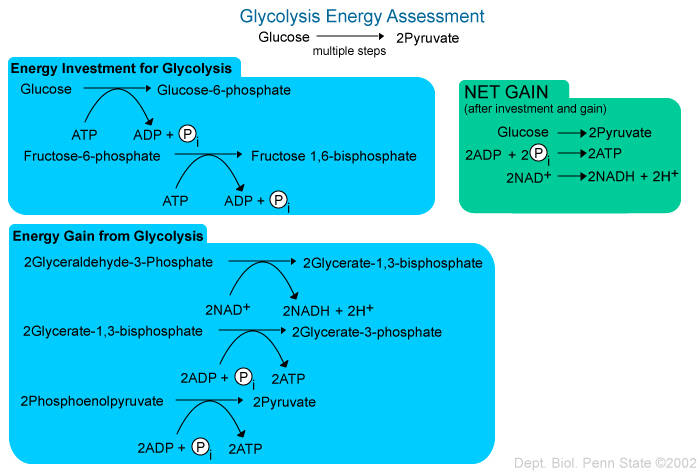
Once we account for the inputs of glycolysis, the entire process yields two molecules of pyruvate, ATP, and NADH.

Reference:

wikispaces.psu.edu

Type a concept, like “slope” or “photosynthesis”.

↑ ↓ to choose · Enter to openSearch explanations and problems