Energy Pyramid — Definition & Diagrams

Before this, knowFood Chain

Illustrated · 1 min

Understanding the Flow of Energy

An energy pyramid is a graphical representation of the flow of energy through the organic matter in an ecosystem.

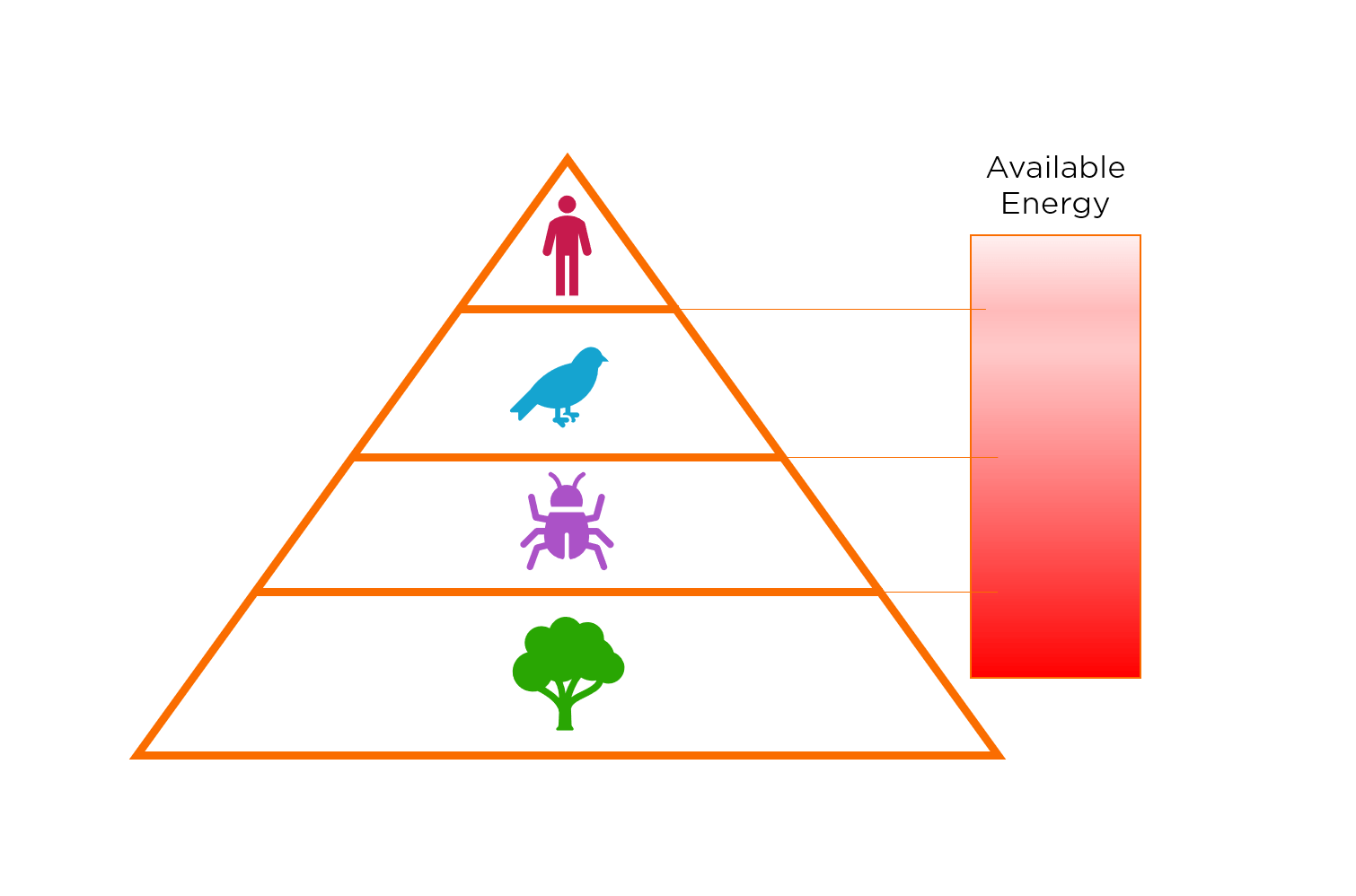
This is a diagram showing an energy pyramid outline. As you move up the pyramid, population size decreases. As you move down the pyramid, the amount of available energy increases. Energy from the sun enters the ecosystem at the level of producers.

Image source: By Valeri Natole

Primary producers like plants are capable of making their own energy from the sun. Producers make up the bottom of a pyramid. There are many organisms that feed on these producers and use their energy in their own biological processes. These organisms are higher in the pyramid.

So why are these pyramids shaped the way they are? The reason is that as you get further and further away from primary consumers, less energy is transferred. Digesting and converting consumed food into usable energy is a pretty inefficient process. This means that as you get further from those organisms that make their own food in-house, less energy is available. This is why there is a cap to predators. Eating an apex predator like a shark or wolf would be energetically inefficient. Only so much energy is available for use by the time you get to the top of the pyramid.

When you look at an energy pyramid, the size of each level represents the energy available to organisms in that level. Once you get to the top, there isn't much energy available and it's difficult to sustain a large population.

Energy differences at different trophic levels. In this pyramid, trees have the most energy, followed by insects, birds, and then humans at the very top.

Image source: By Valeri Natole

Illustrated · 2 min

What Are Energy Pyramids?

An energy pyramid is an easy way to show the energy flow in a community.

How Is It Set Up?

Energy pyramids always show producers at the bottom, then herbivores, omnivores, and finally carnivores. Carnivores are at the top because they eat other consumers. Plants are at the bottom because other organisms eat them, but they never eat other organisms. Decomposers eat organisms (and their waste) from any level, so they are normally on the side of the pyramid. Decomposers play the leading role in ammonification, an important part of matter recycling for an ecosystem.

A diagram of an energy pyramid. The bottom section of the pyramid is labeled primary producers and 100%. Moving up, we have primary consumers with 10%, then secondary consumers with 1%, tertiary consumers with 0.1%, and apex predators at the top with 0.01% of the energy. Each trophic level has an arrow pointing towards decomposers and another to energy lost as heat.  The producers get nutrients from decomposers and energy from the sun.

Image source: By Swiggity.Swag.YOLO.Bro CC BY-SA 4.0, via Wikimedia Commons

What Exactly Do Energy Pyramids Have to Do With Energy?

Energy pyramids show a very cool trend: Each level only gets 10% of the energy from the level below it. So, let's say plants have 100% of the energy in an ecosystem. When the herbivores (primary consumers) eat the plants, they gain 10% of the energy the plants had.

When secondary consumers eat the herbivores, they get 10% of the herbivores' energy, or 1% of the plants' energy. The tertiary consumers get 10% of the secondary consumers' energy, which is about 0.1% of the plants' energy.

The apex predator gets about 0.01% of the plants' energy. So each level gets less and less energy per meal. This is why there are few apex predators compared to tertiary consumers and why the diagrams are pyramid shaped.

So it makes sense that the levels of the pyramid get smaller and smaller as you go up the pyramid. There is less energy available to the consumer with each level. Although the levels represent the amount of energy available, it can also be helpful to think in terms of population size. The plants are at the bottom and are able to sustain the largest population. At the top, the apex predators tend to have much smaller populations because they only get 0.01% of the available energy from their prey.

Vocabulary Review:\color{#8925ae}{\text{Vocabulary Review:}}

Food Chain\color{#8925ae}{\text{Food Chain}} : How energy passes through an ecosystem through organisms eating and being eaten

Energy Pyramid\color{#8925ae}{\text{Energy Pyramid}} : An easy way to show the energy flow in a community

Producer\color{#8925ae}{\text{Producer}} : Organisms that produce their own food through photosynthesis or chemosynthesis

Consumer\color{#8925ae}{\text{Consumer}} : Organisms that consume other organisms for energy

Decomposer\color{#8925ae}{\text{Decomposer}} : Organisms that break down waste and dead matter

Video

(Video) Energy Pyramids

by Region 10 ESC

Did you know you can describe energy transfer in an ecosystem with both a food web and an energy pyramid? This quick video reminds you where different organisms are found within energy pyramids and why they are found there.

Video

(Video) Trophic Level Pyramid

by MooMoo Math and Science

Did you know humans need the sun to live? That's not just because it's way easier to get motivated on a sunny day. Solar energy is the basis for all the energy that travels up through an ecosystem's trophic levels. This video by MooMoo Math and Science explains how we can use a trophic pyramid to view all the levels within an ecosystem.

Type a concept, like “slope” or “photosynthesis”.

↑ ↓ to choose · Enter to openSearch explanations and problems