Entropy — Definition & Overview

Illustrated · 2 min

Entropy is possibly the most important concept in all of thermodynamics. Unfortunately, entropy is also an incredibly difficult concept to fully grasp. This lesson will give an overview of the necessary basics, but is in no way comprehensive. For a more in depth understanding of entropy, a strong background in statistics is required.

Microstates and Macrostates

Let's play a game.

I roll a single, fair, 6 sided die. What number most likely comes up?

As you probably guessed, it's impossible to tell what I am going to roll. All of the options are equally likely.

Let's say I roll two fair 6 sided dice. What sum most likely comes up?

The answer is 7. But why exactly is that?

When we roll 2 dice, each die has 6 possible outcomes. This means that in total we have 6⋅6=366 \cdot 6=36 unique outcomes when we roll two dice. But if we only want the sum of the dice, we don't care if we get a result of 7 from rolling 3 and 4, or 4 and 3. We only care that the sum is 7. In more technical terms we can say that the macrostate of the system is 7, and that the particular combination (i.e. 3 and 4) is the microstate.

When we roll 2 dice, 7 may be the most likely outcome, but even the least likely outcomes, 2 and 12, show up 136\frac{1}{36} of the time. Now let's blow this example up.
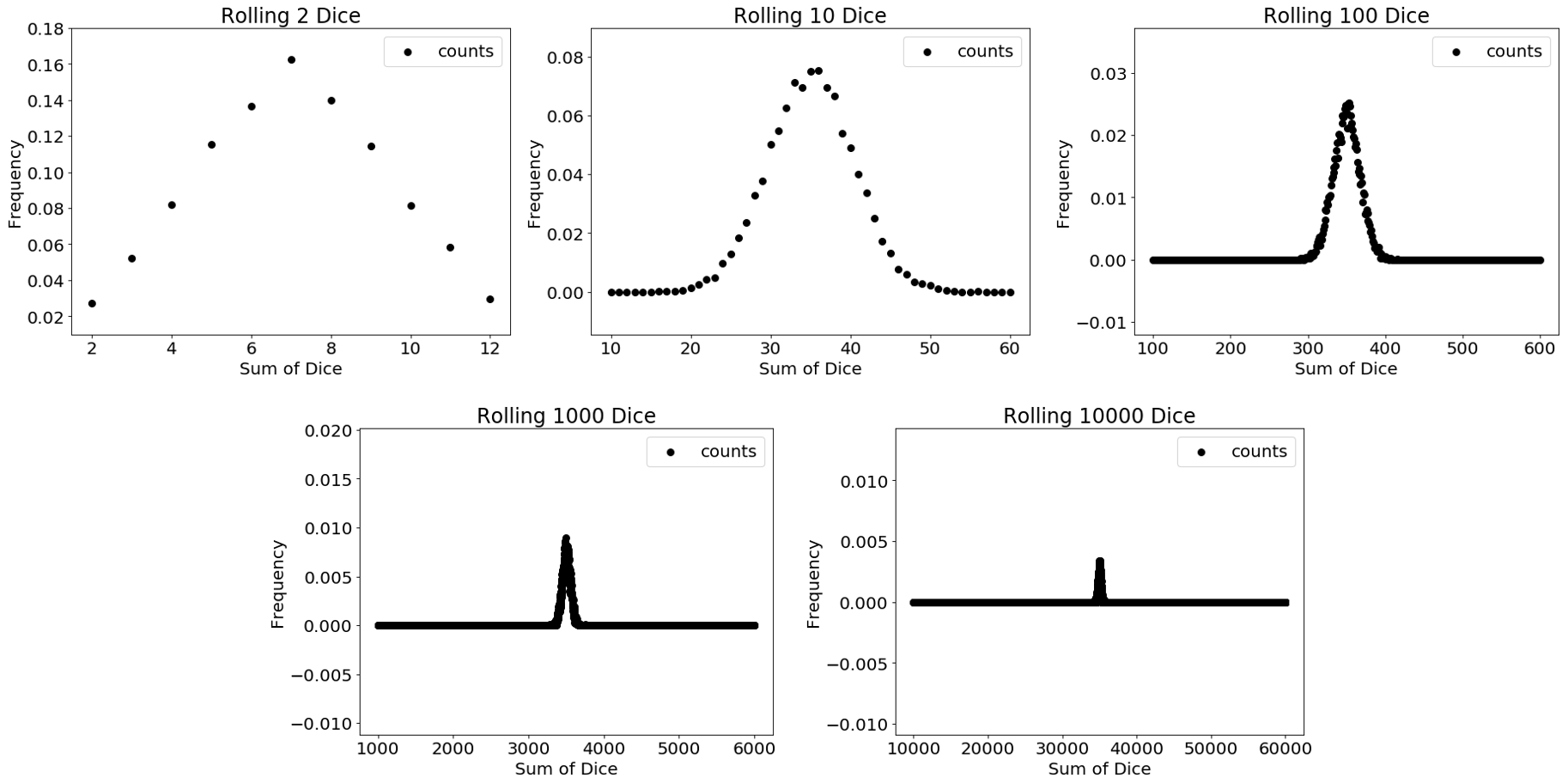
Histograms of the produced sum from rolling 2, 10, 100, 1000, and 10000 dice, each with 10000 trials

As we can see from the graphs above, as the number of dice increases, the system begins to exhibit a smaller and smaller percent of available macrostates. Imagine what the histogram of 102310^{23} dice would look like. In physical scenarios we are typically dealing with numbers of this magnitude.

Entropy and State

People often say that entropy is a measure of the disorder of a system. This is an oversimplification. Entropy is the tendency of a system to approach the most likely macrostate. Think back to our dice. Every microstate of our dice was equally likely to occur, but when we looked at the sum, certain sums were more likely to occur than others. Particles are exactly the same. Every microstate of particles is equally likely to be observed, but the vast majority of microstates correspond to a single macrostate. Since the properties of the macrostate are what we are generally interested in, it is easier to just consider the system as the macrostate. It turns out that the relevant "dice rolls" for particles are energy, UU, volume, VV, and number of particles, NN. This is to say, the entropy, SS, of our system depends on these three variables. Mathematically, entropy is a state function, and most commonly seen in the differential form shown below. dS=1TdU+PTdV−μTdNdS=\frac{1}{T}dU+\frac{P}{T}dV-\frac{\mu}{T}dN

Read · 1 min

Entropy is the measure of the disorder or lack of order in a system. The Second Law of Thermodynamics states that the entropy of the universe is increasing. To understand why this is true, we can employ several analogies. For example, your room naturally tends to become disordered, as items can be misplaced. This is because there is only one state of order, while there are far more possible states of disorder. As a result, the probability of disorder is far greater than the probability of order. The universe proceeds to the state that is most likely, which is disorder.

Entropy is very important in determining whether a reaction will occur or not. Since the universe can be divided into system and surroundings, we can write that Suniv=Ssystem+SsurrS_{\text{univ}} = S_{\text{system}} + S_{\text{surr}} For a reaction to be spontaneous, or to "naturally" occur, the change in entropy of the universe must be positive, since the entropy of the universe increases. ΔSuniv=ΔSsystem+ΔSsurr\Delta S_{\text{univ}} = \Delta S_{\text{system}} + \Delta S_{\text{surr}} Note that this does not tell us anything about how to predict whether a reaction will occur from just the change in entropy of the system. We will see how to do this when we are introduced to Gibbs free energy. For now, however, it is important to realize that if the change in entropy of the system is negative, the change in entropy of the surroundings must be positive with a greater absolute value in order for the reaction to be spontaneous. Similarly, if ΔSsurr<0\Delta S_{\text{surr}} < 0, ΔSsystem\Delta S_{\text{system}} must counteract this for the reaction to be spontaneous.

Video

(Video) Entropy

by Bozeman Science

Entropy is the dispersal of matter. In this video, Mr. Andersen shows you some great examples to help you understand this topic. You will also learn how to predict changes in entropy in a system.

Illustrated · 1 min

Entropy: What is entropy?

Entropy is generally oversimplified as a measure of the disorder of a system. You can think of molecules doing random activities. However, entropy is the tendency of a system to approach the most likely macro state. You can think of entropy that wants a specific macrostate that is inside a vending machine.

Image Source: Leo Dong

Type a concept, like “slope” or “photosynthesis”.

↑ ↓ to choose · Enter to openSearch explanations and problems