Enzyme Inhibition — Overview & Types

Before this, knowRate of Reaction (Enzymes) — Role & Importance

Illustrated · 1 min

Types of Enzyme Inhibition

An enzyme binds to a substrate in order to speed up a chemical reaction.

Image source: By Gabi Slizewska

Different molecules can decrease an enzyme's activity so that a reaction stops or less product is made.

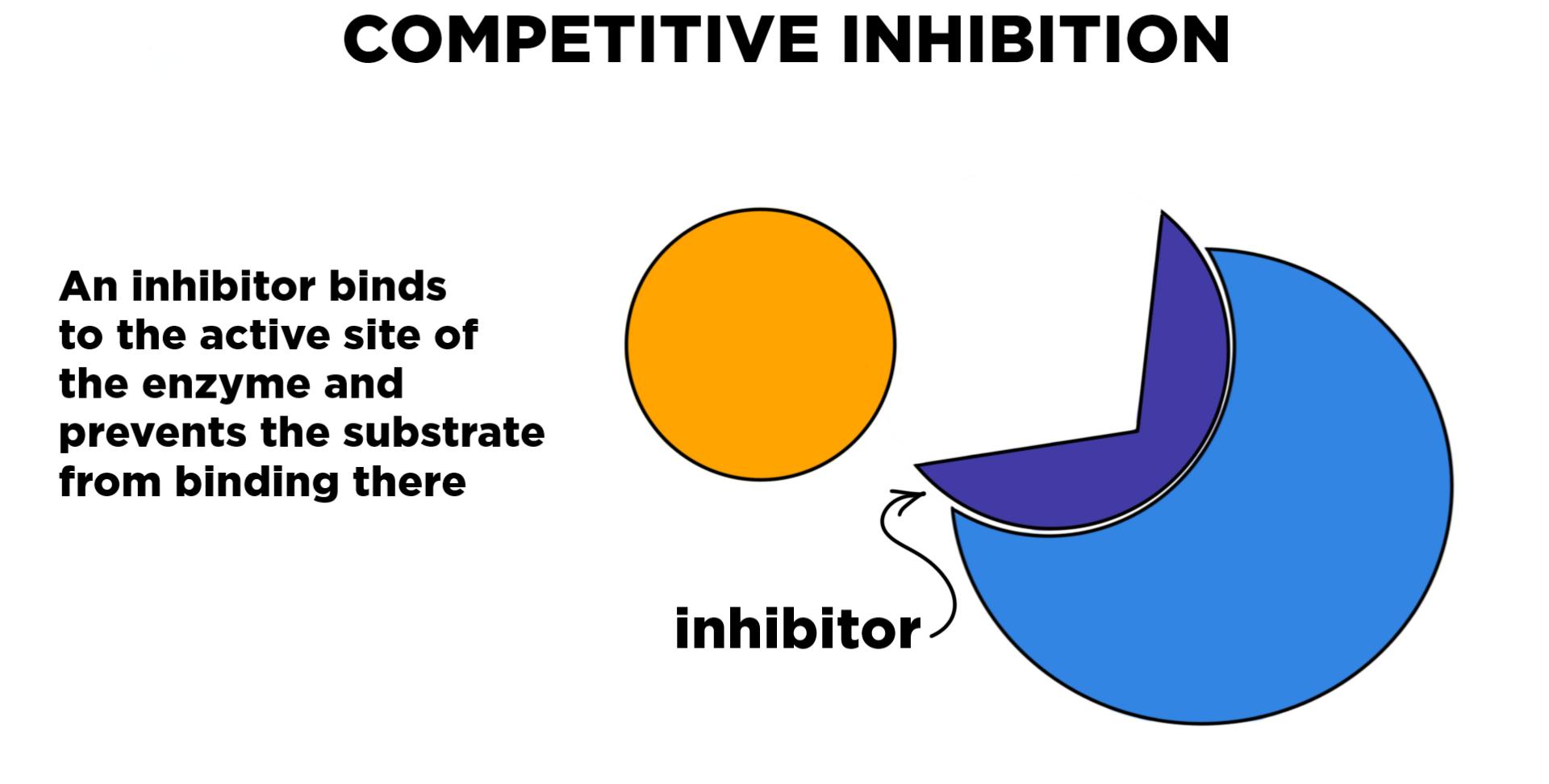
Competitive inhibition. An inhibitor binds to the active site of the enzyme and prevents the substrate from binding there.

Image source: By Gabi Slizewska

In competitive inhibition, a molecule that is similar in shape and structure binds to the active site instead of the substrate.

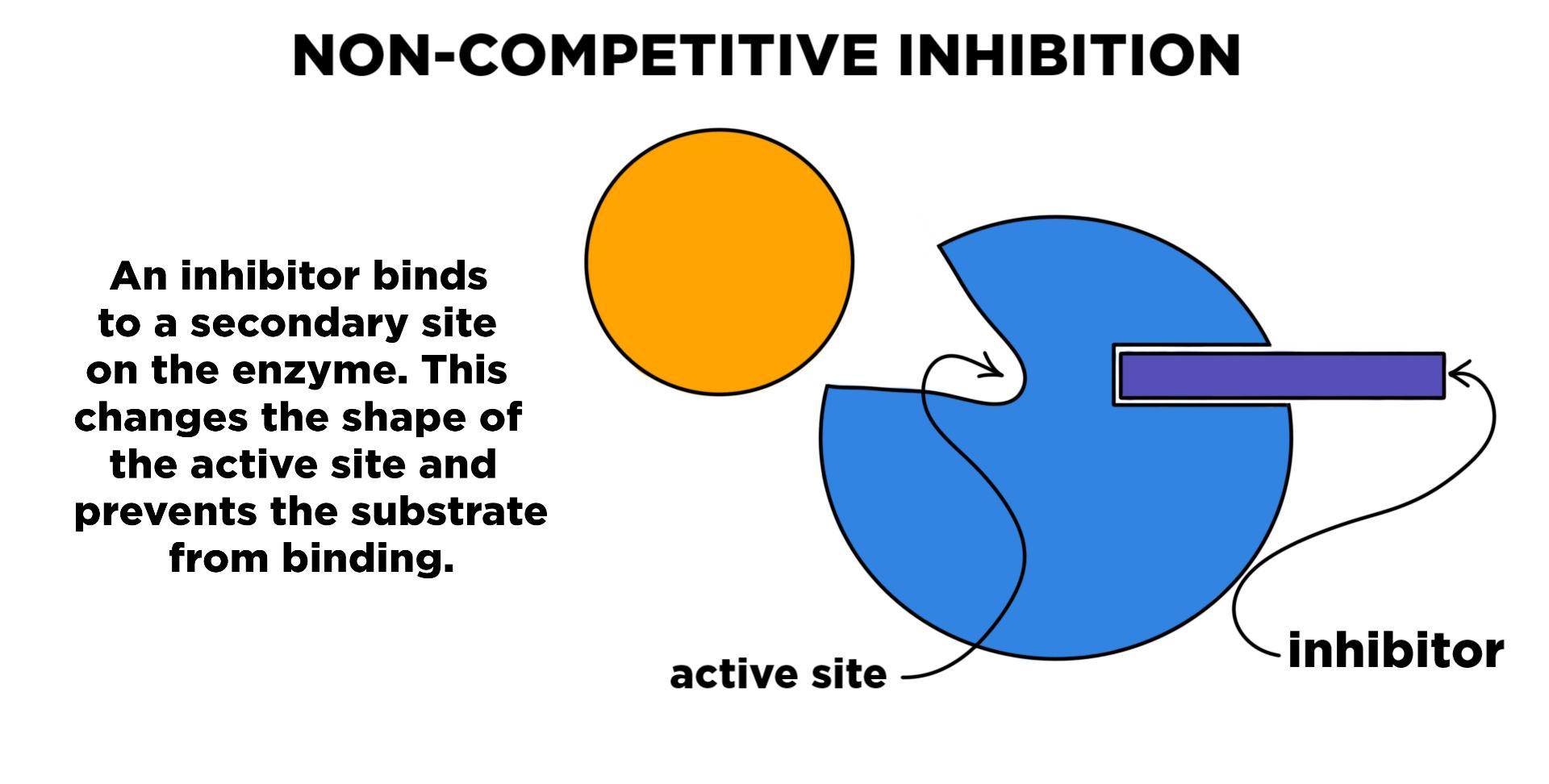
Non-competitive inhibition. An inhibitor binds to a secondary site on the enzyme. This changes the shape of the active site and prevents the substrate from binding.

Image source: By Gabi Slizewska

In non-competitive inhibition, a molecule binds to a secondary site on the enzyme. This is different from the active site, where the substrate normally binds.

When the inhibitor binds, it alters the shape of the enzyme and its active site. This prevents the substrate from binding.

Read · 2 min

What Is Inhibition?

Enzyme inhibitors inhibit enzymes. Kind of a redundant sentence, right? You may be thinking, well sure, I could've told you that from just the name, but what does that actually mean?

So first, let's break down the words: enzymes are biological catalysts. Catalysts are molecules that help speed up chemical reactions. Enzymes bind to substrates to form products. Inhibit means to stop or prevent.

Put the words together and you get enzyme inhibiton. Enzyme inhibitors slow down or completely block enzyme action.

How Do Enzyme Inhibitors Slow down Enzymes?

There are two types of enzyme inhibitors: competitive and noncompetitive inhibitors. Depending on the type of inhibitor, its mechanism (the way it works) is different.

Competitive inhibitors compete with the substrate for binding to the enzyme. They typically do this by binding to the enzyme's active site, but there are some competitive inhibitors that bind to other parts of the enzyme. When a competitive inhibitor is bound to its target enzyme, it blocks the substrate from binding and forming an enzyme-substrate (ES) complex.

Noncompetitive inhibitors bind elsewhere on the enzyme. When an inhibitor binds somewhere other than the enzymes' active site, the binding spot is called an allosteric site. Even though noncompetitive inhibitors don't bind to the active site, the inhibitor binding to the allosteric site will often change the shape of the enzyme, making it harder for the substrate to bind to the enzyme.

Once an enzyme is blocked, will it stay that way forever? Well, there are ways that enzymes can function again. It depends on the inhibitor. For example, there is a special group called reversible inhibitors. When these are removed from an enzyme, the enzyme can function again like normal.

When Do Inhibitors Work Best?

It might sound pretty scary that inhibitors can block enzymes and stop reactions from taking place, but sometimes it's hard for them to get to an enzyme anyway. One major factor in this is the concentration of substrate molecules in a given environment. Think about it this way: If there is a high substrate concentration, the substrates and enzymes will bond with each other, and the inhibitor will have a harder time finding an available enzyme. On the other hand, if there is a low substrate concentration, an inhibitor will have an easier time finding an available enzyme.

Video

(Video) Competitive and Non-Competitive Inhibitors

by Jeremy LeCornu

Enzyme inhibitors are molecules that bind to the enzyme to interfere with its function.

The video above explains how competitive and non-competitive inhibition works.

Illustrated · 1 min

How does an Inhibitor Reduce Enzyme Activity?

Enzymes are proteins that make chemical reactions go faster. Certain molecules can inhibit, or stop, an enzyme from doing its job.

There are two types of inhibition: competitive and noncompetitive.

Competitive inhibitors are molecules that have similar properties to the enzyme’s substrate. Because they are just like the substrate that fits the enzyme’s active site, competitive inhibitors enter the active site and keep substrate out. If substrate doesn’t enter the active site, the reaction can’t be catalyzed.

Noncompetitive inhibitors use a different method to keep enzymes from working. Unlike competitive inhibitors, these molecules do not bind to the active site. They bind to other parts of the enzyme instead, causing a change in the shape of the protein. If a protein’s shape changes, it can’t work as well.

If an inhibitory molecule binds to an enzyme, whether competitively at the active site or noncompetitively somewhere else, that enzyme won’t be able to function as a catalyst.

A reaction catalyzed by an enzyme vs. Competitive inhibition vs. Noncompetitive inhibition

Image source: By Valeri Natole

Vocabulary Review:\color{#8925AE}{\text{Vocabulary Review:}}

Protein\color{#8925AE}{\text{Protein}} : Complex polymer made of carbon, hydrogen, nitrogen, and oxygen. They are made of amino acids

Enzyme\color{#8925AE}{\text{Enzyme}}: A protein that acts as a catalyst

Catalyze\color{#8925AE}{\text{Catalyze}}: Speed up a reaction

Inhibition\color{#8925AE}{\text{Inhibition}}: Blocking a molecule from functioning efficiently

Substrate\color{#8925AE}{\text{Substrate}}: A reactant that enters an enzyme's active site for catalysis

Competitive inhibitor\color{#8925AE}{\text{Competitive inhibitor}}: A molecule that is not the substrate but fits into the active site, preventing the enzyme from catalyzing the reaction it usually catalyzes

Noncompetitive Inhibitor\color{#8925AE}{\text{Noncompetitive Inhibitor}}: A molecule that interacts with the enzyme at a spot that is not the active site but still prevents the enzyme from working as a catalytic protein

Type a concept, like “slope” or “photosynthesis”.

↑ ↓ to choose · Enter to openSearch explanations and problems