Enzyme Reaction Rates: pH — Effects & Examples

Interactive · 1 question

The Ideal pH Range

Enzyme activity is influenced by pH, temperature, and the substrate concentration of the solution. Depending on the type of enzyme, the pH will have a different impact on the rate of reaction.

Major digestive enzymes are listed. Enzymes that digest carbohydrates are neutral or basic and found in the mouth or small intestine. Protein digestion happens in acidic pH in the stomach and basic pH in the small intestine. Nucleic acid digestion occurs at a basic pH in the small intestine. Fat digestion happens in a basic pH in the small intestine.

Image source: By Stephaniegreenwood [Public domain], via Wikimedia Commons

All enzymes have specific pH dependencies. If the enzyme is typically found in the stomach, it will probably work best in an acidic environment. If this stomach enzyme is thrown into a neutral or basic pH, it will have a much slower rate of reaction because it is outside of the enzyme's ideal pH range.

Using the chart above, what is the preferred pH of enzymes that digest nucleic acids?

Choose one answer

Illustrated · 1 min

What Effect Does pH Have on Enzyme Function?

Enzymes are picky molecules. They work within a very specific range of conditions and fall apart (literally) when those conditions are violated.

One of these conditions is pH (the concentration of hydrogen ions in a solution).

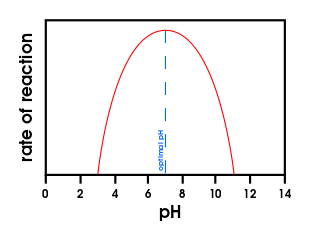
Every enzyme molecule has an optimum pH—the pH at which they work best. The rate of reaction is greatest at the optimum pH.

So, what happens to enzymes outside their optimal pH range? Why do they stop working?

Denatured enzymes lose their shape.

Image source: By Scurran15 CC BY-SA 4.0, via Wikimedia Commons

Recall that enzymes are proteins made of amino acids. The side chain of each amino acid determines how the protein folds and what shape it takes.

The shape of an enzyme is fundamental to its ability to work. So, damaged enzymes are ones whose shapes have been altered in some way. Damaged enzymes no longer have a lock-and-key fit with their substrate molecules, which means they can't catalyze the reaction.

When an enzyme is denatured, it essentially melts and loses its shape. Denaturation can be caused by any change in an enzyme's narrow pH range.

Key Vocabulary:

  1. Enzyme
  2. pH
  3. Optimum
  4. Denature
  5. Active site
  6. Substrate

Video

(Video) How Enzymes Denature

by FuseSchool

Many factors can change how enzymes and substrates fit together.

Explore how movement away from an enzyme's optimal pH affects that enzyme's performance with this video.

Illustrated · 1 min

Enzymes and pH. Example: pepsin. Pepsin is most active around pH 1-2. Pepsin breaks down peptide bonds in food during digestion. The pH in the stomach ranges from 1.5 to 3.5, perfect for pepsin.

Image source: By Gabi Slizewska

Video

(Video) Effect of Temperature and pH on Enzyme Activity

by Ms Cooper's A level Biology

pH is one of the factors that affects the activity rate of an enzyme-catalyzed reaction.

This video explains what happens to enzymes when they are placed outside of their optimal pH range and shows some examples of enzymes that catalyze chemical reactions at different pH levels.

Type a concept, like “slope” or “photosynthesis”.

↑ ↓ to choose · Enter to openSearch explanations and problems