Enzymes In Biochemical Reactions — Role & Importance

Before this, knowChemical Reaction — Definition & Overview

Illustrated · 3 min

What Are Enzymes?

Biological molecules that change the rate of a chemical reaction are called catalysts. Enzymes are an example of catalysts.

Because they are proteins, enzymes are made up of long chains of amino acids joined together by peptide bonds.

Enzymes are a type of protein, so they are made of chains of amino acids joined together by peptide bonds.

Chain of amino acids

Image source: By National Human Genome Research Institute (NHGRI) [Public domain], via Wikimedia Commons

Enzymes almost always have names that end in -ase. If you see a molecule whose name ends in -ase, I promise you that it's an enzyme.

Examples of this include: amylase, lactase, cellulase, telomerase, and peroxidase.

Examples of the few enzymes without -ase names include: peptin, trypsin, and chrymotrypsin.

What Do Enzymes Do?

Enzymes catalyze chemical reactions. This generally means that they speed up the rate of reactions by lowering the reaction's activation energy—the energy required to get the reaction going.

Graph showing a reaction with a catalyst and without a catalyst.

Enzymes are catalysts.

Image source: By Jerry Crimson Mann, Tutmosis, Fvasconcellos (modified by expii) CC BY-SA 3.0, via Wikimedia Commons

As the image above shows, having an enzyme reduces a reaction's activation energy by quite a bit.

It's important to note that all of the reactions would still happen even if the enzymes weren't there. They'd just happen much more slowly.

Enzyme Active Site and Substrate

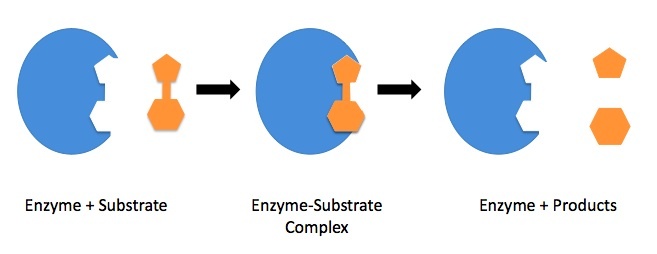
The reactants in an enzyme-catalyzed reaction are called substrates. Substrates must bind to enzymes before the enzymes can do their job.

Substrates bind to a specific spot on the enzyme called the active site. The shape of the active site must match the shape of the substrate, like a puzzle piece or a lock and a key.

If a substrate doesn't match an active site, then it won't bond and the enzyme can't do its job. The shapes of the substrate and active site are really important.

Once the enzyme and substrate bind, the active site changes shape slightly to fit it more closely. This is known as induced fit. Finally, we get an enzyme-substrate complex, as shown in the image below.

Substrates fit into enzymes like a key into a lock.

Image source: By Hottuna080 CC BY-SA 3.0, via Wikimedia Commons

Example of an Enzyme Reaction

Start by taking a look at the image below.

Enzymes help convert substrates into products.

Image source: By OpenStax CC BY 3.0, via Wikimedia Commons

Let's talk about what's happening here:

  • (a) There are two substrates in our reaction (S1S_1 and S2S_2). They approach the enzyme.
  • (b) The substrates fit into the active site and bind to the enzyme. We get our enzyme-substrate complex.
  • (c) The enzyme helps the substrates bind together to form the reaction's product.
  • (d) The product of the reaction is released from the enzyme. The enzyme can now be reused.

Just to mention it again (because it will come up): Enzymes are not used up or changed in chemical reactions. They can be reused over and over again.

Notice how, in our reaction above, the enzyme never changes shape. This is important because it's precisely why the enzyme can be used again.

Denaturation

Remember how we mentioned that the shape of an enzyme's active site is really important? Well, if the shape of the active site is changed or deformed, the substrates will no longer fit into it.

If substrates can't fit into the enzyme, then the enzyme can't catalyze the reaction.

When proteins denature, they lose shape. This happens with heat or extreme pH.

Image source: By Rhannosh CC BY-SA 3.0, via Wikimedia Commons

See how the enzyme gets sort of melty looking in the last two pictures on the graph above?

This melting or deforming of the active site is called denaturation. Denaturation is primarily caused by two things:

  1. Extreme pH
  2. High temperatures

Enzyme Inhibition

There's another way to prevent an enzyme from working properly. This is called inhibition.

There are two types of inhibition:

  1. Competitive inhibition
  2. Non-competitive inhibition

Let's look at competitive inhibition first:

Competitive inhibition

Image source: By Jerry Crimson Mann, TimVickers, Fvasconcellos, Retama [Public domain], via Wikimedia Commons

In competitive inhibition, something other than the substrate binds to the enzyme's active site. The thing binding to the enzyme is called the inhibitor.

Because it sits in the enzyme's active site, an inhibitor blocks the substrate from binding to the enzyme. This means that the enzyme cannot do its job.

This is called competitive inhibition because the inhibitor and the substrate compete for the active site.

Now, let's look at non-competitive inhibition:

Non-competitive inhibition

Image source: By Jerry Crimson Mann CC BY-SA 3.0, via Wikimedia Commons

In non-competitive inhibition, an inhibitor binds to a part of the enzyme other than the active site. This bonding, as shown above, blocks the active site. This prevents the substrate from binding.

This is called non-competitive inhibition because the inhibitor and the substrate are not directly competing for the active site.

Key Vocabulary:

  1. Protein
  2. Enzyme
  3. Catalyst
  4. Activation energy
  5. Denaturation
  6. Substrate
  7. Active site
  8. Competitive inhibition
  9. Non-competitive inhibition

Interactive · 1 question

What Do Enzymes Do?

Enzymes are biological catalysts that help our bodies perform chemical reactions, such as digesting food and absorbing oxygen. They are specialized proteins that act as catalysts for a type of reactant called a substrate. Enzymes are so important that living organisms wouldn't be able to keep existing without their help.

GIF of an enzyme being rotated

This weird crinkled mess is an enzyme.

Image source: By BQUB15-Salmeron CC BY-SA 4.0, via Wikimedia Commons

As a reminder, catalysts speed up chemical reactions without any change to themselves. They lower the activation barrier of the chemical reaction, making it easier for the products to be formed. Catalysts are not used up or changed no matter how many reactions they help with.

Reaction diagram with and without an enzyme

Less activation energy is needed in an enzyme reaction.

Image source: By OpenStax College CC BY 3.0, via Wikimedia Commons

What does "biological catalyst" mean?

Choose one answer

Video

(Video) Enzymes

by Amoeba Sisters

Enzymes are organic molecules that often act as catalysts. These molecules speed up reactions in the body. For example, the enzyme lactase helps your body break down lactose more quickly.

Illustrated · 2 min

Biologic Catalysts

You've probably heard of enzymes before, whether it was in school or somewhere else, like at the doctor's office. Some people even take digestive enzymes as health supplements. But what exactly is an enzyme? First, we'll talk about one example of what can go wrong when there's not enough of an enzyme, then we'll explain the science behind enzymes.

Lactose Intolerance

Lactose intolerance is a fairly common problem. You may already be familiar with it, but did you know it's caused by an enzyme deficiency? If you are lactose intolerant, you've realized you can't drink milk or eat foods that contain dairy—like pizza, ice cream, or yogurt—without getting stomach pain, cramps, and bloating, plus other delightful symptoms I won't mention.

Did you ever wonder why this happens? This is because people who are lactose intolerant don't make enough of the digestive enzyme lactase. Lactase is found in your small intestines. Its job is to break down the sugar lactose (be careful not to get the names mixed up). When you don't have a lot of lactase, you can't digest as much lactose. Dairy has a lot of lactose in it, so it causes indigestion for lactose intolerant people because their body can't handle all the lactose at once.

Where Enzymes Come In

Enzymes are biological molecules, typically proteins. They usually have names ending in -ase (like lactase ). Enzymes are essential for basically all cellular processes and metabolic pathways.

Enzymes act as catalysts on their target molecules, also called their substrate, to cause some sort of chemical change to create a product. A catalyst is something that speeds up a chemical reaction without getting changed or used up in the process. Without enzymes to help biological processes occur, things wouldn't happen fast enough for there to be life.

All enzymes have an active site, which like it sounds, is where the reaction catalyzed by an enzyme happens. Each enzyme's active site has a very high affinity for that enzyme's particular substrate. Affinity for a substrate means that the active site is highly specific (chemically and physically) to match the chemistry and shape of the substrate molecule. Below, you can see how the active site for the enzyme maltase matches the shape of its substrate, the sugar maltose. If an enzyme's active site was not specific to a substrate (if it had a low affinity), then it would not function, or function very slowly.

Image of the enzyme maltase matching its substrate, maltose, perfectly

Maltose is a disaccharide sugar made of two glucose molecules. Maltase (blue) is an enzyme that breaks maltose (its substrate, pink) into two glucose monosaccharides (the products). Here, you can see how the active site of maltose matches the shape of maltose perfectly. \\ Image source: By Sylvia Freeman

Video

(Video) How Enzymes Work

by RicochetScience

Enzymes bind to a substrate to speed up a chemical reaction. The substrate binds at a region of the enzyme called the active site. The enzyme allows the reactants to interact with each other and make products more efficiently.

Type a concept, like “slope” or “photosynthesis”.

↑ ↓ to choose · Enter to openSearch explanations and problems