
Video · + 3 min read

(Video) Sketching the Derivative of a Function
by PatrickJMT

Here's a video by patrickJMT showing you how to sketch a derivative given the graph of a function.
The first graph he looks at is

Remember that we can interpret the value of the derivative, , at any particular -coordinate as the slopes of the tangent lines on the original function.
The first thing to do is look for when the graph peaks out or bottoms out.

Here we have a point where our graph peaks out. If we were to take the tangent line at that point we would get a horizontal line.

Recall that the slope of a horizontal line is zero. So for the derivative at that point we plot it at the -coordinate of the slope of that tangent line. In other words, zero.

Notice there's a point to the right where the graph bottoms out. Here, we will also get a slope of zero. So the derivative point will be zero.

Now let's look at a point between the peak and bottom. If we take the tangent line we see it it's decreasing, starting from a higher point and ending at a lower point. This means it's slope is negative.

You might notice that at every point between the peak and bottom has a negative slope. It will be the most negative at the point exactly in between the two. So on the derivative graph, all the points on this segment will be negative, or below .
As we start from the peak the slope gets more and more negative until it reaches the middle. From there is gets less and less negative until it reaches the the bottom out point where the slope is zero. On the derivative graph we see:

The more negative the slope of the tangent line, the more negative the -coordinate of the derivative function.

After the bottom point point, we see that the tangent lines become increasingly large. This means the slopes will get larger and larger. Positive slopes tell us that the -coordinate of the derivative function is positive.

As we move to the left of the peak point, we see the slope is positive and gets larger as you move further left. This tells us the derivative function will have positive -coordinates.
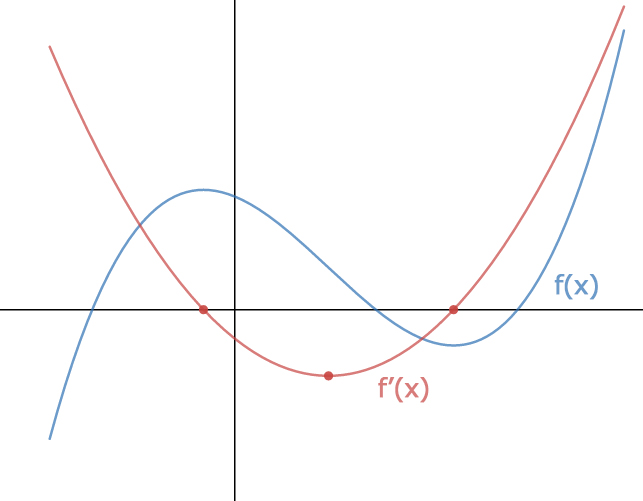
Notice that the original graph is increasing from negative infinity to the peak. If you look at the derivative for this section, notice that it is positive.
- is increasing; -coordinates of will be positive
The original graph is decreasing from the peak to the bottom. If you look at the derivative for this section, notice that it is negative.
- is decreasing; -coordinates of will be negative
The next graph he looks at is

It turns out that DNE when one of three things happens:
- If there's a break or a hole in the derivative doesn't exist there.
- If the tangent line is vertical. This is because the slope of a vertical line is undefined.
- At any sharp points or cusps on the derivative doesn't exist.
If we look at our graph above, we notice that there are a lot of sharp points. But let's take a closer look.
If we look at any point between and and take the tangent line, it will be the exact same as the original line. So we can calculate the slope by using the points and . We get .
Likewise, when we look at the segment between and , the tangent line will have a slope of .
So where ever the graph is decreasing the slopes of the tangent lines will be and where ever the graph is increasing the slopes of the tangent lines will be . This means the value of the derivative will alternate between and .

The derivative doesn't exist at endpoints so we put an open circle. Then we have a constant slope of as we move from to so our derivative will have a -coordinate of . We put another open circle at because the limit doesn't exist there since it's a sharp point. We can continue this for the rest of the graph.
