Read · 1 min

+4 contributors



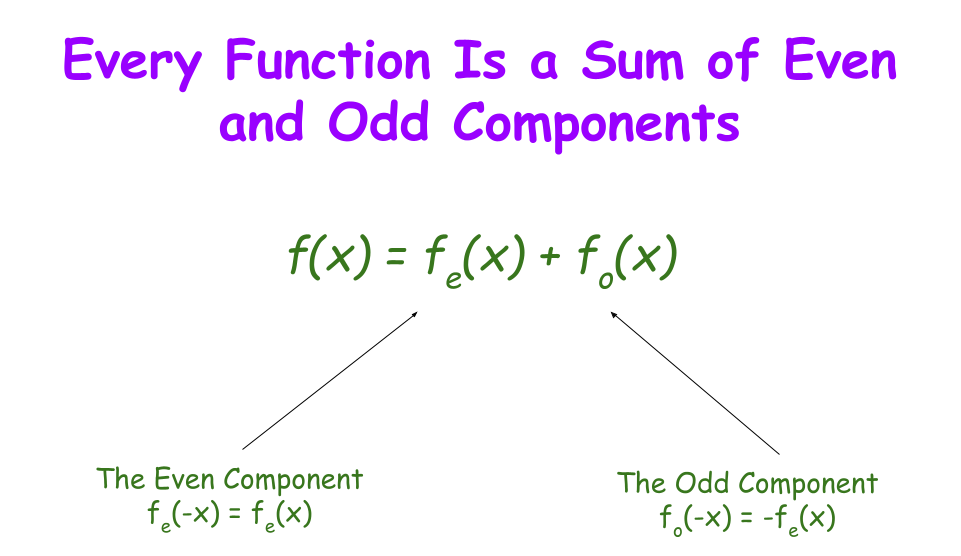
Some functions are even and some are odd, but most functions are not fortunate to have one or both of these properties. However, we can decompose a function into an "even part" and an "odd part." Consider a function , and we will write it as the sum of an even function and an odd function. Define
and we must show two things. The first is to show that . The second is to show that is an even function and is an odd function. Showing is easy:
On the other hand, showing that is even and is odd are more involved. Recall to show that is even, we must show that for each real number . This requires using the definition of :
In a similar vein, showing that is odd is basically the same procedure, except the negative signs pop up in different places.
In summary, we have shown that every real function can be written as the sum of an even function and an odd function.
Looking Further
This concept seems a little out of place right now, but it will come in handy in the future. For example, you will encounter odd functions when learning about the Fourier series. The Fourier transform of an even part of a function is even, while the Fourier transform of an odd part of a function is imaginary. Don't worry - you will learn more about this later!
When you learn more about real and imaginary spaces, you will also learn about how even and odd functions interact with vector spaces.