Exocytosis (Active Transport) — Definition & Examples

Illustrated · 2 min

What Is Exocytosis?

Exocytosis is a form of active transport. This means that it requires energy to occur. It doesn't just happen on its own.

The best way to remember what exocytosis means is to break the word down. Cyto means having to do with cells, and exo means outside. Think of it as the reverse of endocytosis.

So, this type of transport involves sending stuff to areas outside the cell (the extracellular matrix). This "stuff" is generally too large to cross the cell membrane on its own.

Exocytosis

Image source: By OpenStax CC BY 4.0, via Wikimedia Commons

How Does It Work?

First, the cell bundles up the things it's going to send out in a little package called a vesicle. This is sometimes also referred to as a vacuole.

Vesicles are made of the same material as the cell membrane: a double layer (bilayer) of phospholipids.

The cell membrane is a fluid membrane; it's not stiff or rigid. In fact, pieces can be pinched off or added in, and no harm is done.

Diagram showing the steps of exocytosis

Image source: By すじにくシチュー [CC0], via Wikimedia Commons

The image above shows the basic process of how materials leave the cell.

The membrane-bound transport vesicle is sent towards the cell membrane on strands and tubules that make up the cell's cytoskeleton. Think of the vesicle as a train car and the cytoskeleton (a network of fibers inside the cell) as the tracks.
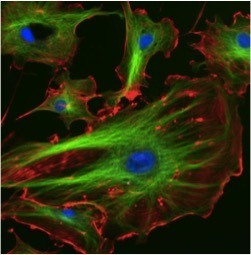
Cytoskeletons chemically dyed green

The cytoskeletons of these cells are shown in green. Notice how the cytoskeleton reaches to all corners of the cell. It's perfect for bringing a vesicle towards the cell membrane.

Image source: By AJC1 CC BY-SA 2.0 via flickr.com

Vesicle Fusion

Once the vesicle reaches the cell membrane, they fuse together. The phospholipids that made up the vesicle membrane are absorbed and added into the chain of phospholipids that make up the cell membrane.

Through this process, the vesicle releases its contents into the extracellular space (the area outside the cell). Although you might think of this material as being waste product, that's not always the case. Different cell types can release different materials. For example, nerve cells use something called synaptic vesicles to release neurotransmitters for cellular communication.

Key Vocabulary:

  1. Active transport
  2. Vesicle
  3. Cell membrane
  4. Cytoskeleton

Illustrated · 1 min

Sending Material Out of the Cell

Exocytosis is when a cell uses secretory vesicles to expel materials or transport large molecules to the exterior of the cell. Many large molecules are polar and too big to pass out of the cell. The cell packages any large molecule it wants to transport out of the cell into a vesicle. The vesicle then fuses with the plasma membrane and pushes the particles out of the cell into the extracellular fluid.

Exocytosis is moving things out of the cell.

Image source: By GrahamColm at English Wikipedia CC BY-SA 3.0, via Wikimedia Commons

Illustrated · 2 min

Removing Waste from the Cell

Exocytosis is the process of transporting materials out of the cell in vesicles. It's how cells get rid of their trash and waste material. It is a kind of active transport, so it requires energy input in the form of ATP.

Exocytosis is the movement of materials out of the cell.

Image source: By OpenStax CC BY 4.0, via Wikimedia Commons

Let's break down the word since it might make it easier to remember. The prefix exo- means out of, away from, or outer. The middle part, -cyto- means cell, while the suffix -sis means the process of doing something. So, exocytosis is the process of transporting things out of the cell.

The whole process begins in the Golgi apparatus (also called Golgi body), where macromolecules and waste material are packaged into vesicles. These transport vesicles move to the cell membrane and then fuse with it.

The lipid bilayer rearranges until there is a hole (facing the outside of the cell) that is large enough for the material or waste to fit through. The contents of the vesicle are spilled out of the cell and the hole closes.

Why Use Exocytosis?

There are two main reasons a cell wants to do this:

  • Waste Removal: There are many processes going on in the cell at any given moment. While these processes are necessary to life, they can produce waste in the process. The purpose of exocytosis is to remove molecules and particles in the cell that may cause harm if they were to remain inside the cell. You can think of this as a kind of garbage disposal.

  • Cellular Communication: A large part of the functioning of both multicellular and unicellular organisms is communication between cells. Cells need to communicate in order to maintain the overall internal environment. The cell may produce signaling molecules that it will then send to neighboring cells.

An example of this in human cells is neurons, which are the brain signaling cells. Neurons produce a type of signaling molecule called a neurotransmitter, which they release through exocytosis. They signal the next neuron to send a signal on to the next neuron, and so on.

Vocabulary Review:\color{#8925AE}{\text{Vocabulary Review:}}

Plasma Membrane\color{#8925AE}{\text{Plasma Membrane}} : A semi-permeable phospholipid bilayer

Active Transport\color{#8925AE}{\text{Active Transport}} : Moving materials across the cell membrane. It requires energy

Pumps\color{#8925AE}{\text{Pumps}} : Proteins embedded in the plasma membrane that only allow specific materials to pass through

Endocytosis\color{#8925AE}{\text{Endocytosis}} : A cell surrounds and takes in materials from its environment. Three types include phagocytosis, pinocytosis, and receptor-mediated endocytosis

Exocytosis\color{#8925AE}{\text{Exocytosis}} : How a cell gets rid of waste

Diffusion\color{#8925AE}{\text{Diffusion}} : The movement of particles from areas of high concentration to areas of low concentration

Facilitated Diffusion\color{#8925AE}{\text{Facilitated Diffusion}} : The movement of particles from areas of high to low concentration with the help of membrane proteins

Passive Transport\color{#8925AE}{\text{Passive Transport}} : The movement of particles across the membrane with no help from the cell

Video

(Video) Active Transport

by Teacher's Pet

If cells take things in, they have to let things out too. This video discusses exocytosis, the type of active transport that takes substances out of the cell into the extracellular environment.

Type a concept, like “slope” or “photosynthesis”.

↑ ↓ to choose · Enter to openSearch explanations and problems


