
Illustrated · 2 min
+4 contributors




What Is Exocytosis?
Exocytosis is a form of active transport. This means that it requires energy to occur. It doesn't just happen on its own.
The best way to remember what exocytosis means is to break the word down. Cyto means having to do with cells, and exo means outside. Think of it as the reverse of endocytosis.
So, this type of transport involves sending stuff to areas outside the cell (the extracellular matrix). This "stuff" is generally too large to cross the cell membrane on its own.

Image source: By OpenStax CC BY 4.0, via Wikimedia Commons
How Does It Work?
First, the cell bundles up the things it's going to send out in a little package called a vesicle. This is sometimes also referred to as a vacuole.
Vesicles are made of the same material as the cell membrane: a double layer (bilayer) of phospholipids.
The cell membrane is a fluid membrane; it's not stiff or rigid. In fact, pieces can be pinched off or added in, and no harm is done.

Image source: By すじにくシチュー [CC0], via Wikimedia Commons
The image above shows the basic process of how materials leave the cell.
The membrane-bound transport vesicle is sent towards the cell membrane on strands and tubules that make up the cell's cytoskeleton. Think of the vesicle as a train car and the cytoskeleton (a network of fibers inside the cell) as the tracks.
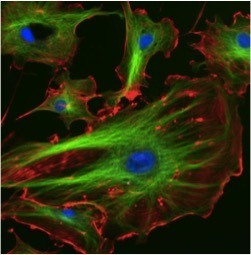
The cytoskeletons of these cells are shown in green. Notice how the cytoskeleton reaches to all corners of the cell. It's perfect for bringing a vesicle towards the cell membrane.
Image source: By AJC1 CC BY-SA 2.0 via flickr.com
Vesicle Fusion
Once the vesicle reaches the cell membrane, they fuse together. The phospholipids that made up the vesicle membrane are absorbed and added into the chain of phospholipids that make up the cell membrane.
Through this process, the vesicle releases its contents into the extracellular space (the area outside the cell). Although you might think of this material as being waste product, that's not always the case. Different cell types can release different materials. For example, nerve cells use something called synaptic vesicles to release neurotransmitters for cellular communication.
Key Vocabulary:
- Active transport
- Vesicle
- Cell membrane
- Cytoskeleton




