Factorial notation allows us to represent a number as the product of a sequence of numbers and factorials are denoted using the exclamation mark (i.e. !)
For example, 5!=1⋅2⋅3⋅4⋅5=120
There are a few things to remember when expanding or simplifying factorials:
0!=1
Factorials cannot be added or multiplied
Terms cancel
Let's think about what it means that factorials cannot be added or mutiplied. This means that if we have 3! + 2!, this does not equal 5!=1⋅2⋅3⋅4⋅5=120. Instead, to solve this we would have to calculate each factorial separately and then add their values together.
Doing this, 3!+2!=(1⋅2⋅3)+(1⋅2)=8
This same principle applies to multiplication: 3!⋅2!=6!=720
Correctly, 3!⋅2!=(1⋅2⋅3)⋅(1⋅2)=6
When dividing, however, it can be useful to remember that terms cancel.
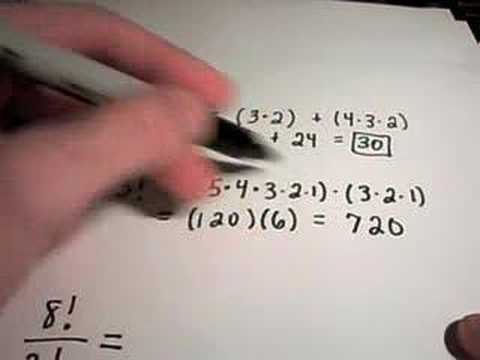
For instance, if we have 6!10! we can simply by canceling out the common terms:
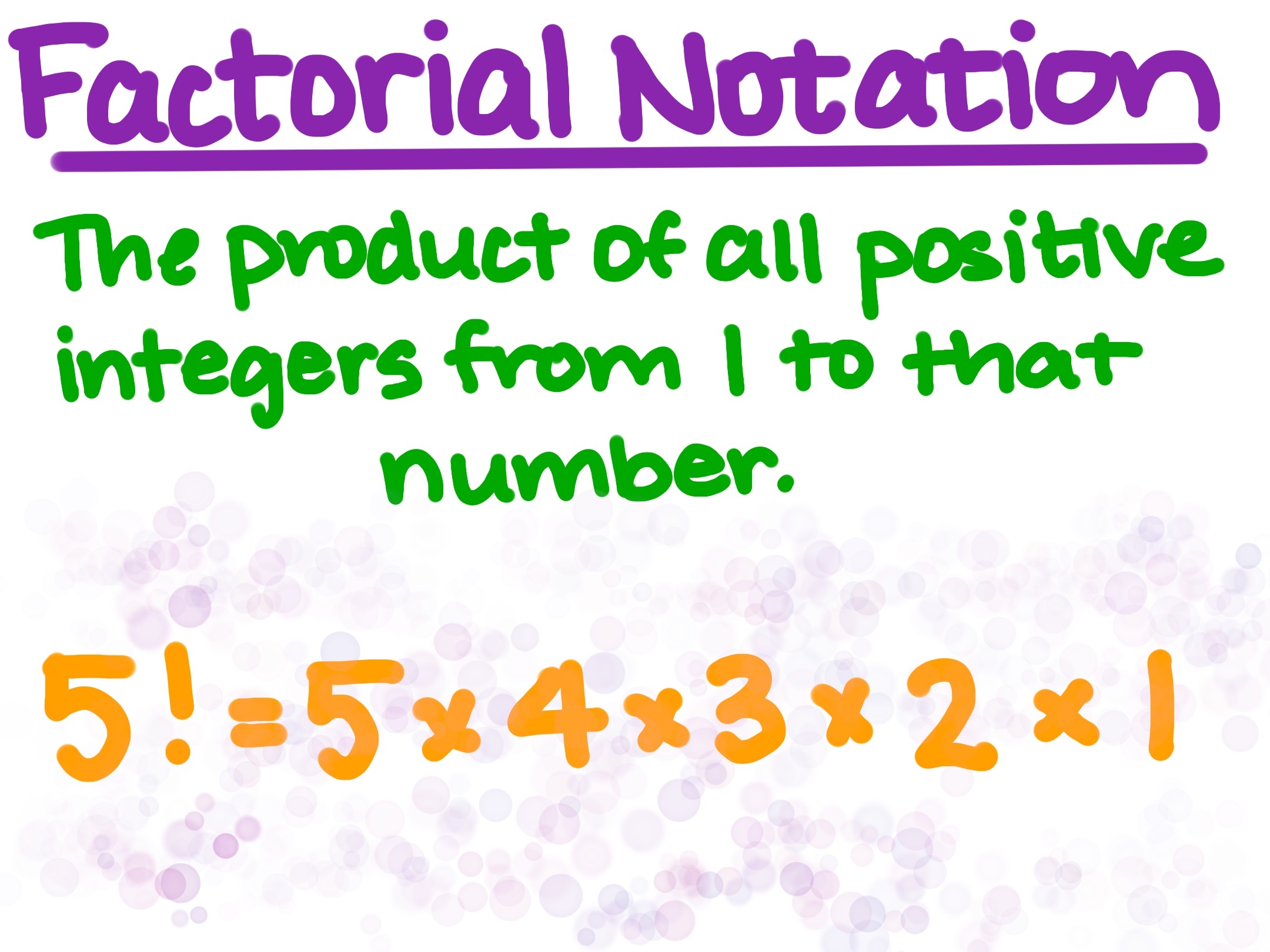
A factorial is a mathematical operation that involves multiplying a number by every whole number smaller than it, down to 1. We write it with an exclamation mark.
Image source: by Anusha Rahman
As we can see in the above example, 5! (read as "five factorial") means you multiply 5x4x3x2x1, which equals 120.
So, 5!=120.
This rule will hold for any positive integer. 0 has its own rule, though. By definition, 0! is always 1. This may seem strange, but it helps make certain math formulas work consistently. Factorials are useful in many areas of math, like counting, probability, and algebra.
Here is the mathematical rule for factorials:
n!=n⋅(n−1)⋅(n−2)⋅....⋅1
This means that for any number n, you keep multiplying it by all the smaller numbers until you reach 1.
Factorials grow very quickly as the number gets larger. For example 6!=720. The more you multiply, the bigger the number gets. That's why factorials are helpful in calculating large combinations or arrangements.
Factorials are also used in the binomial theorem. The binomial theorem helps us expand expressions like (a+b)n, and factorials are used to calculate the coefficients in the expansion. For example, when expanding (a+b)3, we use the binomial coefficients, which are found using factorials. These coefficients tell us how much of each term (like a3, a2, ab2) should appear in the expanded form. This is where factorials come into play, as they are part of the formula for finding these coefficients.
Once you master this topic, get ready to learn about Pascal's Triangle!