Read · 3 min

In contrast to observational research, we have experimental research!
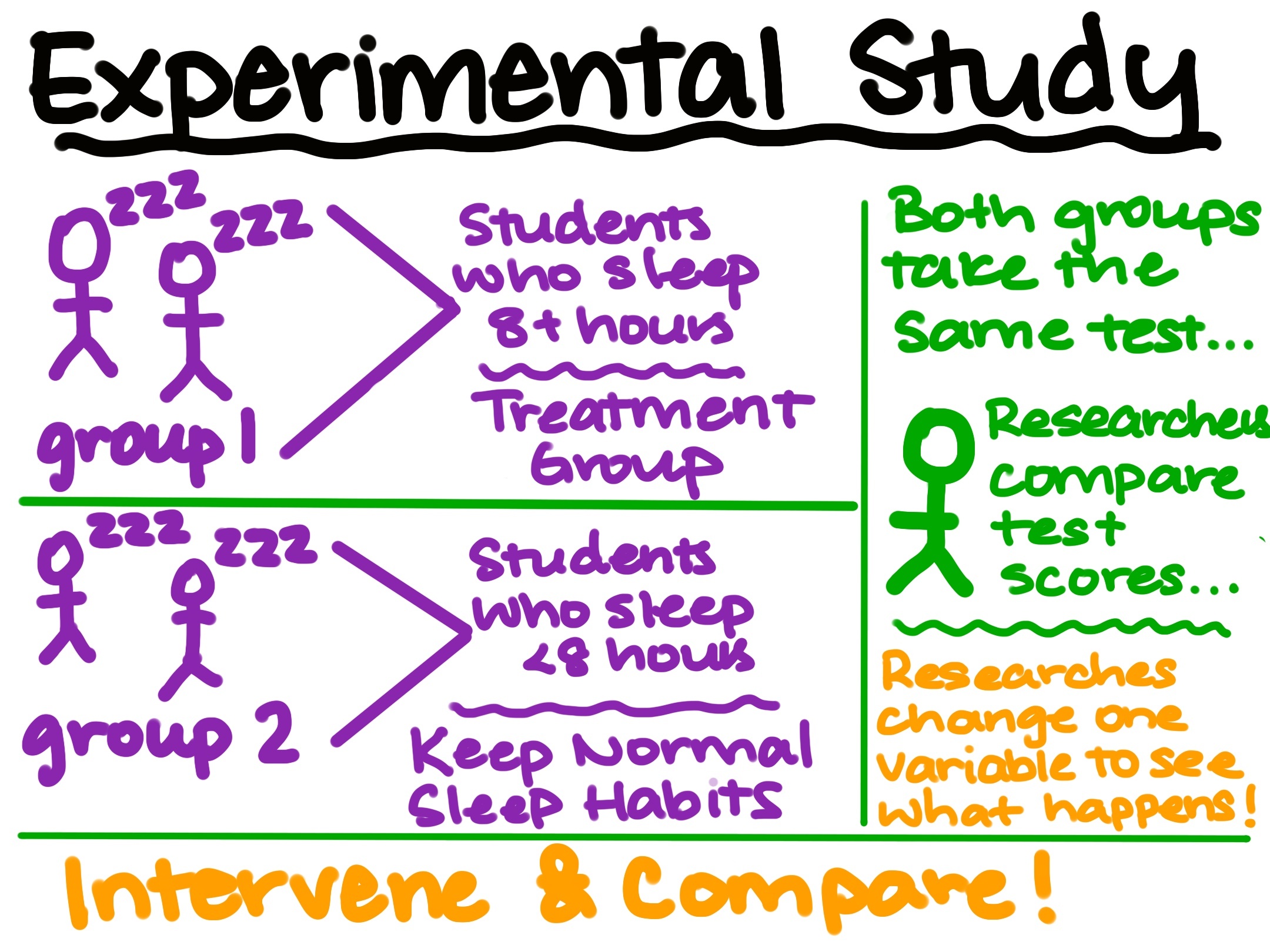
Kabir wants to test the effect that spicy food has on people sweating. To do that, he randomly assigned people to either a low spicy group or high spicy group. He will then feed all participants with a bowl of soup, either low spice or high spice. After the participants eat the soup, he will measure how sweaty their foreheads become.
This is an example of an experimental study!
Experimental Research
The overarching goal of experimental research is to establish a causal relationship between two factors. In the soup example given above, Kabir is looking for the casual relationship between spicy food causing an increase in people sweating.
There are some requisites for experimental research:
-
Independent and dependent variables: you manipulate the independent variable (IV) in order to see the effect on the dependent variable (DV). There is typically a control group where no IV happens to them
-
Constants: the factors in an experiment that don't change
-
Hypothesis: your educated guess as to what the relationship between two variables will be
Let's talk through an example.
Example
You want to understand the relationship between drinking hot chocolate and sleep time. You randomly select college-aged students to be a part of your experiment. You randomly assign of them to drinking one cup of hot chocolate before going to bed, and you randomly assign the other to not drinking anything before going to bed. Everyone sleeps in the same room, and they all eat the same meal before bed. You predict that the group that drinks hot chocolate will sleep later.
-
Independent variable: drinking hot chocolate or not before bed
-
Dependent variable: sleep time
-
Constant: room they sleep in, meal before bed
-
Hypothesis: he group that drinks hot chocolate will sleep later than the group that doesn't drink hot chocolate before bed
Using statistical analysis on the collected data, you find that your hypothesis is supported! The group that drank hot chocolate ended up sleeping later than the group that didn't.
Because you saw that those drinking hot chocolate sleep later, you can establish a causal (cause-and-effect) relationship between drinking hot chocolate before bed (IV) and sleep time (DV).
Levels of IV
We can make this concept a little more complex by adding levels of IV. Sometimes, we want to test a variable, but we want to understand just how much of that variable will cause a change in the dependent variable.
Let's go back to the previous example. You found out that drinking hot chocolate before bed causes people to sleep later. But now you're curious just how much hot chocolate you need to drink before your sleep is affected. You decide to run this new experiment on a sample of . You give participants of hot chocolate, participants get of hot chocolate, participants get , and participants get no hot chocolate.
Your levels of IV:
-
-
-
-
No hot chocolate
You find that the groups that drank of hot chocolate or no hot chocolate slept at the same time. The group that drank slept one hour earlier than the group that slept .
There is a difference between the levels of IV! Turns out that hot chocolate itself doesn't cause people to sleep later.
Studies involving experimental research are often what we typically think of when we think of research. Understanding experimental design is fundamental for your further career in science and statistics!