This video by PatrickJMT covers formulas to find the nth term of a sequence.
Summary
The general formula for the nth term of a geometric sequence is:
an=a1⋅rn−1
where a1=first term and r=common ratio.
How?
To show we got this formula, let's look at a sequence:
3,6,12,24,48,⋯
First off, we know it's a geometric sequence because each term is multiplied by 2 to get to the next term. Since each term is just being multiplied by 2 again, we can rewrite our terms as:
a1a2a3a4a5=3=3⋅2=3⋅2⋅2=3⋅2⋅2⋅2=3⋅2⋅2⋅2⋅2⋯
We can even combine like terms and simplify more.
a1a2a3a4a5=3=3⋅2=3⋅22=3⋅23=3⋅24⋯
So the nth term in this sequence would be, following this pattern:
an=3⋅2n−1
Since we know that our first term is 3 and our common ratio is 2, we can write our general formula from above.
an=a1⋅rn−1
Using the Formula
Suppose we now want to find the tenth term in the sequence:
3,6,12,24,48,⋯
We can use the formula we found and plug in n=10.
ana10a10a10a10=3⋅2n−1=3⋅210−1=3⋅29=3⋅512=1536
A Harder Problem
If a2=32 and a5=−4, find a9.
First, we want to find how many terms are between the two we're given. We have the 5th term and the 2nd term. So there's,
5−2=3,
spaces between them.
We know the 5th term will equal the 2nd term multiplied by 3 powers of whatever the common ratio is. In other words,
a5=a2⋅r3
Since we know the values of a5 and a2, we can solve for the common ratio, r.
a5−4−813−813−81−21=a2⋅r3=32⋅r3=r3=r=r=r
Next, we want to find a9. We're going to use the same method. Take either of the terms given and see how many spaces are between it and a9. I'm going to choose a5.
9−5=4
There's 4 spaces which means you multiply 4 times by the common ratio to get from a5 to a9. We can set up another equation with these two and solve for a9.
a9a9a9a9a9=a5⋅r4=−4⋅(−21)4=−4⋅(−2)41=−4⋅161=−41
Writing out the sequence takes up a lot of space and requires people to figure out the pattern. There are better, more concise ways to represent a geometric sequences.
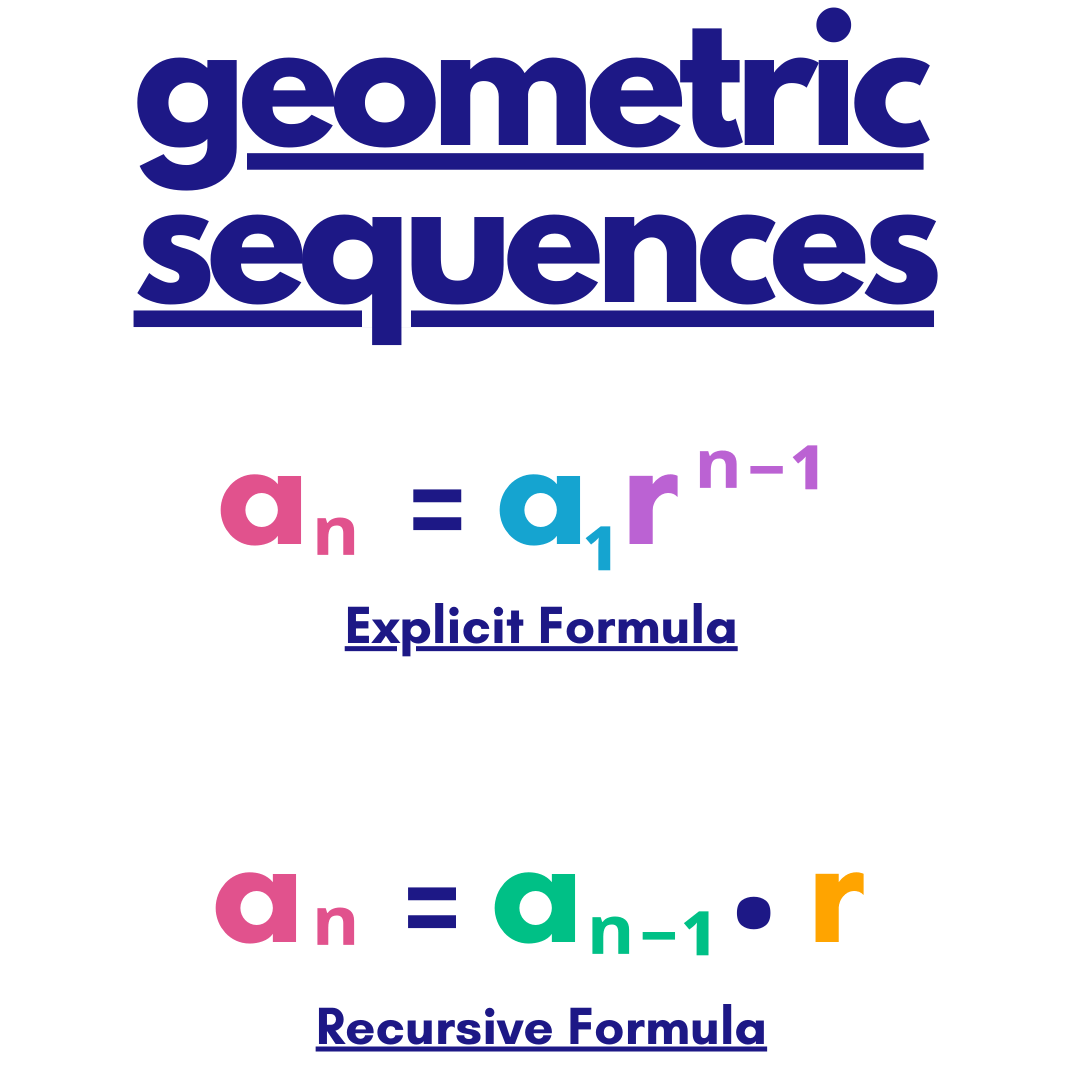
Explicit Formulas
Image source: by Christine
In explicit formulas, if you want to figure out what the nth term of a geometric sequence is, you only need the initial term and the common ratio.
Image source: by Christine
Recursive Formulas
Image source: by Christine
In recursive formulas, if you want to figure out what the nth term of a geometric sequence is, you need the initial term, the common ratio and the term before the desired term.
Image source: by Christine
Here is another graphic outlining what we have learned!
Image source: By Caroline Kulczycky
Try it!
To get a better sense of both formulas work, apply it to the following sequence.
2,4,6,8,10...
This sequence starts with 2 and has a common ratio of 2.
What is the 9th term of this sequence?
Try to answer this question by:
Using the explicit formula
Using the recursive formula
Writing of the sequence and check what the 9th term is
An example of a recursive formula for a geometric sequence is
bn=3×bn−1
because bn is written in terms of an earlier element in the sequence, in this case bn−1. We often want to find an explicit formula for bn, which is a formula for which bn−1,bn−2,…,b1,b0 don't appear. To do this, it's easiest to plug our recursive formula into a Python program:
Image by Joshua Siktar
Now we find b(n) for the values n=0,1,2...,20 (we could keep going if we wanted but there's no need):
Image by Joshua Siktar
To get to b(n), we multiply b(0) by 3 a total of n times, which produces a factor of 3n. This means our explicit formula is
b(n)=11×3n.
This pattern is much more clear because we listed out a bunch of terms first.