Exponent Product Rule — Definition & Examples

Video

(Video) Product Rule for Exponents

by mathman1024

Here's a video by mathman1024 explaining the product rule.

Summary\large{\text{Summary}}

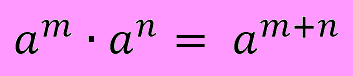
The product rule for exponents states: xa⋅xb=xa+bx^a\cdot x^b=x^{a+b}

We're going to focus on the rule when aa and bb are natural numbers.

To see why, let's look at the example x2⋅x3x^2\cdot x^3. If we expand these we see

x2⋅x3=(x⋅x)⋅(x⋅x⋅x)x^2\cdot x^3=(x\cdot x)\cdot(x\cdot x\cdot x)

The first term has two factors of xx and the second term has three factors of xx. When we multiply these two we see there are now five factors of xx.

x2⋅x3=(x⋅x)⋅(x⋅x⋅x)=x⋅x⋅x⋅x⋅x=x5\begin{align}x^2\cdot x^3&=(x\cdot x)\cdot(x\cdot x\cdot x)\\ &=x\cdot x\cdot x\cdot x\cdot x\\ &=x^5 \end{align}

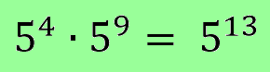
So this rule tells us that if we multiply two exponents with the same base then we just add the exponents together.

Let's try another example: x5⋅x8x^5\cdot x^8. x5⋅x8=x5+8=x13\begin{align} x^5\cdot x^8&=x^{5+8}\\ &=x^{13} \end{align}

Try these other examples on your own and then watch the video to see if you get the same answers. Notice that this rule applies for variables and for numbers.

  1. x15⋅x10x^{15}\cdot x^{10}
  2. x43⋅x54x^{43}\cdot x^{54}
  3. 37⋅343^7\cdot3^4
  4. x14y5⋅x11y9x^{14}y^5\cdot x^{11}y^9

Interactive · 6 questions

Adding Exponents

Let's be honest—exponents are little tiny numbers that can cause enormous headaches if you don't know how to handle them.

The good news is that there are a few simple rules we can follow that help turn exponents into nothing more than cute mini-numbers sitting on the shoulders of their regular-sized friends.

Let's quickly summarize the parts of an exponential function before we move on. Take a look at this picture:

y^3
y is the base
3 is the exponent

Consider this expression: 535^3

What is the base?

Choose one answer

Video

(Video) Basic Exponent Properties

by PatrickJMT

This video by PatrickJMT explains the basic properties of exponents. Recall that an exponent is just a shorthand way of referring to repeated multiplication. 53=5⋅5⋅5=1255^3=5\cdot5\cdot5=125

Summary\large{\text{Summary}}

Product Rule

The product rule says that if we have exponents with the same base being multiplied, then we can just add the exponents together. am⋅an=am+n\boxed{a^m\cdot a^n=a^{m+n}}

For example, suppose we wanted to simplify 34⋅323^4\cdot3^2. Our rule tells us: 34⋅32=34+2=363^4\cdot3^2=3^{4+2}=3^6 And to prove this we can write out the multiplication. 34⋅32=(3⋅3⋅3⋅3)⋅(3⋅3)=3⋅3⋅3⋅3⋅3⋅3=36\begin{align} 3^4\cdot3^2&=(3\cdot3\cdot3\cdot3)\cdot(3\cdot3)\\ &=3\cdot3\cdot3\cdot3\cdot3\cdot3\\ &=3^6 \end{align}

This rule is not to be confused with the power rule. In that exponent rule, we multiply powers together, rather than add them.

Type a concept, like “slope” or “photosynthesis”.

↑ ↓ to choose · Enter to openSearch explanations and problems