
Interactive · 4 questions
As you may have already learned, represents area under the graph of the Cartesian equation on the interval . But what if the graph is defined by a set of parametric equations of the form
The area under this parametric curve to the -axis on the interval is given by
Thus, it is possible that the lower limit is larger than the upper limit. Do not get terrified when you see this, it is perfectly normal.
To make your life easier, here is the derivation of the formula above (the limits are omitted)
Now let us try an example. We want to find the area bounded by the curve and , the -axis and the lines and and we do not feel like to find the corresponding Cartesian equation (if you want, you can do it as an exercise, but most of the time, finding the Cartesian equations are just nightmares). By the way, you may wish to look at the graph below as a reference.
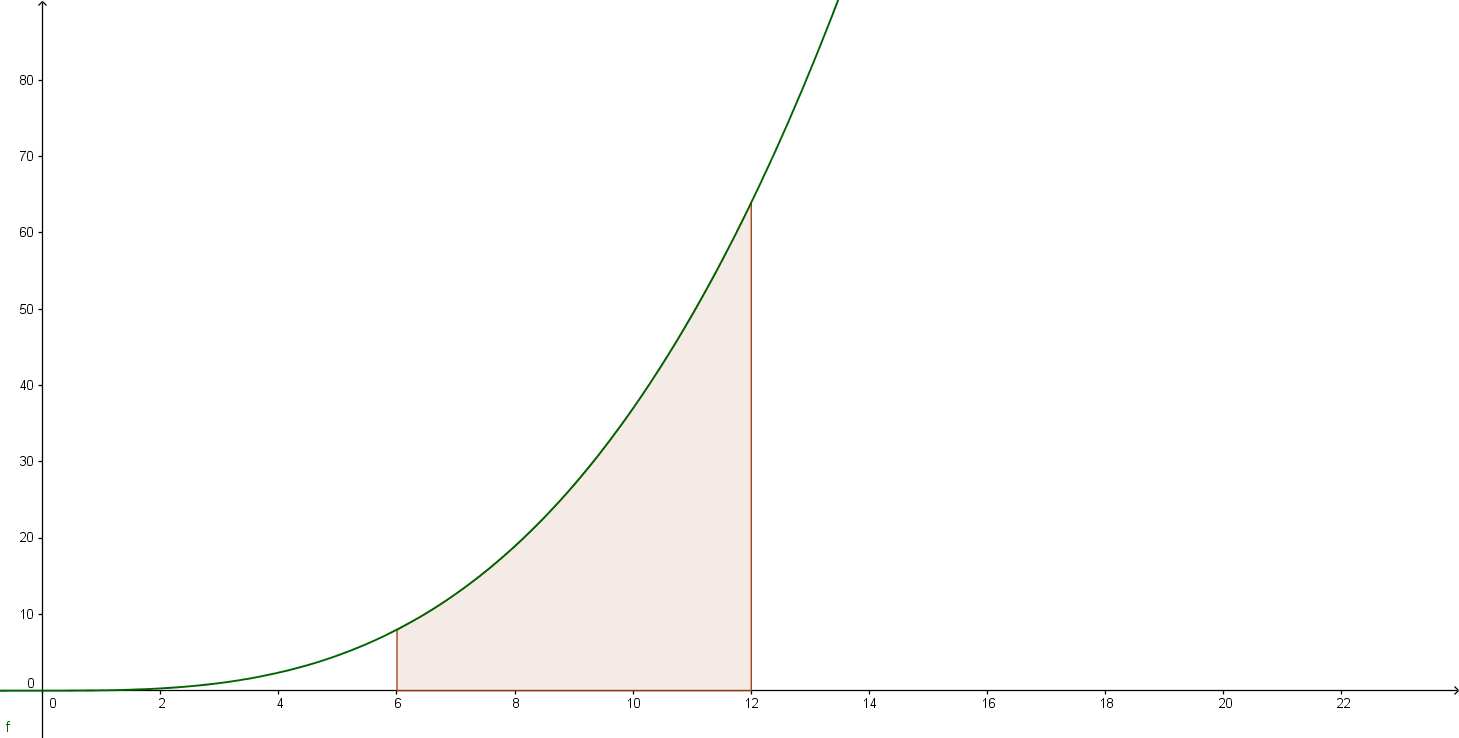
Graph of
Now, let us construct the necessary integral for us to compute the integral.
Fill in the blanks (the first answer represents the top blank and the second answer represents the bottom blank).
With that, we are now ready to evaluate the integral.
Again, fill in the blanks. Separate your answers with a space. For exponents, use caret (^) symbol.
Great! We are done. But you may have noticed that we only evaluate the integral on -axis. What about -axis? Think about it, and fill in the blanks below (limits are omitted).
Good! With that in mind, shall we try another example? Say we want to find the area bounded by the parametric curve and the -axis, and we do not want to find the Cartesian equation, and we want to integrate it with respect to -axis (You can integrate it with respect to -axis as an exercise). For your reference, here's the graph of the equations.
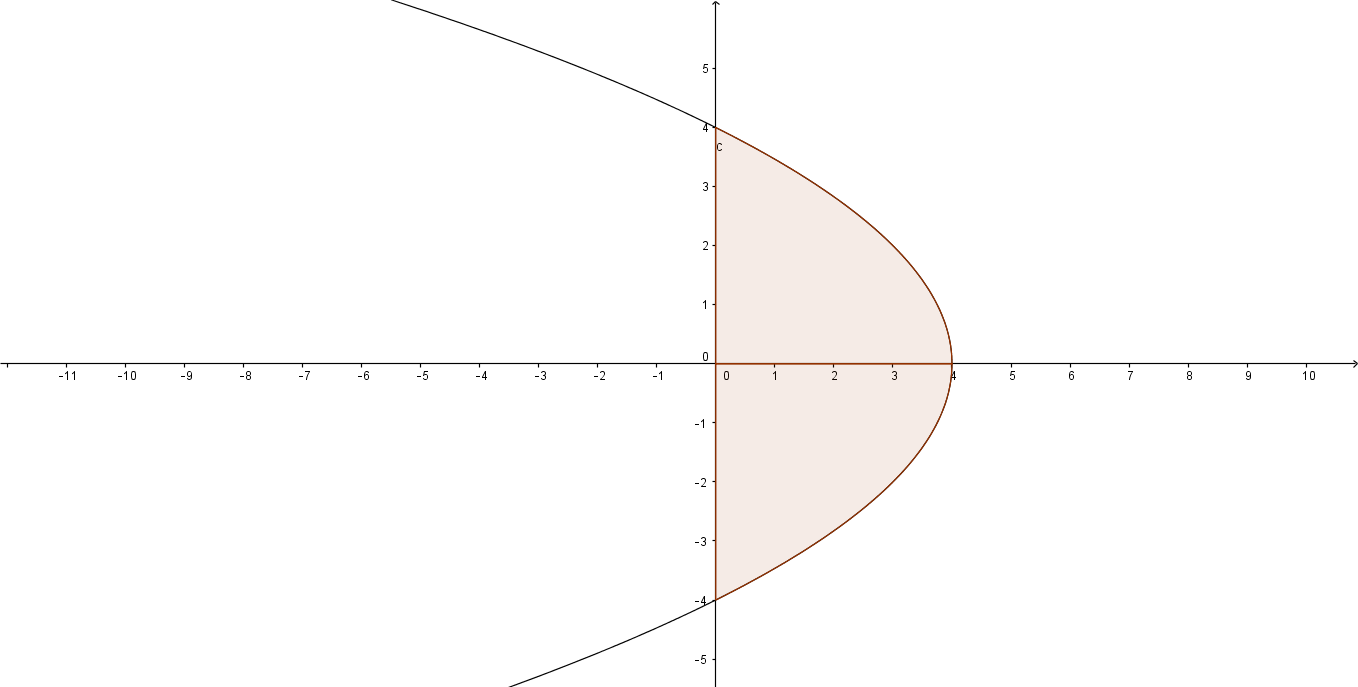
Graph of
Just like the previous example, we need to construct the necessary integral for us to obtain the interested area.
Fill in the blanks (the first answer represents the top blank and the second answer represents the bottom blank).
Now, with that in mind, the evaluation of the integral is left as an exercise to the reader. In case you are wondering , the final answer is