Interactive · 5 questions
Now that we understand continuity reasonably well, let's try to look at limits.
The idea of a "limit" essentially means "getting really close". For functions that are continuous at a point, the limit at that point is very easy: it's the same as the function's actual value.
What is the limit of at ?
If that's all there were to it, the idea of a limit would be really boring. But we can study the limit of certain functions that aren't continuous at a point. Particularly, they can have a limit when they're not defined.
The value of a two-sided limit is just the value the function would have at that point in order to be continuous.
In particular, the limit does not depend on what the function's value actually is at that point.
What is the limit of at ?
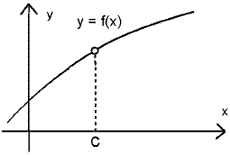
Looking at the graph may make it easier to understand. If we ignore the dot at itself, which is how limits work, we can observe that the function gets really close to when .
You may complain that this function is also boring --- why not just simplify it to ? But some functions don't allow that.
What is the limit of at ?
The graph looks like this:
This function is more interesting because, even though we can't easily simplify it to avoid the division by zero, there's a value we can define it to have at zero that makes it continuous. That's the limit!
Of course, not all functions have limits.
What is the limit of at ?
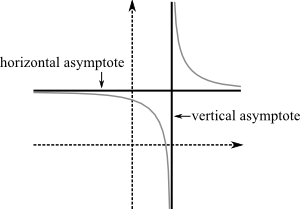
If we look at the plot again, we can maybe see why. The function becomes infinitely large. No value we could assign to the function at could make it continuous, because the function would just go right past it.
Here's another example.
What is the limit of at ?
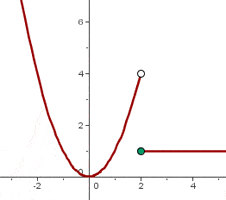
The plot looks like this:
Here, even though the function stays reasonably small, there's a "gap" between the left part and the right part that a single value couldn't possibly bridge to make it continuous, Therefore, the limit at 0 is not defined.
(However, the limits on one side are defined. We'll look at this more later.)
Having gone through all this, it's time to try writing down a definition for the two-sided limit.
It's actually very similar to the definition for continuity. Try writing down a definition.
We can replace a few expressions in our definition of continuity to create this:
Definition? The limit of a function at is a value such that, for all , we can find a number such that is within of for all values of within of .
But this definition misses one of the most important parts of the limit. Can you see what it is?
This definition actually involves the value of itself, because is certainly within of for any . So we have to patch that as follows:
Definition: The limit of a function at is a value such that, for all , we can find a number such that is within of for all values of within of but not equal to itself.
That is the definition of the two-sided limit. It is also written .