Facilitated Diffusion — Definition & Types

Illustrated · 1 min

What Is Facilitated Diffusion?

Facilitated diffusion is a type of passive transport. Molecules that are polar or too big to diffuse across the plasma membrane using simple diffusion need extra help getting into or out of the cell. Transport proteins embedded in the plasma membrane allow these molecules or ions to get across the cell membrane. In other words, they help facilitate their movement.

This process is spontaneous. Molecules naturally "want" to go from areas of high concentration to areas of low concentration. But sometimes the molecules need some extra help to get past the cell membrane. That's where transport proteins in the membrane come in:

This is a cartoon explaining facilitated diffusion. The image shows a lipid bilayer with proteins inside of it. On one side of the membrane there is a high concentration of molecules. On the other side there are very few molecules. The two types of transport proteins, channel and carrier, are shown. Molecules are diffusing through them down their concentration gradient. This means they are moving from high to low concentration.

Image source: By Sylvia Freeman

There are two types of membrane proteins involved: channel proteins and carrier proteins. Channel proteins are pretty much what they sound like. They allow certain molecules to pass through them in both directions. Carrier proteins bind to specific molecules and let them into or out of the cell.

In active transport, like exocytosis or endocytosis, energy is required to move substances. The transport proteins involved in facilitated diffusion don't need energy. This is because the molecules are spontaneously going down their concentration gradient.

Illustrated · 2 min

Transmembrane Proteins

Facilitated diffusion is a type of passive transport in which substances move across the cell membrane through helper proteins.

Because it is a form of passive transport, it requires no energy to occur. In diffusion, substances move from areas of high concentration to areas of low concentration.

Substances diffuse from high concentration to low concentration.

Image source: By Gabi Slizewska

Recall that the cell membrane is semi-permeable. This means that only some things are allowed to pass through it.

Let's take a quick look at the structure of the cell membrane. This will help explain why some substance movement doesn't require energy:

The cell membrane is a phospholipid bilayer. It is made of two layers of phospholipids. Each one has a hydrophilic part and a hydrophobic part.

Image source: By Gabi Slizewska

The cell membrane is made of a bilayer of phospholipids. Each one has a hydrophilic (water-loving, polar) head and a hydrophobic (water-hating, non-polar) tail.

Substances that can move through the membrane without assistance include water, small non-polar molecules like oxygen (O2O_2) and carbon dioxide (CO2CO_2), and other small, uncharged polar molecules.

Substances that require help diffusing through the cell membrane are larger, polar, and usually charged. The polar and charged molecules are unable to pass through the hydrophobic phospholipid tails. Some examples are ions, amino acids, and carbohydrates.

Transporting Molecules Across the Membrane

In order to get across the cell membrane, these substances need a little help from some friends.

These "friends" come in the form of two types of transmembrane proteins that go from one side of the cell membrane to the other.

Channel proteins are open in the center and can have gates. Carrier proteins change their shape to allow molecules to pass through.

Image source: By Gabi Slizewska

Concentration Gradients

Both of these methods of transport require a concentration gradient. This is just a difference in concentration of substances on each side of the membrane.

Because facilitated diffusion is a type of passive transport, the substances will move from the side of the area with a higher concentration to the side with a lower concentration until dynamic equilibrium is reached. This is different from active transport, which uses pumps and other structures to move substances against their gradient.

Key Vocabulary:

  1. Passive transport
  2. Channel protein
  3. Carrier protein
  4. Cell membrane
  5. Semi-permeable
  6. Phospholipid
  7. Transmembrane
  8. Hydrophobic
  9. Hydrophilic

Video

(Video) Facilitated Diffusion | Membranes and Transport

by Khan Academy

In this video, you will learn all about the process of facilitated diffusion. You will also learn why some molecules use it instead of other forms of transport.

Which of these is an example of facilitated diffusion?

Choose one answer

Illustrated · 2 min

Transport Proteins

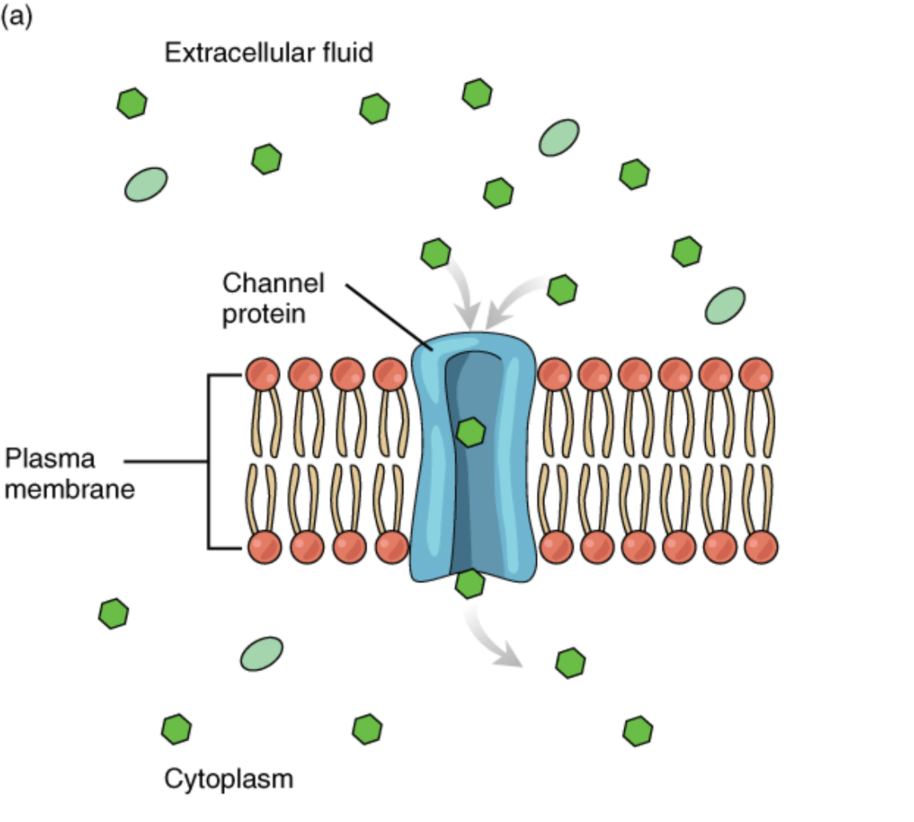
During facilitated transport, molecules that would not be able to pass through the lipid bilayer are allowed through the biological membrane by transport proteins. These proteins are specific to different types of molecules. Some only let sugars into the cell, some let water molecules into the cell, and others only allow specific ions.

These channels work both ways, so if a protein lets glucose into the cell, it also lets it out of the cell.

Facilitated diffusion through the cell membrane.

A protein channel helps molecules pass through the membrane.

Image source: By OpenStax CC BY 4.0, via Wikimedia Commons

No Energy Required

This is a type of passive transport, meaning no energy is needed for the movement to happen. Many molecules can't easily cross the cell membrane. Integral transport proteins, also called carrier proteins, assist by allowing them to pass through the plasma membrane freely. Without the presence of these proteins, the molecules could not pass through the membrane. They would remain at high concentrations outside of the cell. This would be bad for many cells, like red blood cells, which need to absorb glucose from the bloodstream.

The protein channels allow the molecules to diffuse into the cell where they can then be used to carry out cellular functions. This is one form of osmoregulation within the cell. This is also a way that the cell maintains a stable internal environment.

Summary

  1. Facilitated diffusion is a type of passive transport. It does not require energy.

  2. Transport proteins allow solute into or out of the cell.

  3. This still requires a concentration gradient. That is, it only happens when the concentration across a membrane is uneven.

Vocabulary Review:\color{#8925AE}{\text{Vocabulary Review:}}

Plasma Membrane\color{#8925AE}{\text{Plasma Membrane}} : A semi-permeable phospholipid bilayer

Diffusion\color{#8925AE}{\text{Diffusion}} : The movement of particles from areas of high concentration to areas of low concentration

Facilitated Diffusion\color{#8925AE}{\text{Facilitated Diffusion}} : The movement of particles from areas of high to low concentration with the help of a transport protein

Passive Transport\color{#8925AE}{\text{Passive Transport}} : The movement of particles across the membrane with no help from the cell

Illustrated · 2 min

Types of Diffusion

Facilitated diffusion and simple diffusion have a few key similarities, but they also have some key differences. Both help molecules move down their concentration gradient. This means moving from areas of high concentration to areas of low concentration. Both of these processes require no input of energy. However, unlike in facilitated diffusion, molecules in simple diffusion are able to pass directly through the plasma membrane. This is because these molecules tend to be small and uncharged. Examples include carbon dioxide and oxygen.

Why Do We Need Facilitated Diffusion?

Some molecules might be too large or have too strong of a charge to pass through the plasma membrane. In order to pass through, these molecules need the assistance of transmembrane integral proteins. These proteins are embedded throughout the plasma membrane. They control the flow of molecules into and out of the cell to maintain the right environment for the cell to survive.

Types of Protein Channels

There are several forms of facilitated transport. In these forms, you can think of the proteins as transport channels.

  • One example is a channel protein made for the transport of water across the cell membrane. These are called aquaporins. They are one of the most important protein channels for cell survival. Although water molecules are small, they have a slight charge which makes it difficult for water to pass into and out of the cell. Through osmosis, the water will either move into or out of the cell to equalize solute concentration on either side of the membrane. Aquaporins have a very specific size and charge inside of the channel to make sure that only water passes through. This specificity makes it difficult for things that may harm the cells to pass through them.
This image shows a water channel through a cell membrane. It allows water to freely flow through the membrane.

Image source: By OpenStax College CC BY 3.0, via Wikimedia Commons

The other two primary forms of facilitated diffusion are through voltage-gated ion channels and ligand-gated ion channels. While aquaporins are constantly open to allow the passage of water into or out of the cell, these two channels only open under certain conditions.

  • In voltage-gated ion channels, the channel will only open when there is a change in the charge either inside or outside the cell. This especially tends to happen in neurons, which are your brain cells. Charges, like a buildup of sodium ions, occur when cells send messages to one another.

  • Ligand-gated ion channels, on the other hand, only open when another molecule, called a ligand, attaches to the channel and opens it up. After the channel is open, another molecule is then able to move down its concentration gradient.

A ligand-gated ion channel opens and calcium ions pass through the membrane.

When there is no ligand attached to the purple channel, the calcium molecules aren't able to pass through the channel. However, after the ligand attaches to the channel, it opens up. This allows the molecules to pass through and move down their concentration gradient.

Image source: By Bensaccount [Public domain], via Wikimedia Commons

Type a concept, like “slope” or “photosynthesis”.

↑ ↓ to choose · Enter to openSearch explanations and problems