Interactive · 8 questions
+5 contributors




We already know how to factor quadratic expressions with the general form:
Sometimes, though, we're tasked with factoring expressions that look almost quadratic and factorable...but aren't.
Consider this polynomial: . How are we supposed to factor this?
Factoring Out a Monomial First
Many of these "weird" polynomials share a monomial in each term. That monomial gets factored out to give us a nicer polynomial.
However, before we get into that, let's run through a brief refresher on monomials: Which of the items in the following list are monomials?
That's right! Despite looking a little different, these are all monomials.
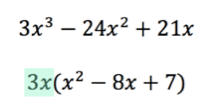
Now, consider our example polynomial from before (i.e. ). Looking out: this polynomial has a cube root!
Which of the following monomials can we factor out of that expression (in other words, which of the following monomials is a factor of each of that expression's terms)?
Right! This is basically the opposite of multiplying a monomial and a polynomial. We can factor the monomial out from our polynomial, which leaves us with an expression consisting of a quadratic that is being multiplied by a single term:
It looks like there are a lot of negative numbers here. Always watch your signs, whether you're working with positive or negative numbers.
We can then finish factoring our expression by factoring the quadratic that it now contains! Which of the following items in the list below represents our polynomial's fully factored form?
You may need to know how to factor with a negative value!
The goal of factoring a non-quadratic is to factor out the greatest common factor. Factoring a monomial is not always necessary. However, it can make difficult polynomials much easier.
Let's go over a few more examples.
Consider the expression . Which of the items in the following list are factors of this polynomial?
Right! All of those items are factors that we could pull out of our polynomial. However, we want to find our polynomial's GREATEST common factor.
Which of these is the greatest common factor of our polynomial ?
Now, suppose that we need to factor the expression . Given that we first want to factor a greatest common factor out of this polynomial, which of the following monomials should we factor out?
Yep! We're left with thexpression after factoring out . We can then factor the quadratic portion of that expression to get our polynomial's fully factored form.
Which of the items listed below represents our polynomial's fully factored form?
Let's tackle one last example: factor .
Remember, if you want to check your work for any of these problems, all you have to do is multiply out all of your factors in the correct answer! You may need to FOIL, square a binomial, or find the product of a sum of difference. Basically, to check your work, you're doing the opposite of what you just did!