Factoring Quadratic ax²+bx+c with ac>0

Before this, knowFactoring Quadratic x²+bx+c with Positive bFactoring Quadratic x²+bx+c Negative b

Interactive · 2 questions

Factoring Quadratics: ax2+bx+c,ac>0ax^2+bx+c, ac>0

Here, we're going to learn factor by grouping of the general form of quadratics!

The first step to factor a polynomial with ac>0ac>0 is to find two numbers that multiply to acac and add to bb. aa is the leading coefficient. Assume we have found dd and ee, where de=acde=ac and d+e=bd+e=b.

We can write the polynomial as ax2+dx+ex+cax^2+dx+ex+c because d+e=bd+e=b. This can be grouped into (ax2+dx)+(ex+c)(ax^2+dx)+(ex+c), and both terms share a common factor. Each grouped term shares a greatest common factor. Factoring out the GCF gives us the expression of two multiplied binomials. This is the factored form of the quadratic.

Example 1:

3x2+10x+33x^2 + 10x + 3

Since 9⋅1=9=3⋅39 ⋅ 1 = 9 = 3 ⋅ 3, and since 9+1=109 + 1 = 10, we can rewrite our polynomial as follows:

3x2+9x+1x+33x^2 + 9x +1x + 3

Now, we factor out greatest common factors from our polynomial's first two terms and from our polynomial's last two terms:

3x(x+3)+1(x+3)3x(x + 3) +1(x + 3)

Finally, we factor the binomial x+3x + 3 out of our expression (note that we are only able to do this because our expression consists of two terms that are both being multiplied by the binomial x+3x + 3):

(3x+1)(x+3)(3x + 1)(x + 3)

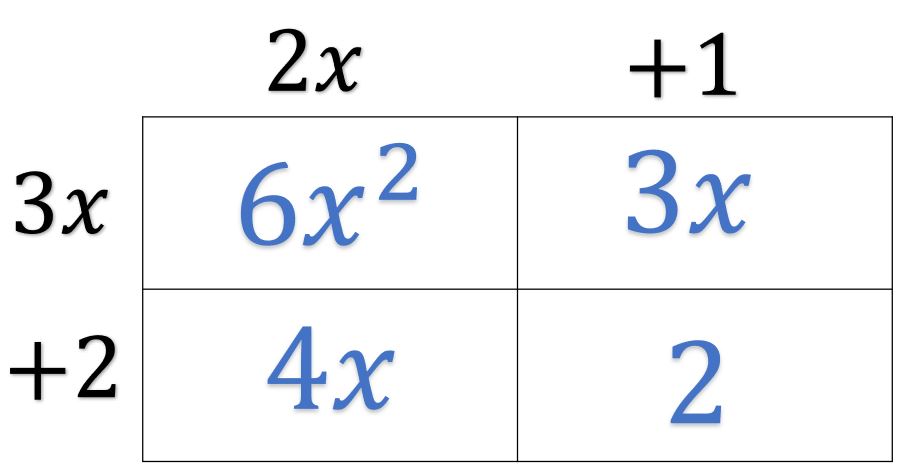
If we want to double check our answer, we can find the product of the two binomials.

Here is a graphic with another example!

Factoring Quadratics in the form ax^2+bx+c with ac>0. Step One: Find d and e such that de=ac and d+e=b. Step Two: Rewrite the quadratic as ax^2+dx+ex+c. Step Three. factor by grouping! Example: Factor 4x^2+12x+5. 4x^2+12x+5 ---> 4x^2+10x+2x+5 ---> 2x(2x+5)+2x+5 ---> 2x(2x+5)+1(2x+5) ---> (2x+1)(2x+5). In this example, d=10 and e=2 since de=10(2)=20=4(5)=ac and d+e=10+2=12=b. All the a's, b's, c's, d's, and e's have their own colors throughout the graphic.

Image source: By Caroline Kulczycky

Test Yourself!

Let's do another problem!

Factor 6x2+11x+36x^2 + 11x + 3

Choose one answer

Illustrated · 1 min

Factoring trinomials algorithmically

This algorithmic method of factoring works the first time every time if you follow the steps in order. Note: if you can first factor out a Greatest Common Factor, do so. This will make the trinomial easier to factor. Then follow these steps.

Example: factor 3x2+20x+123x^{2}+20x+12, where a=3a=3, b=20b=20, and c=12c=12.

  1. Draw a large XX.

  2. In the top portion of the XX, multiply aa and cc to get acac; here, multiply 33 and 1212 to get 3636.

  3. In the bottom portion of the XX, write bb; here, 2020.

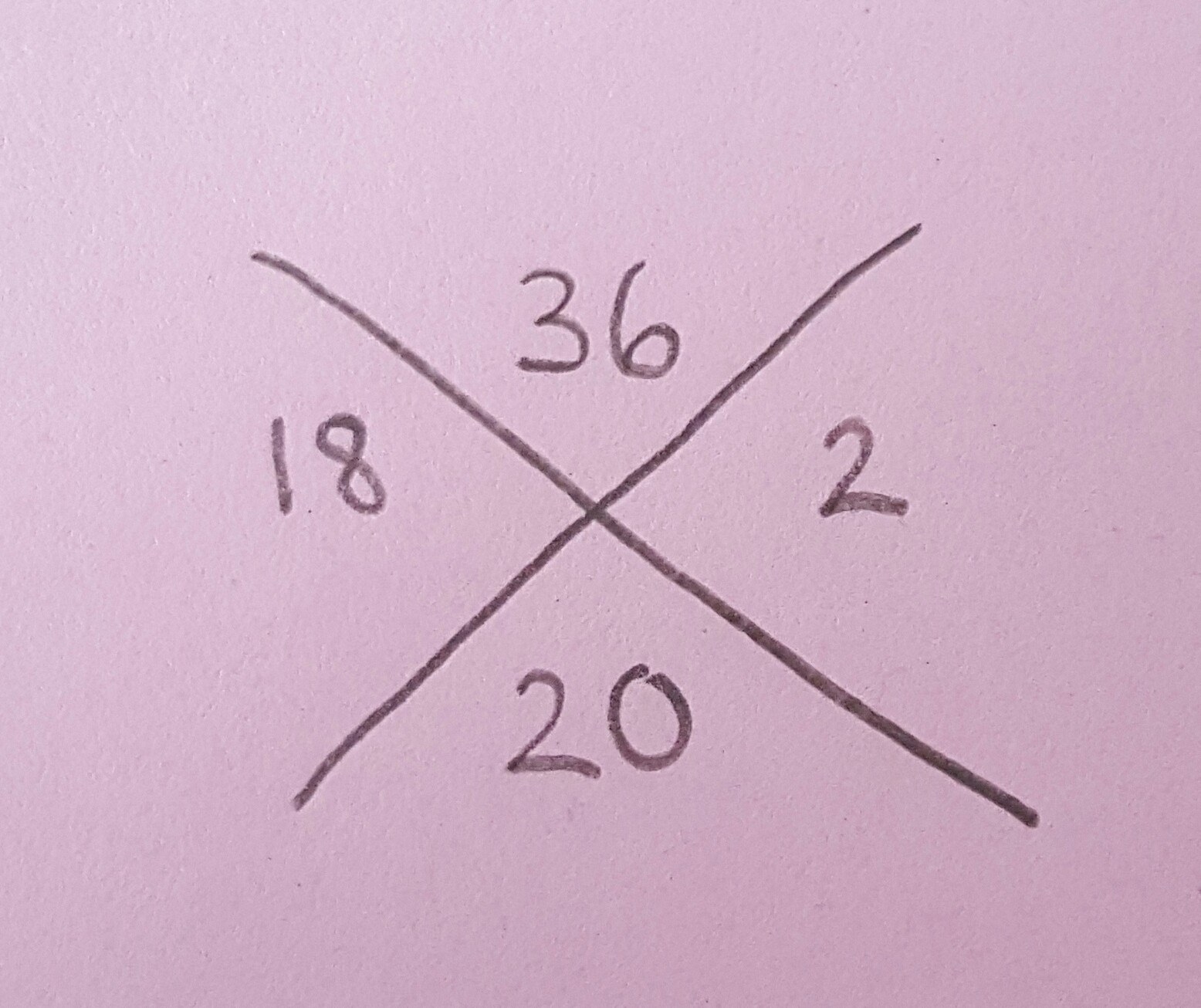
  4. Find two numbers that multiply to acac but add up to bb; here, 18⋅2=3618\cdot 2=36 and 18+2=2018+2=20. This usually takes some trial and error.

  5. Write these two numbers from step (4) on the sides of the XX.

So far, your XX should look like this:

An X with 36 on the top, 18 on the left, 2 on the right, and 20 on the bottom.

Image source: by Kendra Din

  1. Next, divide both side numbers (here, 1818 and 22) by the aa value (here, 33).
An X with 36 on the top, 18/3 on the left, 2/3 on the right, and 20 on the bottom.

Image source: by Kendra Din

  1. If you can, reduce your fractions; here, you can reduce 183\frac{18}{3} to 61\frac{6}{1}.

  2. Lastly, write your fractions as binomials where the denominator becomes the coefficient of the variable, and the numerator gets added on as a constant. In this case, 61\frac{6}{1} becomes (x+6)(x+6) and 23\frac{2}{3} becomes (3x+2)(3x+2).

  3. Simplify your answer into (x+6)(3x+2)(x+6)(3x+2) (or equivalently, (3x+2)(x+6)(3x+2)(x+6)).

  4. Check your answer by multiplying the binomials!

Video · + 3 min read

(Video) Common Factor Fail

by mathman1024

Here's a really helpful video by mathman1024 that teaches you a trick to factor trinomials more quickly.

Summary\large{\text{Summary}}

When factoring a trinomial that doesn't contain a common factor by using trial and error, if any of the possible combinations of binomial factors that you generate contain common factors themselves, then you know for certain that those combinations will not result in your original trinomial when FOILed out.

Now, let's take a look at an example that illustrates how we can apply this trick. Suppose that we want to factor the following trinomial:

2x2+7x+62x^2+7x+6

First off, in order to find the first terms of this trinomial's two binomial factors, we need to find two terms that multiply to the trinomial's first term: 2x22x^2. Since both factors of 2x2+7x+62x^2+7x+6 must contain at least one term consisting of one or more variables, there exists only one pair of terms that we can break our trinomial's 2x22x^2 into: 2x2x and xx.

We then plug those terms into two empty sets of parentheses, like so:

(2x     )(x     )(2x\ \ \ \ \ )(x\ \ \ \ \ )

Next, when we examine the terms that our original trinomial contains, we see that all of those terms' signs are positive, meaning that our trinomial's factors will solely contain plus signs:

(2x+   )(x+   )(2x+\ \ \ )(x+\ \ \ )

Finally, in order to determine the last terms of our trinomial's factors, we first must look to our trinomial's last term and write down all the pairs of terms that multiply to it. In other words, we need to list all the factors of 66:

1623\begin{array}{cc} 1&6\\ \hline 2&3 \end{array}

We now know that the last terms of our trinomial's factors are either 11 and 66 or 22 and 33. However, only one of these possible pairs of last terms will give us our trinomial's middle term (7x7x) when the expression's binomial factors are multiplied together.

So, let's first try plugging 11 and 66 into the two sets of parentheses that we've already partially filled, like so:

(2x+1)(x+6)(2x+1)(x+6)

If we use the FOIL method to multiply this expression's inner and outer terms, we get a 1x1x and a 12x12x, and when we add those two results together, we get 13x13x. Since the term 13x13x has a larger coefficient than our trinomial's middle term (7x7x), we know that this potential set of factors won't result in our original trinomial when FOILed out completely.

Next, let's try swapping the last terms of the (2x+1)(x+6)(2x+1)(x+6) expression that we just ruled out:

(2x+6)(x+1)(2x+6)(x+1)

Here's where the trick that we briefly discussed at the beginning of this explanation comes into play. We know for certain that this new expression won't result in our trinomial when FOILed out because one of the binomials it contains (i.e. 2x+62x+6) has a greatest common factor (i.e. 22). A common factor can only be present in one (or both) of a trinomial's binomial factors if a common factor was present in the original trinomial to begin with. However, our trinomial does not contain a common factor, meaning that the expression (2x+6)(x+1)(2x+6)(x+1) cannot possibly be our trinomial's factored form.

So, without having to perform any further multiplication, we can definitively say that 11 and 66 are not the last terms of our trinomial's factors. Therefore, we can now try plugging 22 and 33 into our two partially filled sets of parentheses, like so:

(2x+2)(x+3)(2x+2)(x+3)

Again, we see that one of the two binomials that comprise the expression we just created (i.e. 2x+22x + 2) has a greatest common factor (i.e. 22). This means that the expression (2x+2)(x+3)(2x+2)(x+3) also cannot possibly be our trinomial's factored form, leaving us with one final combination of binomial factors to consider:

(2x+3)(x+2)(2x+3)(x+2)

Right away, we note that neither of this new expression's binomials contain common factors. Also, when we use the FOIL method to multiply the expression's inner and outer terms, we get the terms 3x3x and 4x4x; when we add those two results together, we get 7x7x, which just so happens to be our trinomial's middle term.

Together, these two facts indicate that the expression (2x+3)(x+2)(2x+3)(x+2) is indeed the factored form of our trinomial:

2x2+7x+6=(2x+3)(x+2)\begin{align} &2x^2+7x+6\\ =&(2x+3)(x+2) \end{align}

After stepping us through the process of factoring the trinomial 2x2+7x+62x^2+7x+6 by using trial and error (in conjunction with checking for common factors, when appropriate), the video above shows us how to employ the same technique in factoring the trinomial 6x2+5x−66x^2+5x-6.

Test Yourself: Assuming that you are using trial and error to factor a trinomial that does not contain a common factor, which of the possible factored forms listed below can you eliminate without using multiplication?

Choose all correct answers

Video · + 2 min read

Factoring Quadratics when a≠1a \neq 1

We're going to quickly review some basics before we dive into this type of factorization.

Which of the following is a factor of x2+11x+28x^2+11x+28

Choose one answer

Type a concept, like “slope” or “photosynthesis”.

↑ ↓ to choose · Enter to openSearch explanations and problems