Illustrated · 2 min

Background

Before we dive into factoring quadratics with complex numbers, we want to understand why we need to learn this concept. You'll remember that you recently learned about quadratics that do not have real solutions, but have complex or imaginary solutions (because the radicand under the square root is negative). With the math knowledge we currently have, we have labeled all of these quadratics as those that are unfactorable or with no solutions. However, we're about to add a new tool to our arsenal, where we can factor some of these quadratics, getting factors with complex solutions.

Back in Algebra 1, we covered a lot of different topics that related to factoring. These are really important to keep in mind as we move forward to factoring quadratics with complex numbers. A really important topic to review is using FOIL to multiply binomials.

From Algebra 2, make sure you review how to multiply complex numbers and how to recognize complex conjugates. Also, remember that you can use the discriminant to find out whether the quadratic has real or imaginary solutions.

Factoring Quadratic with Complex Numbers

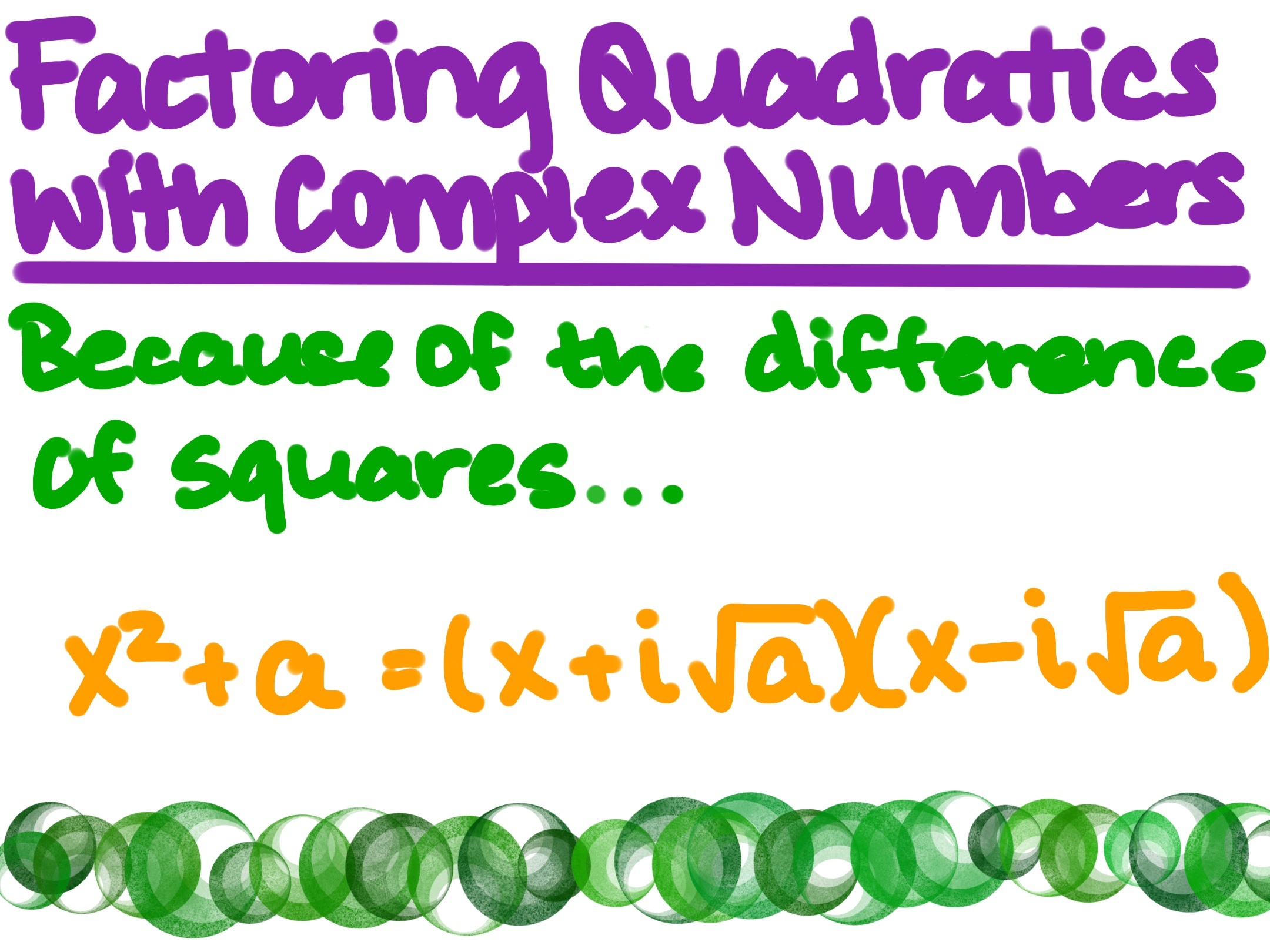
Factoring quadratics with complex numbers is pretty similar to factoring quadratics with real solutions. The good news is that there is a theorem that will help you to solve some of these problems! If you have a complex number of the form, x2+ax^2 +a, you can use this theorem:

(x+ia)(x−ia)x2−ixa+ixa−(ia)2x2−(−1⋅a)x2+a\begin{align} (x + i\sqrt{a})(x - i\sqrt{a}) \\ x^2 -ix\sqrt{a} +ix\sqrt{a} - (i\sqrt{a})^2 \\ x^2 - (-1 \cdot a) \\ x^2 +a \\ \end{align}

You'll notice that looks similar to a difference of squares! So that means that if you see a quadratic of the form x2+ax^2 +a, you can use the pattern:

x2+a=(x+ia)(x−ia)x^2 +a = (x + i\sqrt{a})(x - i\sqrt{a})

Let's walk through an example.

Example: Factor the following quadratic equation: x2+3x^2 +3

We can use the discriminant or graph the function to see how many solutions the quadratic has. I chose to graph.
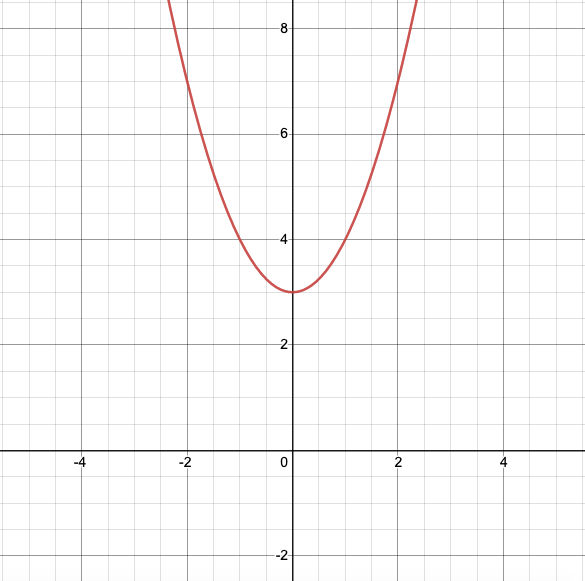
Graph of x^2 +3

Made using Desmos

We can see from the graph that there are no real solutions. That means that there will be complex roots. While we could use the quadratic formula to find the complex roots, we will factor in this case because the quadratic follows the pattern of completing the square, that we saw earlier.

x2+3x2−xi3+xi3+3(x+i3)(x−i3)\begin{align} x^2 +3 \\ x^2 -xi\sqrt{3} + xi\sqrt{3} +3 \\ (x +i\sqrt{3})(x -i\sqrt{3}) \\ \end{align}

So, our factors are: (x+i3) and (x−i3)(x +i\sqrt{3}) \text{ and } (x -i\sqrt{3})

Video

(Video) Factoring Quadratics Using Complex Numbers

by larryschmidt

This video by larryschmidt walks you through an example of how to factor expressions using complex numbers.

Example: Factor 9x2+169x^2 + 16 over the set of complex numbers.

Because it's a quadratic, we can set the expression equal to 00.

9x2+16=09x2=−169x2=−163x=±4i\begin{align} 9x^2 + 16 &= 0 \\ 9x^2 &= -16 \\ \sqrt{9x^2} &= \sqrt {-16} \\ 3x &= \pm 4i \\ \end{align}

So, now we can say that:

3x=4i AND 3x=−4i3x−4i=0 AND 3x+4i=0\begin{align} 3x=4i \text{ AND } 3x=-4i \\ 3x-4i=0 \text{ AND } 3x+4i=0 \\ \end{align}

9x2+16=(3x−4i)(3x+4i)9x^2 + 16 = (3x-4i)(3x+4i)

He walks through a second example.

Example: Factor 4x2+94x^2 +9 over the set of complex numbers.

Same as before, we will first set this expression equal to 00.

4x2+9=04x2=−94x2=−92x=±3i\begin{align} 4x^2 + 9 &= 0 \\ 4x^2 &= -9 \\ \sqrt{4x^2} &= \sqrt{-9} \\ 2x &= \pm 3i \\ \end{align}

So, now we can say that:

2x=3i AND 2x=−3i2x−3i=0 AND 2x+3i=0\begin{align} 2x=3i \text{ AND } 2x=-3i 2x-3i=0 \text{ AND } 2x+3i=0 \end{align}

We have found that:

4x2+9=(2x−3i)(2x+3i)4x^2 +9 = (2x-3i)(2x+3i)

Illustrated · 1 min

Factoring Quadratics with Complex Numbers

When factoring quadratics with complex numbers, one helpful method is the difference of squares. This technique is used when you have a quadratic equation where one side is a perfect square, and the other side is a negative number.

Factoring Quadratics with Complex Numbers

Image source: by Anusha Rahman

The key ideas behind the difference of squares is recognizing that expressions like x2−ax^2 - a can be factored into (x+a)(x−a)(x+a)(x-a). For quadratics involving complex numbers, we treat the negative number as a square of an imaginary number, using ii (where i=−1i=\sqrt{-1}).

Once you rewrite the equation in the form of a difference of squares, you can easily factor it and find the solutions. The result often involves complex numbers, and solving for xx gives you the roots of the equation.

Type a concept, like “slope” or “photosynthesis”.

↑ ↓ to choose · Enter to openSearch explanations and problems