Interactive · 6 questions
In this post we will prove that a homogeneous polynomial's factors are also homogeneous, and then briefly discuss the implications of this on other areas of math. First, let's remind ourselves what homogeneous polynomials are, and why this result should intuitively hold:
A homogeneous polynomial in variables , which we denote as assuming has real coefficients, has the property that for any term with nonzero coefficient, the degree of that term is equal to .
Which of the following polynomials are homogeneous? Mark all that apply.
Now, it makes sense for the factors of some homogeneous to also be homogeneous- if they weren't, then the other factors wouldn't be able to multiply and "eliminate" the non-homogeneous terms.
Let's look at a classic example in :
How does the polynomial factor in the reals?
It is well-known that has the mentioned factorization. So this gives us a hopefully nontrivial example of how polynomials in factor.
We still haven't proven the claim yet, but first- can we generalize? How will factor in , the set of complex numbers? Will the factors still be homogeneous? How about in other rings?
How will factor in the complex numbers?
Miraculously, the property holds in other rings as well! For example, in , if is a primitive 3rd root of unity, we can show that
.
Recall that since is a constant, these factors are still homogeneous.
Now we will prove the result in complex numbers. This has the added benefit that each polynomial has zeroes by the Fundamental Theorem of Arithmetic, and proving the result in will prove the result in anyway.
Suppose some is homogeneous and with not homogeneous.
What can we do with the equation ?
What this means is, suppose we write . Then clearly . So we still have .
This means, for example, that we could take each to equal for and get a polynomial divisibility result in .
To understand what I mean, let's consider .
We can let and we will end up with new polynomials: . You can verify that we still have and .
Now we can use this fact in conjuction with the homogeneity of to deduce some very nice things. But before that, let's examine the case.
What happens when (i.e., is only in one variable )?
So the case is very easy to deal with, and yet we will soon see that every other case reduces to it.
Reconsider . We want to somehow make this one-variable, and yet still homogeneous.
How do we accomplish this? Remember that we are free to plug in whatever we want for the values of .
Suppose that and that is not homogeneous. Then if , we can rewrite where each is a homogeneous polynomial of degree . WLOG suppose for some fixed , we have or else we are trivially done.
We can use the properties of homogeneous polynomials: For fixed values , we can set . Then each term of will be some term of the form for a constant . So becomes something of the form .
We will choose so that and . It will be left as an exercise to the reader to prove that such values of exist (don't worry, it's not hard since having a polynomial equal zero is much rarer than having it not equal zero).
Now as a result of this substitution, and will become different-degree terms of the form and for nonzero . Then we will have , which is clearly a contradiction since the only factors of are for .
Remarks: This proof is motivated by the basic properties of homogeneous polynomials, among which are that .
Homogeneous polynomials are important because of their properties in projective spaces: We can define an -dimensional complex projective space by the coordinates , with the condition that multiplication by a scalar keeps points unchanged. You may have seen examples of this space with in the form of barycentric or trillinear coordinates. Of course, in the mentioned coordinate systems, we usually restrict the coordinates to reals, meaning we are only working in , a subset of a larger space which can actually be visualized.
Unfortunately, cannot be visualized so I can't put a picture here. However, according to quora, here's a partial illustration:
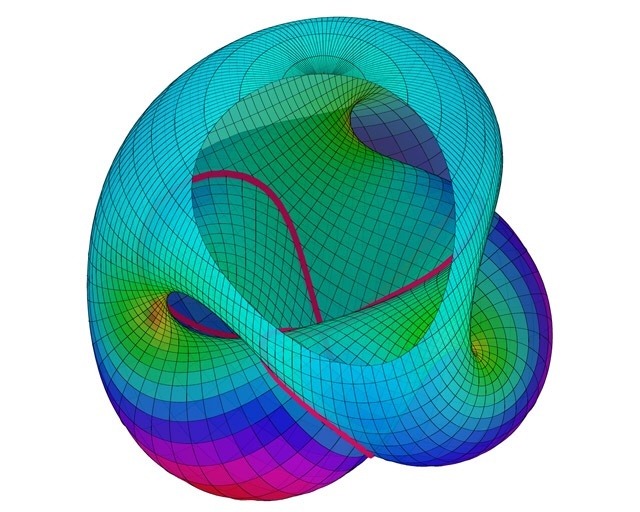
Then naturally, the surface of a homogeneous polynomial in this space will be the set of points which are roots of the polynomial. We need the polynomial to be homogeneous because for any which is a solution to the polynomial, must also be a solution. The result we have proven essentially says we can't find any strange exotic homogeneous polynomial which suddenly factors into non-homogeneous polynomials that no longer exist in the projective space.
You can read more about these topics at this page