Illustrated · 1 min
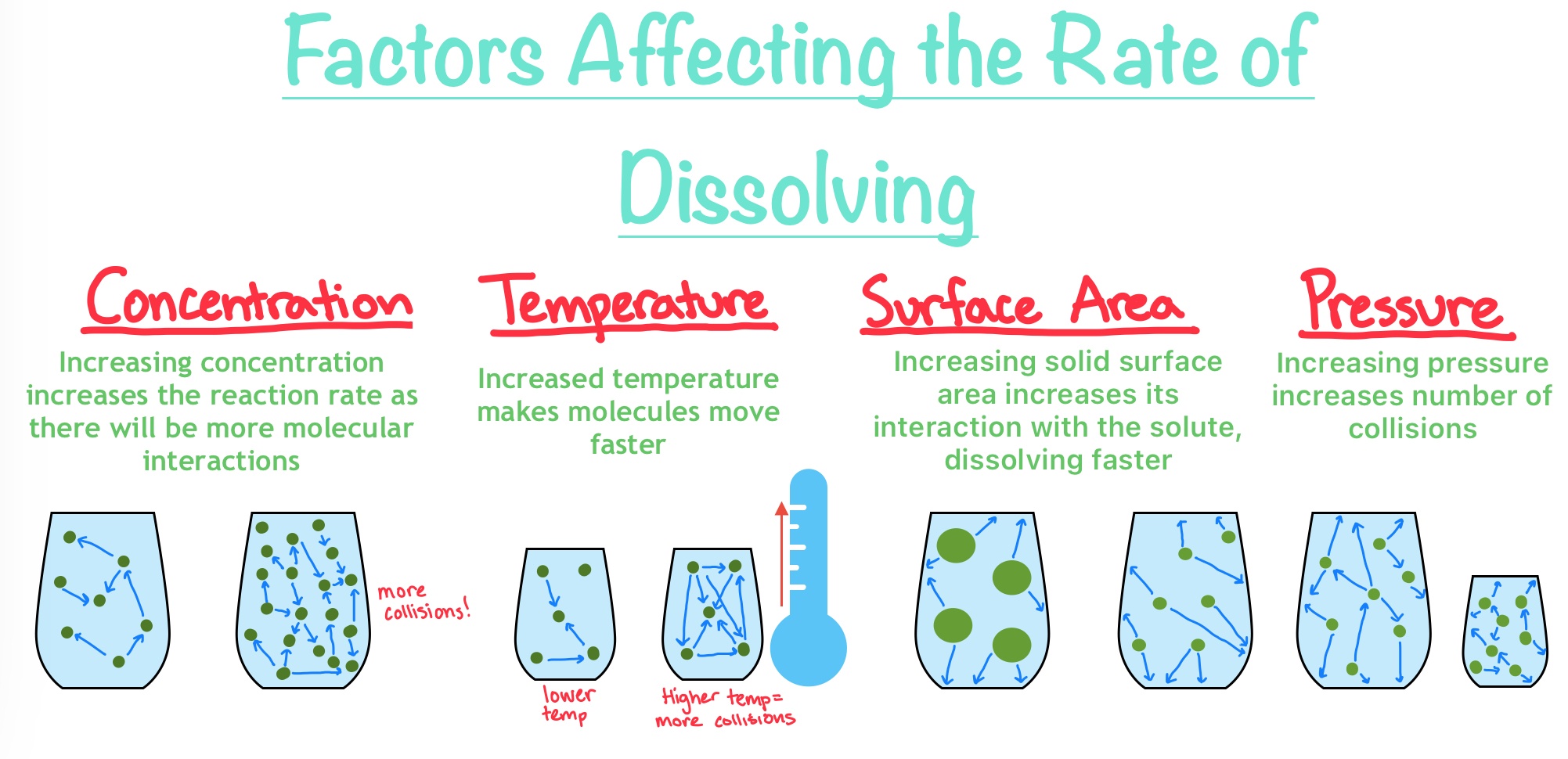
Image Source: By Trisha

Before this, knowSolute and Solvent — Definition & Overview
Illustrated · 1 min
Image Source: By Trisha
Read · 2 min
Solutions are formed when a solute is dissolved in a solvent. We can think of this as a reaction using the equation: Dissolution occurs when going from reactants to products. The reverse of dissolution is crystallization. Crystallization occurs when the solute dissolving is not favored. Certain conditions cause dissolution to become more or less favored. A solution is saturated when equilibrium between products and reactants is reached.
The main factors which affecting dissolution rate are:
Temperature
Surface area
Movement
When it comes to solid solutes, increasing the temperature will increase the rate of dissolving. As heat is added, the solute particles move around more, getting closer to the solvent molecules. This makes helps the solid dissolve faster in a liquid.
For gases, increased temperature decreases solvation. As the gas gains more energy, the molecules move more. This makes it harder for the gas to remain solvated and decreases the solvation rate.
When dissolving a solid in a liquid, the solvation rate increases as more of the solid's surface are is in contact with the liquid. This increases the interaction between solute and solvent.
An good example is loose sugar versus sugar cubes. When the sugar in two different forms is added to water, the loose sugar will dissolve faster. Each individual sugar crystal is able to interact with the water. In the sugar cube, the sugar crystals in the middle will not come in contact with the water until the exterior ones dissolves.
Movement or agitation of a solute/solvent mixture will help solvation occur faster. This increases the contact of solute and solvent.
You have probably used this before in the form of stirring a hot drink. When a solid such as hot cocoa powder or sugar is added to hot water, string helps solvation. Without stirring, clumps of solid can forms which prevents even contact between solute and solvent.
Video
by Tyler DeWitt

In this video, Tyler DeWitt explains the factors that affect the rate of dissolving. He illustrates each one and gives a clear concise explanation. This video will help you envision why and how something dissolves.
