Fermentation — Definition & Role in Cellular Respiration

Illustrated · 1 min

What Are the Types of Fermentation?

Fermentation is one way for organisms to make energy-rich adenosine triphosphate (ATP).

It was first observed and studied by Louis Pasteur, who looked at acetic acid bacteria. This is the same guy who developed the process of pasteurization.

There are a few types, but ethanol and lactic acid are the main two.

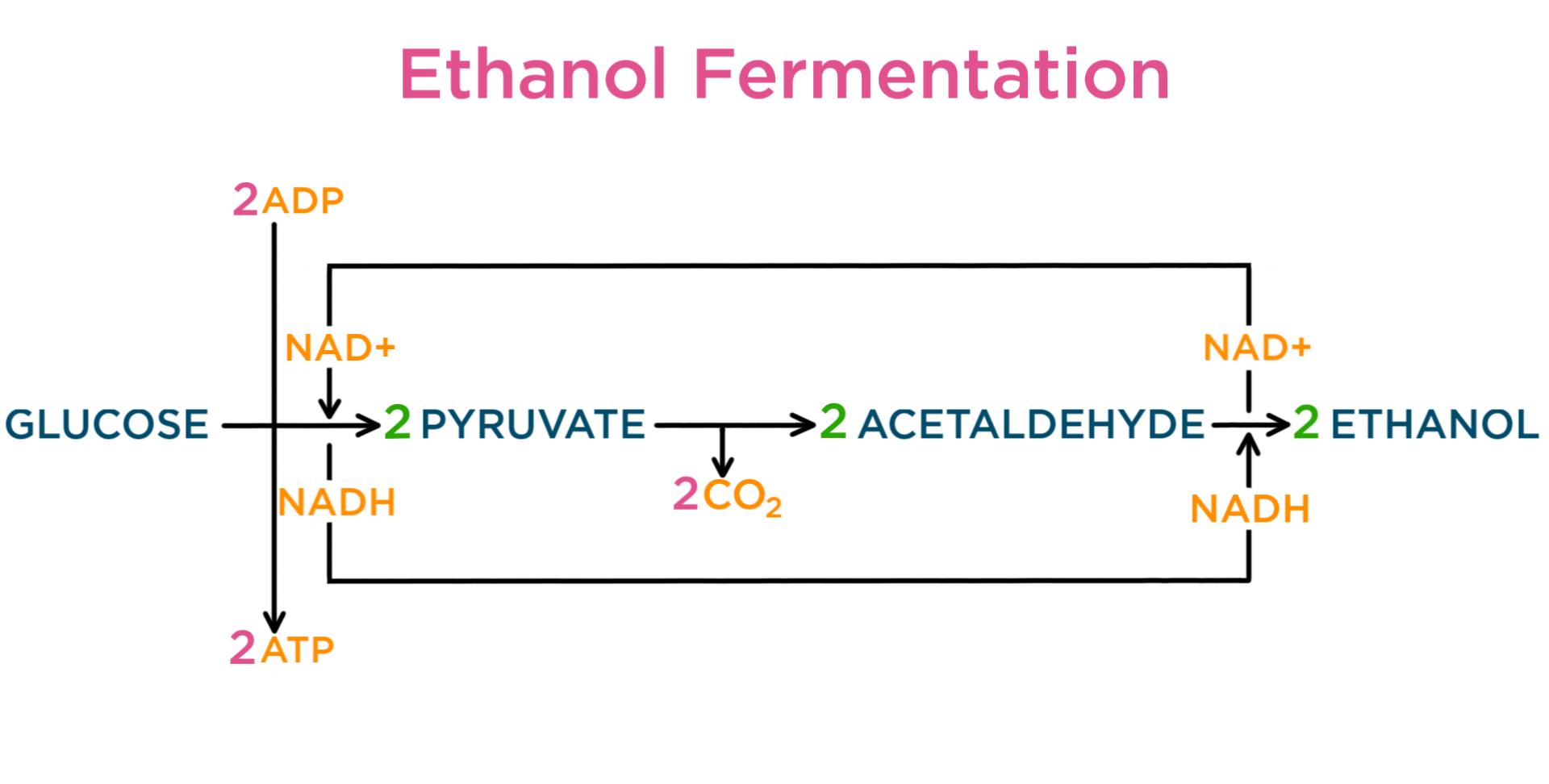
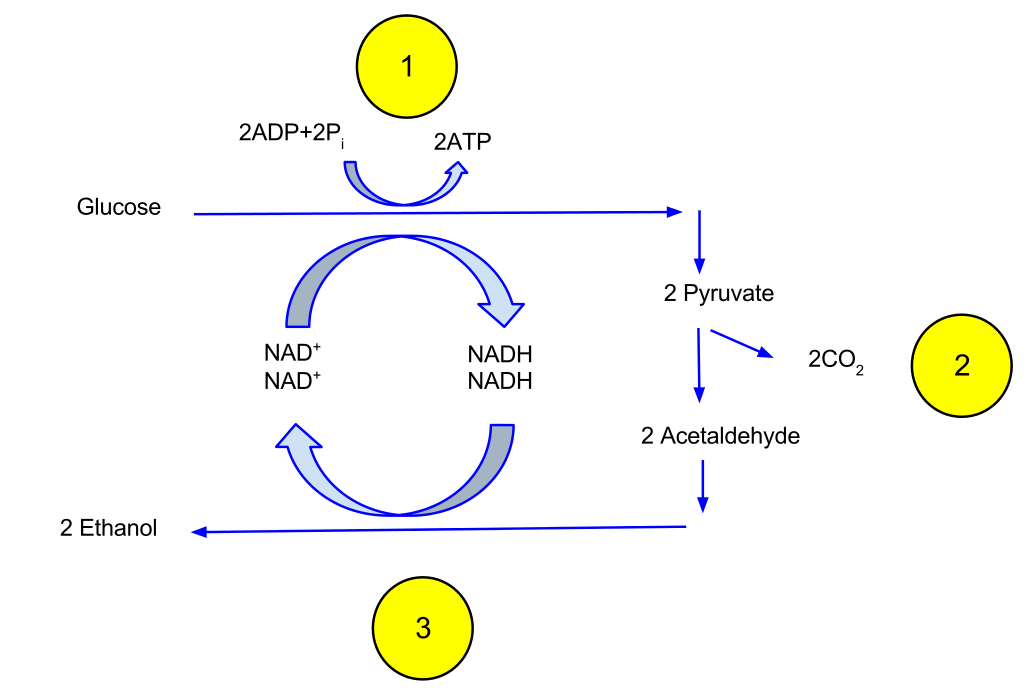
In ethanol or alcoholic fermentation, glucose is converted into 2 pyruvate molecules. In the process, 2 ADP molecules are converted to ATP, and NAD+ is converted to NADH. The pyruvate molecules are converted to 2 acetaldehyde molecules, releasing 2 carbon dioxide molecules. The acetaldehyde is converted into 2 ethanol molecules. In the process, NADH is converted to NAD+.

Image source: By Gabi Slizewska

Ethanol fermentation products include alcohol and carbon dioxide gas.

As you might have inferred, this is how we make things like wine and beer with the help of yeast cells.

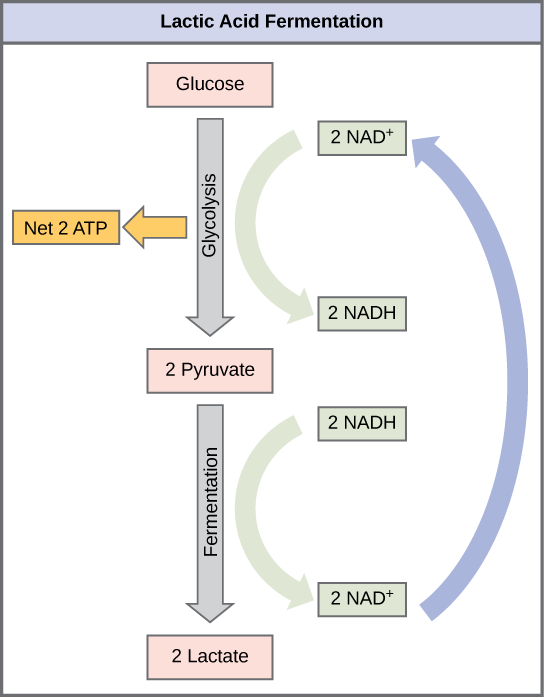
In lactic acid fermentation, glucose is converted into 2 pyruvate molecules. In the process, 2 ADP are converted into 2 ATP, and 2 NAD+ are converted into 2 NADH. 2 pyruvate molecules are converted into 2 lactate. In the process, 2 NADH are converted into 2 NAD+.

Image source: By Gabi Slizewska

Lactic acid fermentation produces lactate. Lactate can then be converted into lactic acid.

Interactive · 3 questions

Why Use Fermentation?

Do you like the taste of bread? Kimchi? Pickles? All of these foods (plus a lot more) are products of fermentation.

This is how organisms generate ATP when oxygen is not available. This is important when cells are performing glycolysis but have no oxygen to complete the Krebs cycle or electron transport chain. The Krebs cycle and electron transport chain are aerobic processes.

After glycolysis, there is an excess of ATP that is quickly grabbed by NAD + to become NADH. However, because there is no oxygen to steal the hydrogen atoms, the NADH can not become NAD + again. Once all of the NAD + is NADH, glycolysis and cellular respiration would stop completely. No more ATP can be produced. The whole process grinds to a halt.

This is where fermentation comes in.

A diagram showing anaerobic respiration

Image source: By Vtvu CC BY-SA 3.0, via Wikimedia Commons

In this process, the NADH molecules convert back into NAD+^+ by donating their high-energy electrons back to the pyruvic acid. Because of this, glycolysis can continue producing ATP.

Two types are common: alcoholic and lactic acid fermentation.

When do organisms use fermentation?

Choose one answer

Illustrated · 2 min

Overview of Anaerobic Respiration

Fermentation is an anaerobic process. It doesn't need oxygen to occur and is sometimes called anaerobic respiration. This is in contrast with aerobic cellular respiration, which needs oxygen to run.

It typically occurs in prokaryotes—cells with no nucleus and no mitochondria. Prokaryotes do have cytoplasm. This is where the reactions occur.

There are two types of fermentation: alcoholic and lactic acid. Both types are chemical processes and produce two ATP. We'll look at each process in detail next.

Fermented foods

Foods like kimchi, yogurt, sauerkraut, and pickles get their sour taste from being fermented.

Image source: By Elisa Shackelton CC0, via pexels.com \\ Image source: By Takeaway CC BY-SA 4.0, via Wikimedia Commons \\ Image source: By Bdubay CC BY-SA 3.0, via WIkimedia Commons \\ Image source: By unknown author CC0, via pxhere.com

Glycolysis

The first step in both lactic acid and alcoholic fermentation is glycolysis. (Glycolysis is also the first step in cellular respiration.)

In glycolysis, one molecule of glucose is broken down into two pyruvate molecules. A net yield of two ATP are produced.

For a unicellular prokaryote (like a bacterium), two ATP at a time is enough to function. For an organism like you or me, two ATP ain't gonna cut it. That's why our bodies use other processes (which produce roughly 38 ATP per cycle) by default.

Glycolysis reactants and products

Image source: By Hannah Bonville

Lactic Acid Fermentation

In this process, each pyruvate made in glycolysis is converted to an organic molecule, lactate.

Lactate can become ionized to lactic acid.

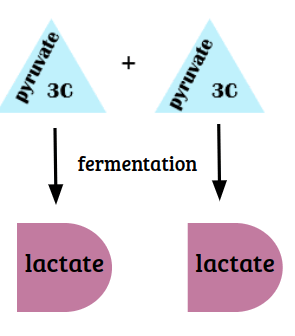
Two molecules of pyruvate are converted to two molecules of lactate.

Image source: By Hannah Bonville

Lactic acid shows up in your body sometimes too.

Think about the last time you ran really fast. Your muscles burned, right? Well, when you force your muscles to work super quickly, not enough oxygen gets to your muscle cells. Without oxygen, cellular respiration isn't an option since it's an aerobic process.

So, what are your poor muscle cells to do?

A silhouette of a woman running

Image source: By Felikss Veilands (neopri) CC0, via pixabay.com

As a last resort, your muscle cells switch over to lactic acid fermentation. It doesn't require oxygen, it produces some ATP (just two ATP, but that's still something), and it's quick. The by-product is lactate.

Remember how we said that the lactate can easily be turned into lactic acid? Well, that acid burns. That's the burning feeling you get in your muscles when you're working them super hard.

People exercising

All these people are feeling the burn... of lactic acid.

Image source: By William Warby from London, England CC BY 2.0, via Wikimedia Commons \\ Image source: By Jon Clegg CC BY 2.0, via flickr.com

Alcoholic Fermentation

The second type of anaerobic respiration is alcoholic fermentation.

In this pathway, each pyruvate made in glycolysis is converted into ethyl alcohol and carbon dioxide. (Ethanol = alcohol)

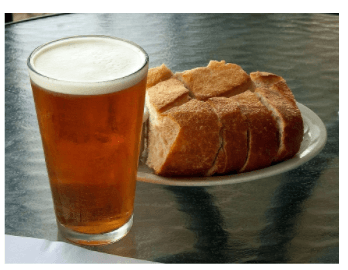
The process occurs most often in yeast and results in products like beers, wines, and bread.

Edible products of alcoholic fermentation include beer and bread.

Image source: By PublicDomainImages CC0, via pixabay.com

Here's a summary of the chemical reaction:

Two pyruvate molecules are converted into two ethanol molecules.

Image source: By Hannah Bonville

Key Vocabulary:

  1. Anaerobic
  2. Lactic acid
  3. Glycolysis
  4. Ethanol
  5. Glucose
  6. Prokaryote
  7. Glycolysis
  8. Cytoplasm

Video

(Video) What Is Anaerobic Respiration

by FuseSchool - Global Education

What happens when we can't get enough oxygen to give us energy? Do we stop producing it? No way. We use fermentation, a type of anaerobic respiration. Check out this video to learn more about fermentation processes and how they helps us.

Video

(Video) Anaerobic Respiration

by Jess & Catherine

This video compares anaerobic respiration to a game of football. Sounds cool, right? It's also easy to understand. Learn more about the process of anaerobic respiration by watching this video from Jess and Catherine.

Type a concept, like “slope” or “photosynthesis”.

↑ ↓ to choose · Enter to openSearch explanations and problems