Interactive · 4 questions
+5 contributors


The degree of a polynomial is guaranteed to be its largest exponent if it contains only one variable. If the polynomial in question contains more than one variable, its degree is the highest degree out of all the polynomial's terms, which is not necessarily the polynomial's greatest exponent. The highest degree is the highest power. This is easiest to figure out if the polynomial is in standard form.
For example, the degree of is because the highest exponent of the variable is (in the term).
The degree of is (not ) because the highest degree of any of its terms is
The term in the polynomial above does not have any variables in it. Thus, the degree is
The term has an raised to the and a raised to the Thus, the degree of this term is
The term has an raised to the and a raised to the Thus, the degree of this term is
The term with the highest degree has degree so is the degree of the whole polynomial.
Scalar Multiplication
The degree of the product of a polynomial and a non-zero real number is the degree of the polynomial itself.
For example, the degree of the product of (some non-zero real number) and is Because The highest degree of this polynomial is equal to the biggest exponent, which is
Multiplication of Two or More Polynomials
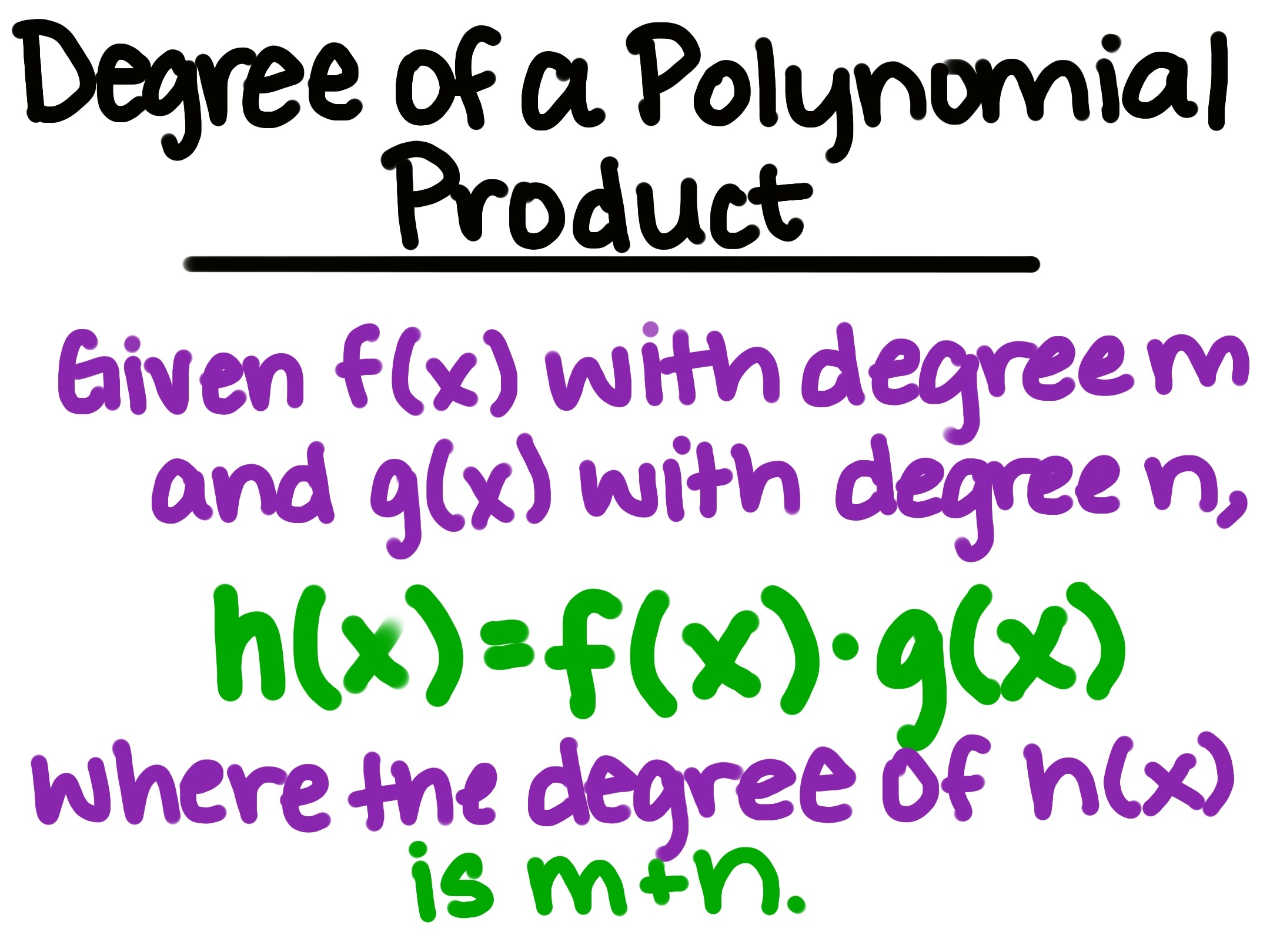
The degree of the product of two or more polynomials with one variable is the sum of the degrees of each polynomial.
For example, the degree of the product of and is . This is because the degree of is and the degree of is so the total degree is
The degree of a term in the product of two or more polynomials with two or more variables is the sum of the exponents of each variable in the term. The degree of the polynomial as a whole is equal to the highest degree of any of the terms.
For example, consider
The term has degree because is raised to the and is raised to the and
The term has degree because is raised to the and is raised to the and
The polynomial has a degree of because is the highest degree of either of its terms!
The degree of a product (which will be a polynomial, itself) of two or more polynomials with multiple variables is equal to the sum of the degrees of each polynomial.
For example, consider the product of and .
The degree of is as we have seen in the previous example. The degree of is (This is because the degree of the term with the highest degree, is .) Thus, the degree of the product of these two polynomials is
When we multiply those two polynomials together and simplify the resulting expression, we get . Note that there are two terms in this product that are tied for highest degree: and . Both of these terms have a degree of which means that the degree of the entire product is
Test Yourself!
Consider the following expression:
What is the degree of (as seen in the polynomial product given above?)
What is the degree of (as seen in the polynomial product given above?)
What is the degree of (as seen in the polynomial product given above?)
What is the degree of the polynomial product