
Finding Parametric Equations from Rectangular Equations

Before this, knowParametrizing A Curve

Read · 1 min

To turn a rectangular equation into a parametric equation, we first have to define an new parameter tt and rewrite our equation in terms of this tt parameter:

Say we have the equation, y=32x2+4y = \frac{3}{2}x^{2} + 4

The first step would be to define a new variable tt. We could say for example that t=x−3t = x - 3.

Now from the two equations we now have, y=32x2+4y = \frac{3}{2}x^{2} + 4 and t=x−3t = x - 3 we can solve for xx and substitute that value into our yy equation.

Doing this we get that, x=t+3x = t + 3 And thus, y=32(t+3)2+4y = \frac{3}{2}(t+3)^{2} + 4

After simplifying we get, y=32(t2+6t+9)+4y = \frac{3}{2}(t^{2}+6t + 9)+ 4 y=32(t2+9t+352y = \frac{3}{2}(t^{2}+9t + \frac{35}{2}

And there we have the two parametric equations that represent our rectangular equation! Converting all rectangular equations to parametric equations follows this similar pattern

Video · + 1 min read

(Video) Converting from Cartesian to Parametric Form

by StraighterLine

This video by StraighterLine goes over an example of converting a circular from rectangular form to parametric form. This is helpful because trigonometric functions are often used when creating parametric equations.

Summary

Example 1: Converting from Cartesian to Parametric Form. y=3x+5x2+y2=16\begin{align} y = 3x+5 \\ x^2 + y^2 = 16 \\ \end{align}

We will tackle the linear equation first.

x=ty=3t+5\begin{align} x &= t \\ y &= 3t +5 \\ \end{align}

Now, we'll tackle the quadratic equation.

x=tsin2t+cos2t=1\begin{align} x &= t \\ sin^2{t} + cos^2{t} &=1 \\ \end{align}

Through some work with trigonometric identities, we will land on: x4=sint\frac{x}{4} = sin{t} and y4=cost\frac{y}{4} = cos{t}. These two equations can be simplified to the follow pair of parametric equations:

x=4sintx=4cost\begin{align} x &= 4sin{t} \\ x &= 4 cos{t} \\ \end{align}

Therefore, these are the sets of parametric equations:

x=4sintx=4costandx=ty=3t+5\begin{align} x &= 4sin{t} \\ x &= 4 cos{t} \\ \text{and} \\ x &= t \\ y &= 3t +5 \\ \end{align}

Looking Beyond

This video does not show how to remove the parameter. But you can use what you already know to figure it out. Think about how you could rewrite the equations so they use only xx and yy.

You can challenge yourself even more by sketching the graphs.

A curve written using parametric equations looks the same as the curve written in rectangular form. The shape does not change.

The main difference is the domain. In parametric equations, the value of tt is often limited. It usually represents time.

You can think of parametric equations as showing the path an object travels over time.

Comparing Parametric and Rectangular Forms

Both parametric and rectangular equations describe the same curve.

Rectangular equations show the curve using only xx and yy. They do not show how the curve is traced.

Parametric equations also show the curve, but they include time. The parameter tt tells you where the object is at each moment.

So while the shape stays the same, parametric equations help you understand movement along the curve.

Illustrated · 1 min

Finding Parametric Equations from Rectangular Equations

Finding parametric equations from rectangular equations involves expressing the coordinates xx and yy using a third variable, usually tt.

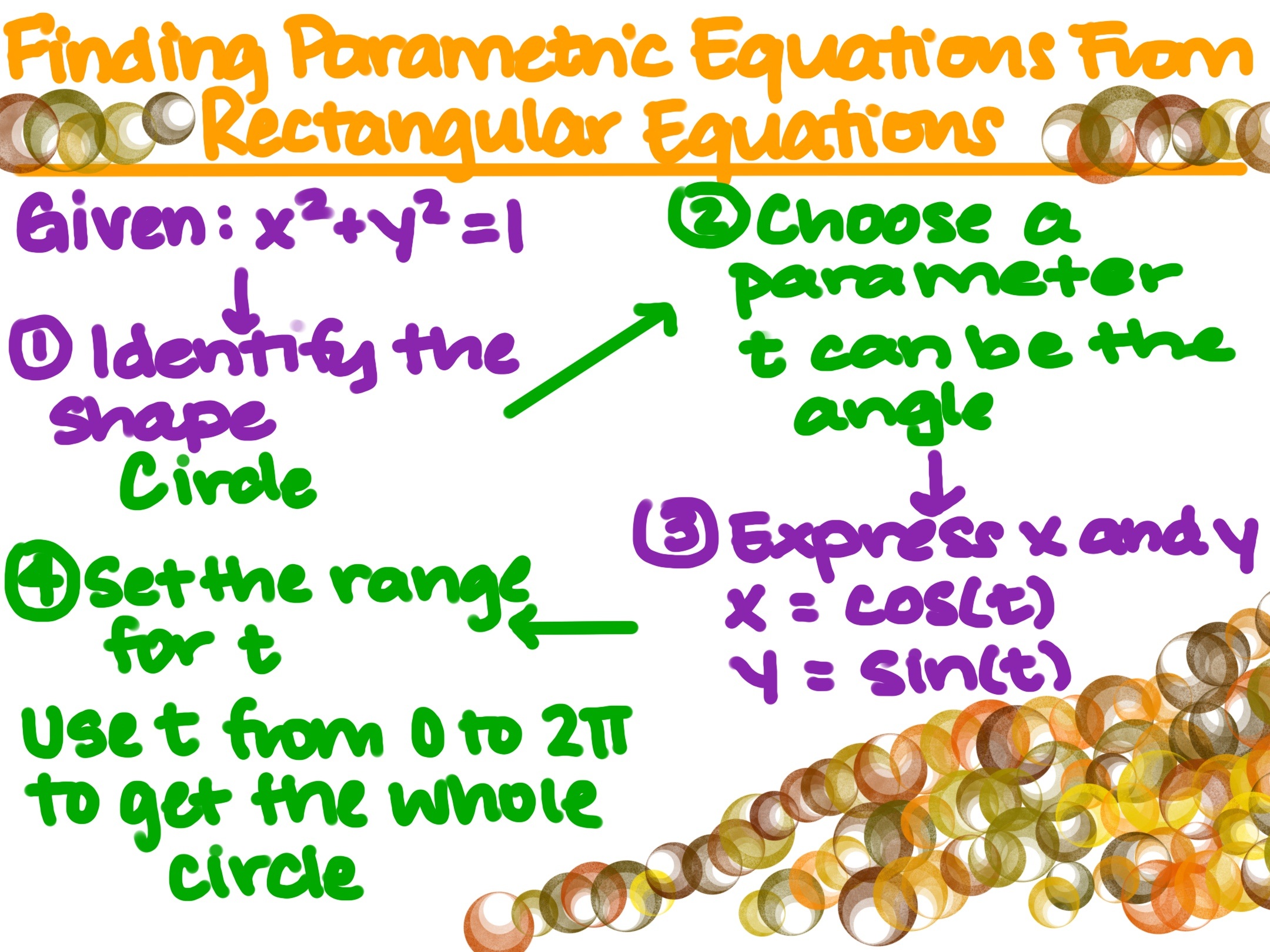
Finding Parametric Equations From Rectangular Equations
Given: x^2 + y^2 =1 
1: Identify the shape: circle
2: Choose a parameter: t can be the angle
3: Express x and y: x=cos(t), y=sin(t)
4: Set the range for t: use t from 0 to 2pi to get the whole circle

Image source: by Anusha Rahman

We can describe a circle using the equation x2+y2=r2x^2 + y^2 = r^2.

We can also describe the same circle using parametric equations:

  • x=r⋅cos(t)x=r \cdot cos(t)
  • y=r⋅sin(t)y=r \cdot sin(t)

Here, tt represents the angle.

These equations show how xx and yy change as the angle changes. This makes it easier to understand movement along the curve of the circle.

By choosing the right parameter and setting its range, we can describe many different shapes and paths.

#####When We Use This

In the real world, parametric equations are used to describe motion, shapes, and curves. These are often hard to write using just one formula.

A parametric equation uses a third variable, called a parameter. This parameter describes both the xx and yy values of points on a graph.

For example, think about a car driving around a race track. Parametric equations can show how the car’s position changes over time.

Sometimes it helps to rewrite parametric equations as rectangular (or Cartesian) equations. These equations use only xx and yy, which can make the relationship easier to understand.

Type a concept, like “slope” or “photosynthesis”.

↑ ↓ to choose · Enter to openSearch explanations and problems
