Read · 1 min

+1 contributors

Parametric equations usually come in pairs (or small sets). Each equation gives part of the information about a point.
In rectangular form, we also use two equations. One equation describes how the variable behaves, and the other describes how the variable behaves.
Because of this setup, converting parametric equations into rectangular form works in a way that is similar to solving a system of equations.. You solve one equation for a variable and substitute it into the other.
This connection helps make the process more familiar and easier to follow.
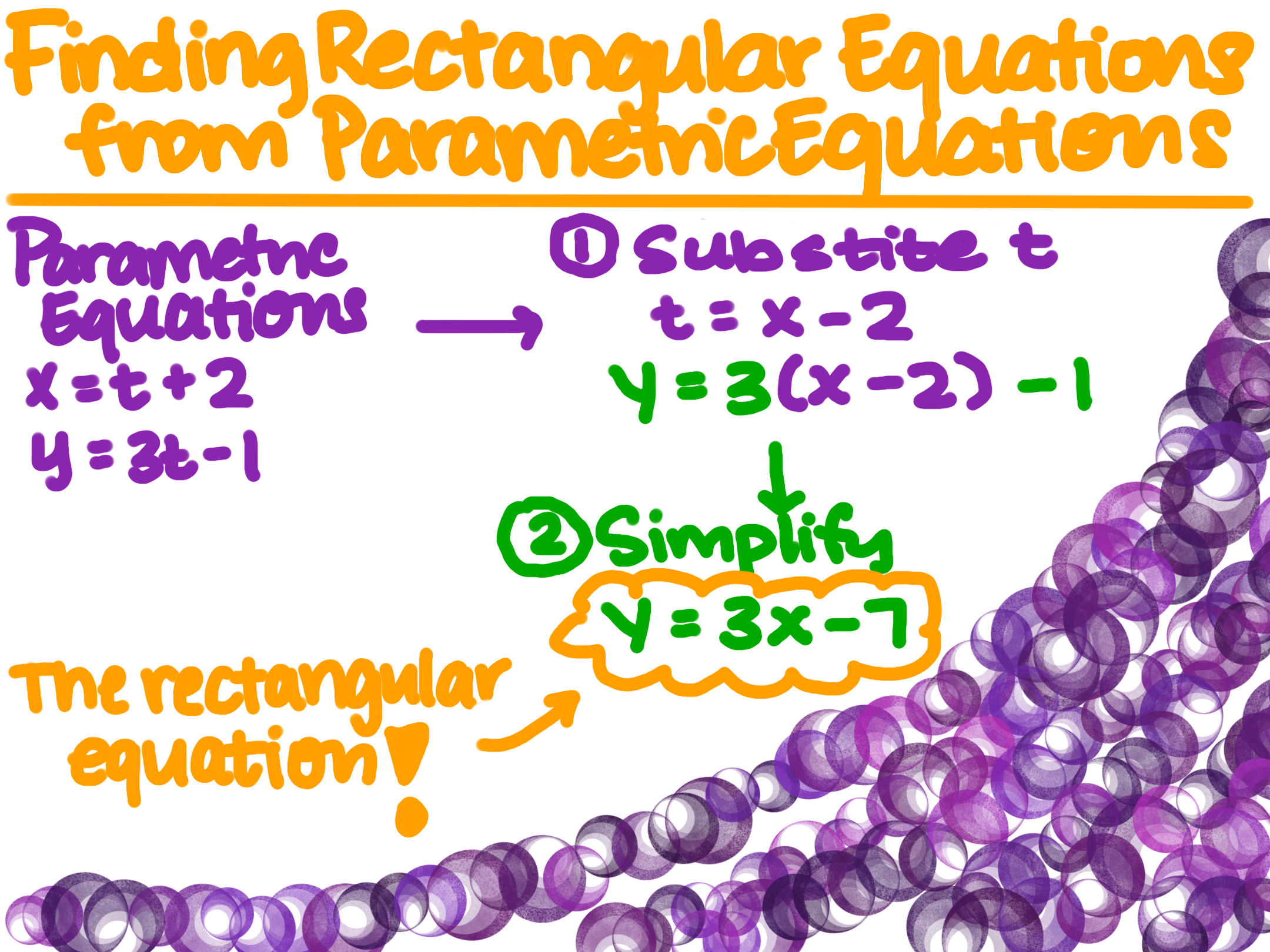
For example, let's say we have the two equations,
To start, if we want to convert these parametric equations back into a rectangular equation, we first have to solve for in terms of . What we are doing is eliminating the parameter. Doing so we have:
From here, we then substitute this value of back into our equation. Every place we have , we will replace it now with .
So, And we can simplify to: Now we have our rectangular equation!
Even though we did this conversion, the equations will have the same graph. If you can't imagine that, it might be helpful to sketch the graph.