Read · 2 min

+3 contributors



If you recall first learning about range many years ago, you may have thought about it as subtracting the lowest value from the highest value in a dataset. We will now be taking this a step further, looking at range of functions.
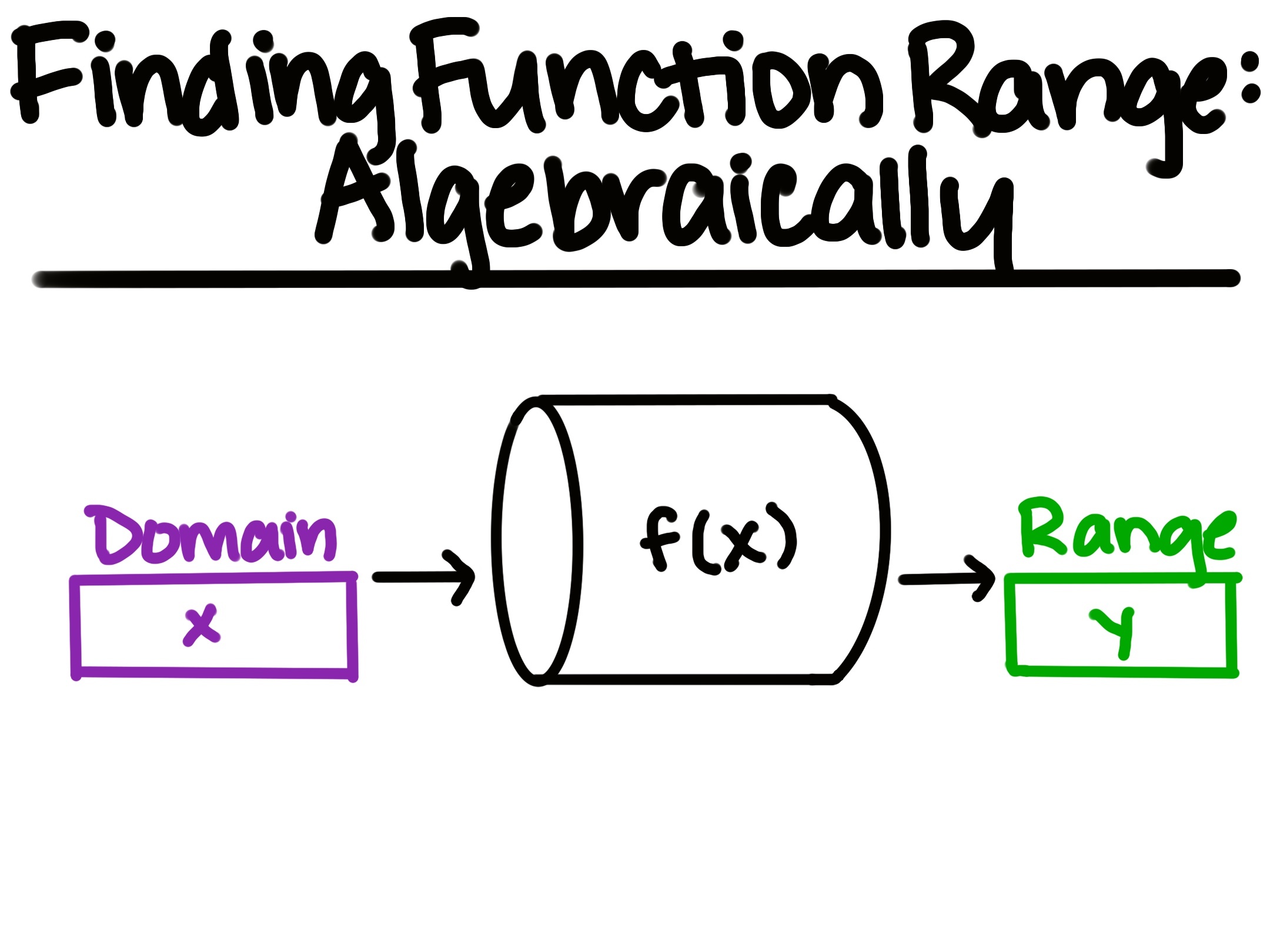
Finding the range of a function is the same as finding all values that could be. To do this, we can think of it this way:
The range of is all the -values where there is a number with .
We can try and motivate how to find this with an example. Let's try to find the range of: So we want to find -values such that there is some where . Suppose we want to check if is in the range of . Then, we want to check if there is an -value such that . We can solve this equation as follows: So since either or works, we know that is in the range of .
More generally, if we want to find the full range of , we can solve for (taking the inverse of the function) to get . Then, the range of is simply the domain of , because these are all the values where there is some -value with . In this example, the domain of is just all values where , so is the range of .
Overall, the steps for algebraically finding the range of a function are:
-
Write down and then solve the equation for , giving something of the form .
-
Find the domain of , and this will be the range of . Note: if there are certain -values that cannot be in the domain, their associated -value cannot be in the range!
-
If you can't seem to solve for , then try graphing the function to find the range.
Common functions and their ranges
Below, we can list a few common functions and the ranges they have. This will help you find the range of more complicated functions without having to do all the steps above.
. . The range of is , which is all non-negative real numbers.
. . The range of is , which is all real numbers. In fact, this range holds for any base for the log.
. For and , has a range of .