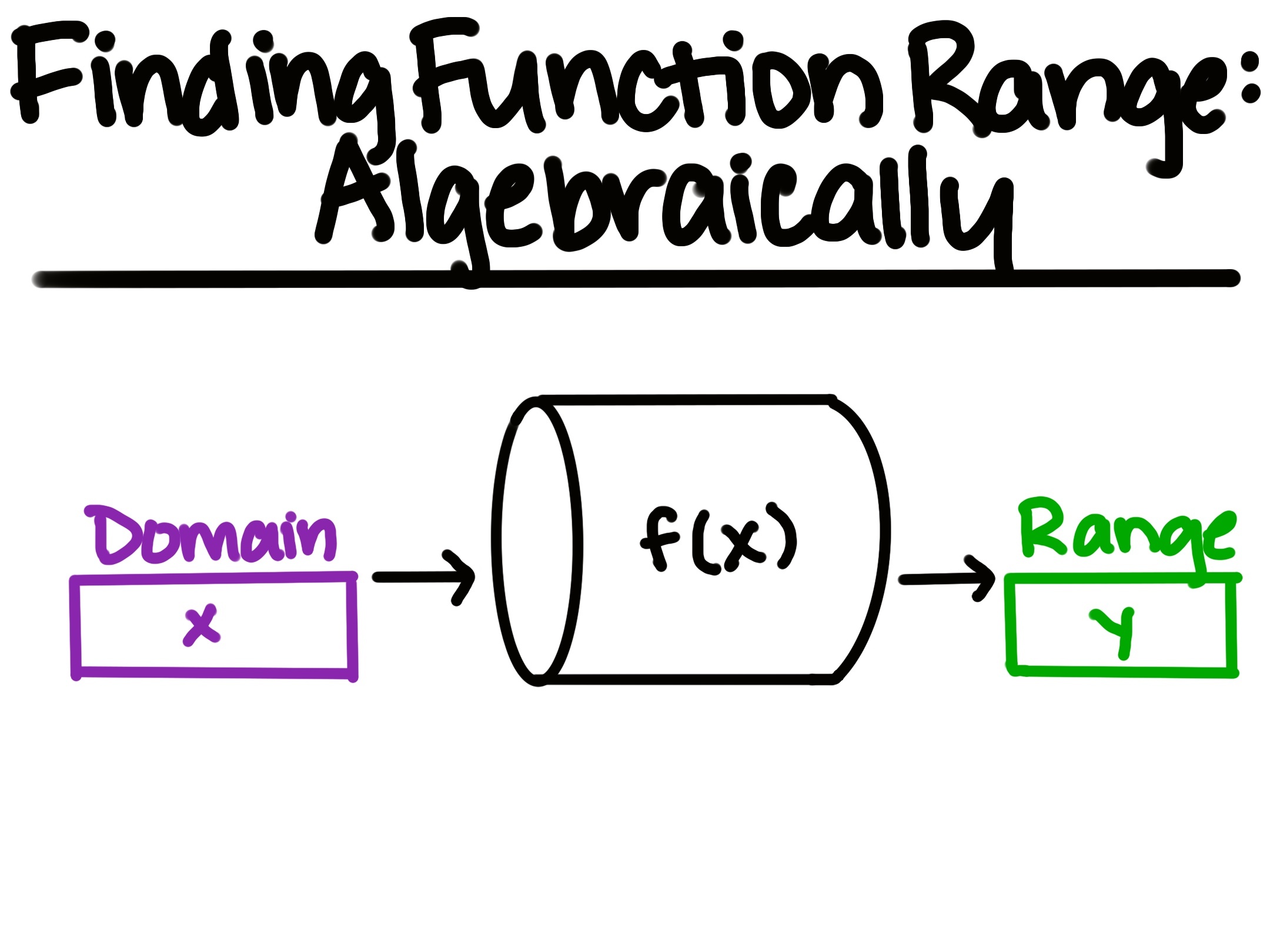
Finding the Range of a Function, Algebraically

Before this, knowDomain and Range - Definition & Finding Graphically

Read · 2 min

If you recall first learning about range many years ago, you may have thought about it as subtracting the lowest value from the highest value in a dataset. We will now be taking this a step further, looking at range of functions.

Finding the range of a function y=f(x)y=f(x) is the same as finding all values that yy could be. To do this, we can think of it this way:

The range of f(x)f(x) is all the yy-values where there is a number xx with y=f(x)y=f(x).

We can try and motivate how to find this with an example. Let's try to find the range of: f(x)=x2+1f(x)= x^2+1 So we want to find yy-values such that there is some xx where y=x2+1y=x^2+1. Suppose we want to check if y=5y=5 is in the range of f(x)f(x). Then, we want to check if there is an xx-value such that x2+1=5x^2+1=5. We can solve this equation as follows: x2+1=5x2=4x=±2\begin{align} x^2+1&=5\\ x^2&=4\\ x &= \pm 2 \end{align} So since either x=2x=2 or x=−2x=-2 works, we know that y=5y=5 is in the range of f(x)f(x).

More generally, if we want to find the full range of y=x2+1y=x^2+1, we can solve for xx (taking the inverse of the function) to get x=y−1x=\sqrt{y-1}. Then, the range of f(x)f(x) is simply the domain of y−1\sqrt{y-1}, because these are all the values where there is some xx-value with f(x)=yf(x) = y. In this example, the domain of y−1\sqrt{y-1} is just all values where y−1≥0y-1 \geq 0, so [1,∞)[1,\infty) is the range of f(x)=x2+1f(x) = x^2+1.

Overall, the steps for algebraically finding the range of a function are:

  1. Write down y=f(x)y=f(x) and then solve the equation for xx, giving something of the form x=g(y)x = g(y).

  2. Find the domain of g(y)g(y), and this will be the range of f(x)f(x). Note: if there are certain xx-values that cannot be in the domain, their associated yy-value cannot be in the range!

  3. If you can't seem to solve for xx, then try graphing the function to find the range.

Common functions and their ranges

Below, we can list a few common functions and the ranges they have. This will help you find the range of more complicated functions without having to do all the steps above.

11. f(x)=∣x∣f(x) = |x|. The range of f(x)f(x) is [0,∞)[0,\infty), which is all non-negative real numbers.

22. f(x)=ln⁡(x)f(x) = \ln(x). The range of f(x)f(x) is (−∞,∞)(-\infty,\infty), which is all real numbers. In fact, this range holds for any base for the log.

33. For a>0a > 0 and a≠1a \neq 1, f(x)=axf(x) = a^x has a range of (0,∞)(0,\infty).

Interactive · 1 question

While graphing functions can help us find the range of a function, sometimes it's easier to find the range algebraically, using a different set of techniques and ideas. Recall that the range of a function is all possible values the function (or dataset) can take on.

When finding the range of a function algebraically, we usually have to solve at least one equation or inequality. This is because a number yy is in the range of the function ff only if there is a value xx such that f(x)=yf(x) = y (and any such xx must be in the domain of ff).

Example: Let's say we want to find the range of the function f(x)=∣x∣.f(x) = |x|. You might remember that the absolute value function is always nonnegative. For instance, if we plug a positive number into the function then ff returns that number; if we plug a negative number into the function then ff removes the negative sign. And finally, f(0)=∣0∣=0.f(0) = |0| = 0.

But this alone doesn't tell us that the range of ∣x∣|x| is [0,∞).[0, \infty). We need to show that every nonnegative number is the absolute value of some number. To do this, let's pick a random nonnegative number y,y, and then we want to show that there is a real number xx such that

y=∣x∣.y = |x|.

However, a lot of the hard work is already done from our understanding of the absolute value function. We know that if we plug a nonnegative number into the absolute value function, we get the same number back. Therefore we can set x=yx = y since yy is nonnegative, and have

∣y∣=y.|y| = y.

In other words, we can "access" any nonnegative number by using the absolute value function, so the range of f(x)=∣x∣f(x) = |x| is [0,∞).[0, \infty).

That problem was relatively easy because we have a lot of intuition on how the absolute value function works already. As a reenforcement, answer this question.

Which value(s) of xx give us f(x)=12f(x) = 12 if f(x)=∣x∣?f(x) = |x|?

Choose all correct answers

Video

(Video) Finding the Range of a Function Algebraically

by Anusha Rahman

In this lesson, you will how to find the range of a function algebraically.

Summary

The range of a function is all possible yy values that a function can have. We can also think of range as the output values of a function.

There are four steps to algebraically find the range of a function:

  1. Define the function in standard form, with "y = "

  2. Express xx in terms of yy

  3. Find all possible values where x=f(x)x=f(x) cannot be defined.

  4. Write the range, being mindful of the values of yy that the function cannot take.

Illustrated · 1 min

Finding Function Range: Algebraically

The find the range of a function algebraically, you first need to understand the values the function can output.

Finding Function Range Algebraically

Image source: by Anusha Rahman

For example, if you have a function like f(x)=x2f(x)=x^2, the output is always a positive number or zero because squaring any number gives a positive result or zero. To find the range, think about the smallest and largest values the function can product (the output). You could use inequalities or solve for yy to figure out which values are possible for the function's output. If you want to visualize the graph, look at the extrema.

Type a concept, like “slope” or “photosynthesis”.

↑ ↓ to choose · Enter to openSearch explanations and problems