Illustrated · 2 min

The Intermediate Value Theorem
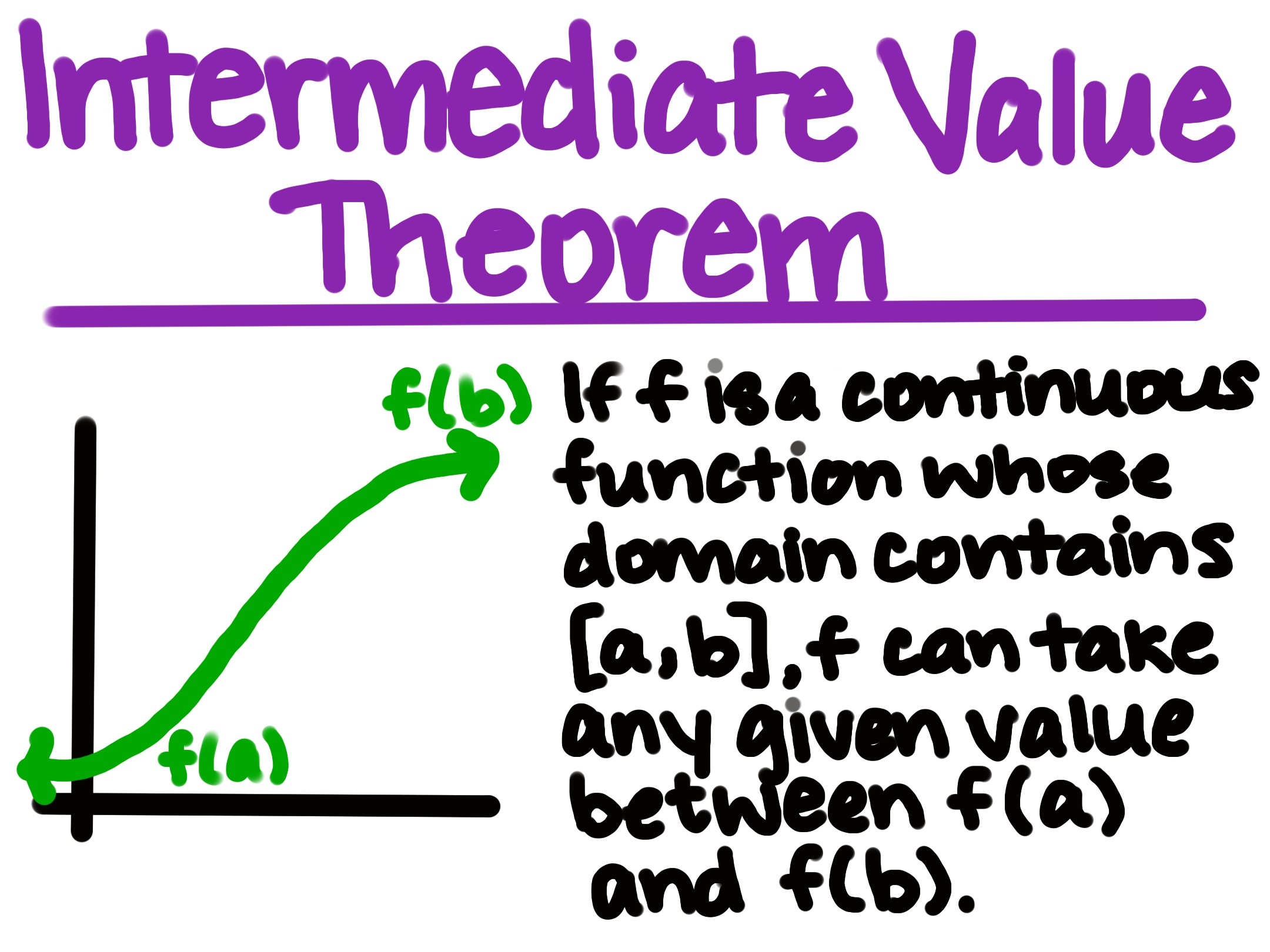
By definition, polynomial functions are continuous functions, meaning that you can draw the entire function without lifting your pencil from your paper. By extension, we can say that between any two points on the function, there will be an infinite number of points. If we have the points and on a function, we know that between , there can be an infinite number of points also on the function, including some point, . So, lies between on the function (on a closed interval).
Consider the function ,

Made using Desmos
This is a graph of a continuous function. I labeled two random points on the graph, but you could pick any two points. If you pick up your pencil and trace this function from the point to the point , then it must pass through any -value, .
This makes sense! This Theorem is just a fancy way of saying that there are points that exist between two points on a function.
But -- think about what would happen if we were to extend this concept to consider how we can determine zeroes of a function.
Finding Zeroes with the Intermediate Value Theorem
If we think about it, there can be a point between two points on a function that lies on the -axis, which would make that point the -intercept, or the zero of the function. This would only be the case, however, if the two points were on either side of the -axis (i.e., one positive -value and one negative -value).
Formally, in order to use the Intermediate Value Theorem to find the zeroes of a function, we must first find a point, , that is above the -axis. Then, we must have a second point, , that lies below the -axis. According to the Intermediate Value Theorem, there must exist a point, , that is between and on the function that then crosses the -axis. We could set , which would make this point cross the -axis.
Let's look again at the function .

Made using Desmos
The Intermediate Value Theorem won't help us determine the -intercept, but it does tell us that the -intercept lies on the function between these two points. This may seem intuitive, but math needs to be proved!