Finite Geometric Series

Before this, knowIntro to Summation (Σ) and Product (Π) Notation

Interactive · 8 questions

Geometric sequences are sequences of numbers that have a common ratio between consecutive terms. Geometric series refers to the sum of the terms of a geometric sequence.

Let's recall some basic facts about geometric sequences first. For example: 1,5,25,125,625...1,5,25,125,625... is a geometric sequence with a common ratio r=5r=5

Try identifying the common ratio in this geometric sequence: 2,6,18,54,162...2, 6, 18, 54, 162 ...

Choose one answer

Preparing for a math contest?

Working through past problems on one idea at a time is one of the most effective ways to prepare. These are real problems from the AMC 8, AMC 12 and AIME, the national math competitions for middle and high school students, each with a worked solution on LIVE by Po-Shen Loh.

Interactive · 15 questions

Decimal Expansion of 1/89

Warning! Expanding 1/89 is long and painful!

The answer is 0.01123595505617977528089887640449438202247191‾0.\overline{01123595505617977528089887640449438202247191}

Yeah, that's pretty insane. You can in fact derive that decimal through long division, but it probably will take you at least until next week.

Instead, we are going to look at a remarkable property of this particular decimal expansion:

1/89=0.0+0.01+0.001+0.0002+0.00003+0.000005+0.0000008+0.00000013+0.000000021+0.0000000034+0.00000000055+0.000000000089+0.0000000000144...=0.01123595505...1/89= \\ 0.0 \\ +0.01 \\ +0.001 \\ +0.0002 \\ +0.00003 \\ +0.000005 \\ +0.0000008 \\ +0.00000013 \\ +0.000000021 \\ +0.0000000034 \\ +0.00000000055 \\ +0.000000000089 \\ +0.0000000000144 \\ ... \\ =0.01123595505...

Notice anything about the digits?

Choose one answer

Interactive · 3 questions

Let's suppose we want to find the sum S=1+2+4+⋯+210S = 1+2+4+\cdots+2^{10} We could just add everything up, but that would take too long! What might you do instead?

Ok, here is a pretty neat trick!

What is 2S2S?

Choose one answer

Read · 2 min

A geometric series is a sum of numbers that follow a pattern. That pattern is that consecutive terms differ only by some common factor, denoted rr. For instance, consider this geometric series with three terms.

S=a+ar+?S = a + ar + ?

Note that each term differs from the previous only by a factor of rr (called the common ratio), so the third term must be r⋅ar=ar2r \cdot ar = ar^2. If more terms are added on, then they similarly must be ar3ar^3, ar4ar^4, and so on.

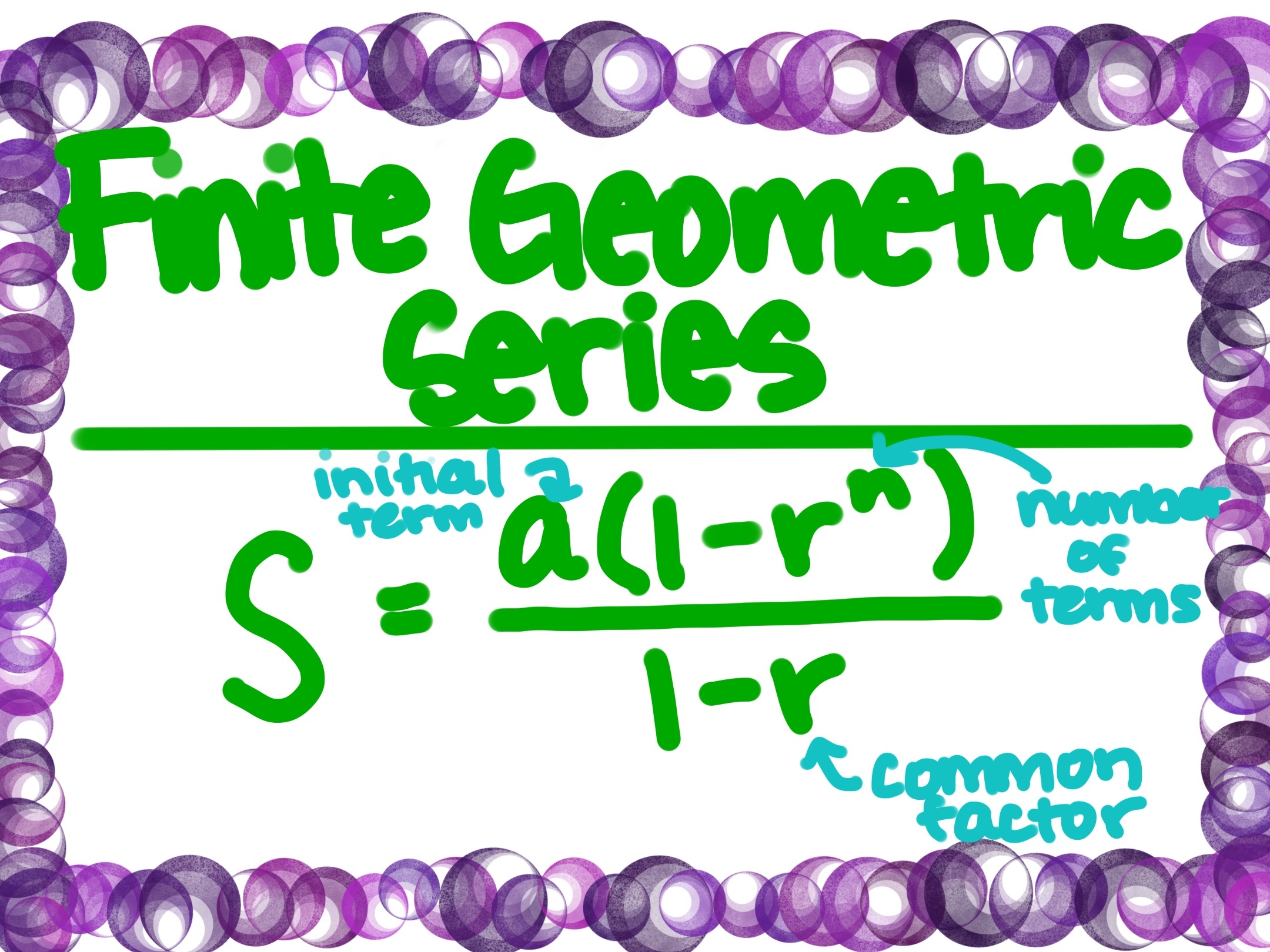
In fact, there is a formula for the value of a geometric series with initial term value aa, common ratio rr, and nn terms:

S=a(1−rn)1−rS = \frac{a(1 - r^n)}{1 - r}

We can use this idea in an example:

What is the value of the geometric series

2+23+29+227+281+22432 + \frac{2}{3} + \frac{2}{9} + \frac{2}{27} + \frac{2}{81} + \frac{2}{243}?

There are 66 terms, so n=6n = 6 and

S=a(1−r6)1−rS = \frac{a(1 - r^6)}{1 - r}

Next, the starting term in the series is 22, so a=2a = 2:

S=2(1−r6)1−rS = \frac{2(1 - r^6)}{1 - r}

Finally, the common ratio is 13\frac{1}{3}, as 2⋅13=232 \cdot \frac{1}{3} = \frac{2}{3}, 23⋅13=29\frac{2}{3} \cdot \frac{1}{3} = \frac{2}{9}, and so on. Thus r=13r = \frac{1}{3}:

S=2(1−(13)6)1−13=2(1−1729)23=2(728729)⋅32=728243S = \frac{2\left(1 - \left(\frac{1}{3}\right)^6\right)}{1 - \frac{1}{3}} = \frac{2\left(1 - \frac{1}{729}\right)}{\frac{2}{3}} = 2\left(\frac{728}{729}\right) \cdot \frac{3}{2} = \frac{728}{243}

However, there are also infinite geometric series that have an infinite number of terms. In this case, the above formula has n=∞n = \infty. However, if r>1r > 1 or r<−1r < -1, then r∞r^{\infty} is infinite (try some values of rr for yourself on your calculator; note how their magnitudes get rapidly bigger without showing any sign of letting up). That said, if −1<r<1-1 < r < 1, then the values of rnr^n for increasing nn get smaller in magnitude until they reach 00. Thus the geometric series remains finite. Under these constraints, for an infinite geometric series:

S=a1−rS = \frac{a}{1 - r}

As before, aa can be any finite number.

Note there are two special cases that you must watch out for.

r=0r = 0: The geometric series is not defined, as if you try to move "closer down the line to the starting term," i.e. from term arnar^n to arn−1ar^{n - 1}, then you are dividing by zero, which is not possible!

r=−1r = -1: This geometric series is not defined either, as you are simply oscillating the sign of the term. For instance, if a=1a = 1 and r=−1r = -1, if the series is infinite, then you get

S=1−1+1−1+1−...S = 1 - 1 + 1 - 1 + 1 - ...

But infinity is not a number, so it cannot be odd or even, so we do not know whether the sum equals 00 or −1-1 when all of the numbers are [hypothetically] added up. Thus this class of geometric series is not defined either.

Exercise: Compute

S=6+92+278+8132+…S = 6 + \frac{9}{2} + \frac{27}{8} + \frac{81}{32} + …

Something to ponder: Why does our formula fail upon trying to compute the value of the infinite series

0+0+0+0+…0 + 0 + 0 + 0 + …?

Read · 3 min

A geometric sequence is a recursively defined sequence of numbers where every term in the sequence (except the first) is found by multiplying the previous term by some constant r,r, often referred to as the common ratio. For example, the sequence 1,2,4,8,16,32,…1,2,4,8,16,32,\ldots is clearly geometric, as each term is the previous one multiplied by the common ratio, which, in this case, is 22.

If we let the first term be aa and the common ratio be r,r, a geometric sequence with nn terms can be written as: a,ar,ar2,…,arn−2,arn−1a, ar, ar^2, \ldots, ar^{n-2}, ar^{n-1} (make sure you see why the last term is not arn.ar^n.)

For more on geometric sequences, I recommend you look at the expii discussion here.

A natural question when working with geometric sequences is how calculate the sum of numbers in a geometric sequence. In mathematical terms, we are asking if there is a simple expression that calculates the sum a+ar+ar2+…+arn−2+arn−1a + ar + ar^2 + \ldots + ar^{n-2} + ar^{n-1}

Returning to our original example of 1,2,4,8,161,2,4,8,16, we could easily compute the sum 1+2+4+8+161+2+4+8+16 directly to get 3131. Let's think about what would happen if we had 1+2+4+8+16+…+2501+2+4+8+16+\ldots+ 2^{50}. Adding each term one by one would be incredibly inefficient. So, we would like to find and prove a simple formula. Finding the motivation for the derivation of the formula is a bit difficult, so I will provide the formula and then prove it.

The formula for a geometric series (with first term a,a, common ratio r,r, and nn terms) is: a+ar+ar2+…+arn−2+arn−1=a(1−rn)1−ra + ar + ar^2 + \ldots + ar^{n-2} + ar^{n-1} = \dfrac{a(1-r^n)}{1-r}

Proof:

Let Sn=a+ar+ar2+…+arn−2+arn−1.S_n = a + ar + ar^2 + \ldots + ar^{n-2} + ar^{n-1}. Multiplying the sum by r,r, we get: r∗Sn=ar+ar2+ar3+…+arn−1+arn.r*S_n = ar + ar^2+ar^3+\ldots+ar^{n-1}+ar^n. Aha! There's that arnar^n term which seemed to be missing from our original sum. Now, we can subtract r∗Snr*S_n from Sn,S_n, as that will make all the middle terms cancel out (which is how our formula looks). We have: Sn−r∗Sn=a+ar+ar2+…+arn−1  −(ar+ar2+…+arn−1+arn)=a+(ar−ar)+(ar2−ar2)+…+(arn−1−arn−1)−arn=a−arn\begin{align} S_n - r*S_n &= a + ar + ar^2 + \ldots + ar^{n-1} \\ &\quad \: \: -(ar + ar^2+\ldots+ar^{n-1}+ar^n) \\ &= a + (ar - ar) + (ar^2 - ar^2) + \ldots + (ar^{n-1} - ar^{n-1}) - ar^n \\ &= a - ar^n \end{align} Now that we have Sn−r∗Sn=a−arn,S_n - r*S_n = a - ar^n, we just need to isolate Sn.S_n. Factoring both sides gives Sn(1−r)=a(1−rn),S_n(1-r) = a(1-r^n), and then dividing both sides by (1−r)(1-r) gives Sn=a(1−rn)1−r,\boxed{S_n = \dfrac{a(1-r^n)}{1-r}}, so we're done. ■\blacksquare

(Disclaimer: The upcoming sections will feature liberal usage of the term infinity which may violate technical definitions in some cases. I understand this, but I am trying to make this as simple to understand as possible for the reader.)

Now that we have a formula for a finite geometric series, we can find something similar for an infinite geometric series! Let's say our original example with powers of 22 went on forever. We want to find the sum 1+2+4+8+16+32+64+…1+2+4+8+16+32+64+\ldots with no end to the sequence. You're probably thinking that this sum is just ∞,\infty, and you're right! Our individual terms in the series keep increasing, and therefore, so does the sum. We call a sequence where the sum approaches ∞\infty divergent. In general terms, any infinite sequence with common ratio ∣ r ∣>1|\,r\,| > 1 will approach either ∞\infty or −∞-\infty. If you try plugging in some aa value with ∣ r ∣>1|\,r\,| > 1 and n=∞n = \infty to our formula for sum of a geometric series, you will find that we will also get ∞\infty or −∞,-\infty, since our numerator is ±∞\pm\infty and our denominator is a constant.

Now let's try looking at a more interesting geometric sequence, one that does not sum to ∞\infty. Let's look at the example 1+12+14+18+116+132+…1 + \frac12 + \frac14 + \frac18 + \frac{1}{16} + \frac{1}{32} + \ldots

We can try plugging this in to our formula for sum of a geometric series, as it worked with the previous infinite geometric series example. Substituting a=1,r=12,a = 1, r = \frac12, and n=∞n = \infty gives: Sn=1(1−(12)∞)1−12S_n = \frac{1\left(1-\left(\frac12\right)^\infty\right)}{1-\frac12} The numerator looks particularly interesting... Especially that (12)∞\left(\frac12\right)^\infty term. Well, as n→∞,n \rightarrow \infty, we know that (12)n\left(\frac12\right)^n gets smaller and smaller, closer and closer to 00. So, we can say that (12)∞=0,\left(\frac12\right)^\infty = 0, making our infinite sum just 1(1−0)1−12=2\dfrac{1(1-0)}{1-\frac12} = 2. We have found a value not equal to ∞\infty for our infinite sum that goes on forever! In mathematical terms, our series is convergent. In general though, an infinite geometric series will only converge if ∣ r ∣<1,|\,r\,| < 1, because only then will rnr^n become smaller and smaller as n→∞n \rightarrow \infty. So, the formula for an infinite geometric series with ∣ r ∣<1| \, r \,| < 1 is Sn=a1−r,\boxed{S_n = \dfrac{a}{1-r}}, because the 1−rn1-r^n term just becomes 00.

Infinite geometric series have applications in a lot of places, for example, finding the probability of winning in a game with a chance of win or loss on any given turn, or converting repeating decimals to fractions, et cetera. Infinite series (not necessarily geometric) will also be covered in great detail in calculus. This will not be your last encounter with them!


Next Lessons

In the next lesson, you will learn about the finite arithmetic series. In a few lessons, you will learn how to find the sum of an infinite series.

Video

(Video) Geometric Series

by GVSUmath

In this video by GVSUmath, the concept of Geometric series is explained.

Illustrated · 1 min

Finite Geometric Series

As we learned earlier, a series is the sum of all the terms in a sequence. Geometric sequences are commonly expressed as recursive sequences. Each new term is found by multiplying the previous term by a constant ratio.

If we want to find the finite geometric series, we are adding up all the terms in a geometric sequence that has a limited number of terms.

One way to do this is to add each term one by one. This works, but it can take a long time if there are many terms.

Luckily, there is a general formula that helps us find the sum much faster.

Finite geometric series

Image source: by Anusha Rahman

You can build on these skills to tackle word problems!

Type a concept, like “slope” or “photosynthesis”.

↑ ↓ to choose · Enter to openSearch explanations and problems