A geometric sequence is a recursively defined sequence of numbers where every term in the sequence (except the first) is found by multiplying the previous term by some constant r, often referred to as the common ratio. For example, the sequence 1,2,4,8,16,32,…
is clearly geometric, as each term is the previous one multiplied by the common ratio, which, in this case, is 2.
If we let the first term be a and the common ratio be r, a geometric sequence with n terms can be written as: a,ar,ar2,…,arn−2,arn−1
(make sure you see why the last term is not arn.)
For more on geometric sequences, I recommend you look at the expii discussion here.
A natural question when working with geometric sequences is how calculate the sum of numbers in a geometric sequence. In mathematical terms, we are asking if there is a simple expression that calculates the sum a+ar+ar2+…+arn−2+arn−1
Returning to our original example of 1,2,4,8,16, we could easily compute the sum 1+2+4+8+16 directly to get 31. Let's think about what would happen if we had 1+2+4+8+16+…+250. Adding each term one by one would be incredibly inefficient. So, we would like to find and prove a simple formula. Finding the motivation for the derivation of the formula is a bit difficult, so I will provide the formula and then prove it.
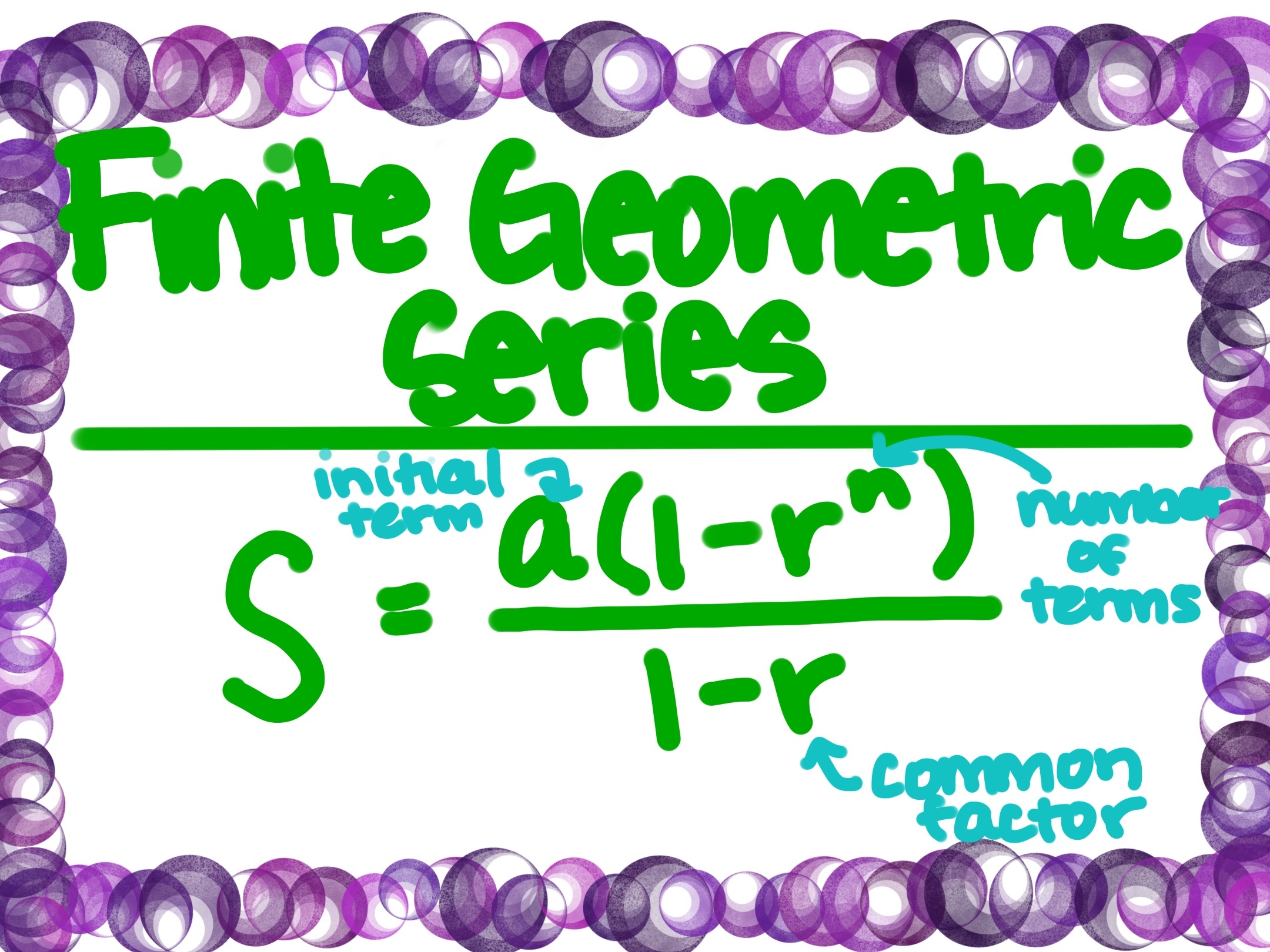
The formula for a geometric series (with first term a, common ratio r, and n terms) is: a+ar+ar2+…+arn−2+arn−1=1−ra(1−rn)
Proof:
Let Sn=a+ar+ar2+…+arn−2+arn−1. Multiplying the sum by r, we get:
r∗Sn=ar+ar2+ar3+…+arn−1+arn.
Aha! There's that arn term which seemed to be missing from our original sum. Now, we can subtract r∗Sn from Sn, as that will make all the middle terms cancel out (which is how our formula looks). We have:
Sn−r∗Sn=a+ar+ar2+…+arn−1−(ar+ar2+…+arn−1+arn)=a+(ar−ar)+(ar2−ar2)+…+(arn−1−arn−1)−arn=a−arn
Now that we have Sn−r∗Sn=a−arn, we just need to isolate Sn. Factoring both sides gives Sn(1−r)=a(1−rn), and then dividing both sides by (1−r) gives Sn=1−ra(1−rn), so we're done. ■
(Disclaimer: The upcoming sections will feature liberal usage of the term infinity which may violate technical definitions in some cases. I understand this, but I am trying to make this as simple to understand as possible for the reader.)
Now that we have a formula for a finite geometric series, we can find something similar for an infinite geometric series! Let's say our original example with powers of 2 went on forever. We want to find the sum 1+2+4+8+16+32+64+…
with no end to the sequence. You're probably thinking that this sum is just ∞, and you're right! Our individual terms in the series keep increasing, and therefore, so does the sum. We call a sequence where the sum approaches ∞ divergent. In general terms, any infinite sequence with common ratio ∣r∣>1 will approach either ∞ or −∞. If you try plugging in some a value with ∣r∣>1 and n=∞ to our formula for sum of a geometric series, you will find that we will also get ∞ or −∞, since our numerator is ±∞ and our denominator is a constant.
Now let's try looking at a more interesting geometric sequence, one that does not sum to ∞. Let's look at the example 1+21+41+81+161+321+…
We can try plugging this in to our formula for sum of a geometric series, as it worked with the previous infinite geometric series example. Substituting a=1,r=21, and n=∞ gives:
Sn=1−211(1−(21)∞)
The numerator looks particularly interesting... Especially that (21)∞ term. Well, as n→∞, we know that (21)n gets smaller and smaller, closer and closer to 0. So, we can say that (21)∞=0, making our infinite sum just 1−211(1−0)=2. We have found a value not equal to ∞ for our infinite sum that goes on forever! In mathematical terms, our series is convergent. In general though, an infinite geometric series will only converge if ∣r∣<1, because only then will rn become smaller and smaller as n→∞. So, the formula for an infinite geometric series with ∣r∣<1 is Sn=1−ra, because the 1−rn term just becomes 0.
Infinite geometric series have applications in a lot of places, for example, finding the probability of winning in a game with a chance of win or loss on any given turn, or converting repeating decimals to fractions, et cetera. Infinite series (not necessarily geometric) will also be covered in great detail in calculus. This will not be your last encounter with them!