
Illustrated · 1 min
By Sylvia Freeman

+2 contributors
Contributors


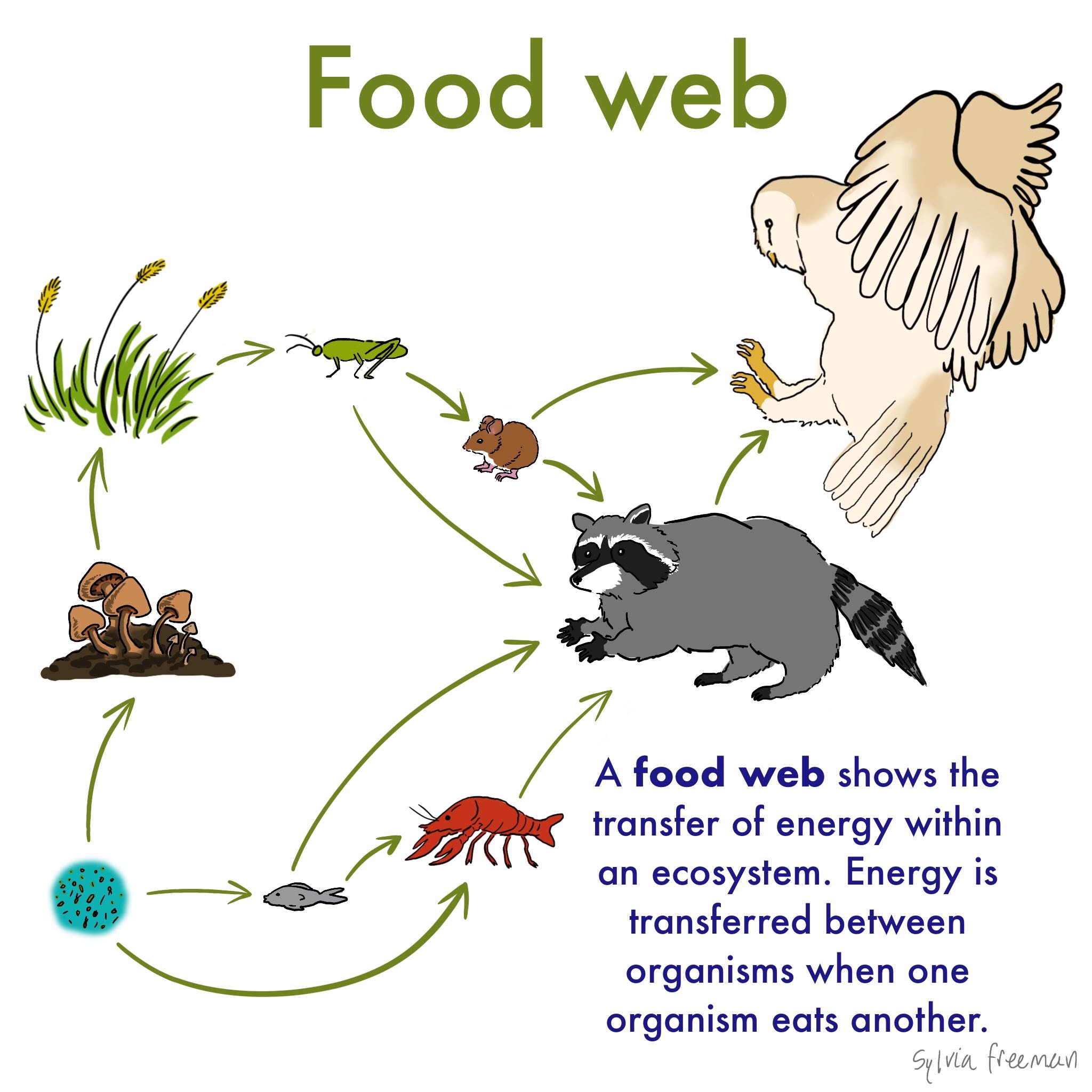
Image source: By Sylvia Freeman
Illustrated · 1 min
Image source: By Sylvia Freeman
Illustrated · 2 min
A food web is the combination of all the food chains in an ecosystem. In a typical food chain, we might see something like a mouse eating a plant and then being eaten by an owl. However, the mouse isn't the only thing eating the plants. There are probably many different animals eating them.

Image source: By Roberta Rosina, DensityDesign Research Lab CC BY-SA 4.0, via Wikimedia Commons
Take a look at this web. First, the sun's energy allows producers to grow and make their own food. Next, many organisms eat the producers to get energy. Notice how it's not just one organism feeding on the producers; many animals include these plants in their diet. At the next level up, we have omnivores and predators eating many organisms below them. They even dip into the aquatic food web in the middle. Finally, we have an apex predator at the top, which feeds on many different levels of consumers.
Food chains show just a single feeding pattern. Each organism has a single role in the ecosystem. Food chains make it easier to visualize trophic levels, or how energy moves through the ecosystem. However, in reality, animals can have more than one food source, and the relationships between different organisms are much more complex. This is why webs are considered to be more realistic than simple food chains.
Changing any part of the web will cause all the other parts to also change. If you remove the mouse from the web in the picture above, a few things can happen.
First, because there are no mice to eat, the lynx population might not have enough food to support itself. This population might decline, which would then cause the snakes to not have enough food. This pattern would keep happening until the entire ecosystem has been changed.
You can think of the food web like a literal spider web: If you touch any part of it, the rest will shiver and shake. Pulling out a single strand from the web can cause strands to cross or even cause the whole thing to come crumbling down. This can happen when an ecosystem is disturbed, like when a non-native species is introduced.
Changes to ecosystems can be devastating, but they can also lead to things like rapid evolution that creates a variety of new adaptations and new webs.
: How energy passes through an ecosystem through organisms eating and being eaten
: The interaction of all the food chains in an ecosystem
: Organisms that produce their own food through photosynthesis or chemosynthesis
: Organisms that consume other organisms for energy
: Organisms, like bacteria and fungi, that break down waste and dead organic matter
Video
by CrashCourse
In this video, Hank explains how nutrients and energy are cycled around an ecosystem through food web and food chain diagrams.
Unlike food chains, webs are representative of complex predator/prey relationships. They can more effectively show how one primary producer can lead to many primary consumers, secondary consumers, tertiary consumers, and quaternary consumers. In addition, webs can show how different species either suffer or benefit when the population of one species is reduced.
Illustrated · 1 min
Ecosystems consist of a bunch of really complex interactions between many different species. When something happens to one organism it can vastly affect other parts of the ecosystem, leading to a much more unhealthy and damaged ecosystem. To help visualize these complex webs of interactions, scientists created food webs which show all of the ways that organisms rely on each other.
These diagrams largely show predator/prey relationships and show the flow of energy among plants and animals. Arrows point from prey to predator, showing the direction the energy flows and how the energy is lost.

Image source: By Matthew C. Perry [Public domain], via Wikimedia Commons
Even a top predator like a wolf can be affected by the disappearance of a much smaller creature like an ant. The ant could feed on a particular type of weed, and once the ant is gone this weed spreads, choking out other grasses which deer feed on. With less grass, the deer population declines and the wolves have less prey. Ecosystems are extremely fragile and need to be protected. Once broken they are even harder to fix.
Humans are often the cause of collapsing ecosystems. The disruptions they cause often lead to species extinction.


