Illustrated · 1 min
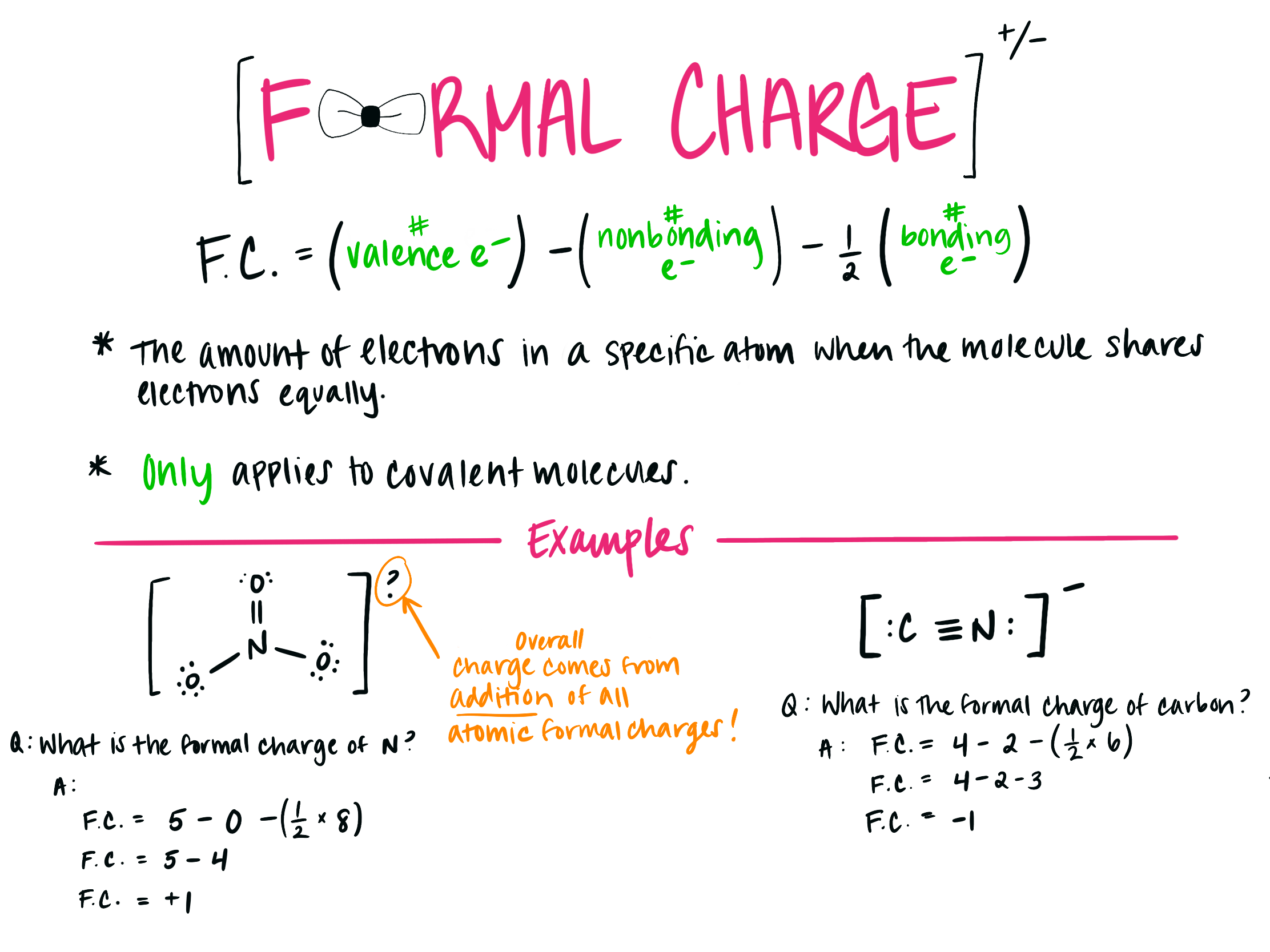
Image By: E. Burnham

Before this, knowIonic BondingCovalent BondingMetallic Bonding
Illustrated · 1 min
Image By: E. Burnham
Read · 3 min
If you were at a formal dinner event, I assume you would wait until the food had been served to all of the guests before you began to eat the food you were given. After dinner, the guests will have different amounts of food left over.
The formal charge is kind of like a dinner party, where all the guests are different atoms, and the food is the electrons. With formal charge, we are assuming that all of the bonding electrons -- "the food" -- are shared, covalently and equally between all the atoms. The resulting number of electrons found on each atom, the valence electrons, or “the amount of food guests have left over” contributes to the overall formal charge of the atom. Let’s get into the equation that describes formal charge.
With the equation below, we can determine the formal charge on a specific atom within a molecule.
F.C.=(# of valence electrons)–(# nonbonding electrons)–(# of bonding electrons)
The valence electrons are determined by the atom's group number on the periodic table, ranging from 1 to 8 electrons. Nonbonding electrons are the valance electrons that do not participate in the covalent bonds, which each contain two electrons.
All of these values are determined by using the Lewis Structure of a molecule, which consists of drawing out the electrons that are found within an atom.
Just like with energy, the closest formal charge to zero is always the most favorable. A molecule's overall charge is determined by adding all the individual atom’s formal charges. The overall charge of a molecule, if something other than zero, is denoted with brackets and a superscript of the charge. A few examples are shown below of different molecules and their overall formal charges.
: The nitrate oxoanion has a negative charge. So, it's written in brackets.
: Hydrochloric acid doesn't have a charge. So it's not written in brackets.
: Water doesn't have a charge. So it's not written in brackets.
: The hydronium ion occurs from adding an acid (hydrogen ion) to water. It has a charge. So, it's written in brackets.
Why is this important though?
The formal charge is significant because it explains the charges of polyatomic ions and sometimes the reactivity of an atom, covered more extensively in organic chemistry. The formal charge also shows scientists, and students, the progression of resonance structures and even which configuration of the molecule is the most favorable and stable.
As an example, let's calculate the formal charges for carbon dioxide. Remember, carbon dioxide has a central carbon double bonded to two oxygens.
Let's start with the formal charge of the oxygen atoms. Oxygen is in group six. So, it has six valence electrons. In carbon dioxide, it has two bonds and two lone pairs.
Now we can calculate the formal charge of carbon.
The total formal charge for the molecule is .
The formal charge is a methodology for approximating how charges are distributed. It assumes the electrons are shared completely evenly. So, it doesn't consider electronegativity differences. The opposite methodology is the oxidation number. In the oxidation number methodology, the electrons reside with the more electronegative element. The molecule's overall charge is the same in each. But, the charge on the individual atoms is different. These two methodologies are the extremes. So, chemists developed the valence bond theory and molecular orbital theory to better describe reality.
Video
by The Organic Chemistry Tutor
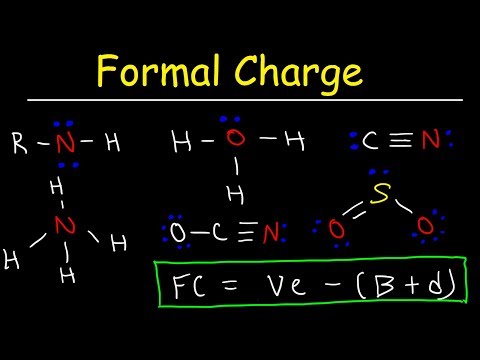
In this video, The Organic Chemistry Tutor works through six examples of formal charge calculations! The lesson starts with a couple of simple examples. He gives you the equation and shows you how to apply it to every atom in a molecule. But, by the end, he is using formal charges to determine the most stable resonance structure! This video will help you master calculating an atom's formal charge.