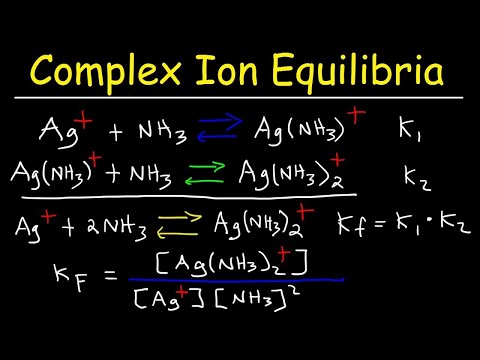
Let's define what a formation constant is and discuss its role in chemical equilibrium.
First, we will back up and recall some details about equilibrium. As we know, when the forward reaction rate is equal to the reserve reaction rate, chemical equilibrium is reached. This can typically be described using an equilibrium constant, K.
However, in the case of complex ion equilibria, a unique equilibrium constant is introduced.
A Formation Constant, Kf, also sometimes known as a stability constant or association constant is used to describe the formation of a complex ion from its central ion and its attached ligands. The equilibrium constant expression for Kf follows the same general form as any other typical equilibrium constant expression, with products over the reactants:
Kf=[M]x[L]y[MxLy]
- M is the metal ion (usually a transition metal)
- And, x and y are the coefficients
The units of Kf depend on the specific reaction it is being used to describe.
Now that we have defined what a formation constant is, let's discuss the role that it plays in equilibrium.
Let's use the the following reaction where aqueous ammonia is being added to a mixture of silver chloride and water to form the complex ion, Ag(NH3)2(aq)+, as an example:
Agaq++2NH3(aq)⇔Ag(NH3)2(aq)+
Kf=[Ag+][NH3]2[Ag(NH3)2+]=1.6x10⁷
The larger the Kf of a complex ion, the more stable that it is. In this example, the large size of the formation constant indicates that the majority of the free silver ions will combine with ammonia to form Ag(NH3)2+. An easy way to think about this is:
- Kf values that are very large in magnitude for a complex ion formation indicate that the reaction heavily favors the products. For complex ions that are poorly formed, this value will be very small
Due to their large values, sometimes formation constants will be listed as logarithms in the form logKf. Other times, they may be in the form of a dissociation constant, Kd, which is merely the inverse of the formation constant that describes the instability of the complex ion.
In other words, Kf is the stability constant and Kd is the instability constant
Per the above example, the dissociation constant expression would be:
Kf=Kd1
Kd=[Ag(NH3)2+][Ag+][NH3]2=6.25x10⁻⁸
Represented as logarithms, Kf and Kd would look like:
logKf=log(1.6x10⁷)=7.20
logKd=log(6.25x10⁻⁸)=−7.20
Solving for Formation Constant of Complex Ions
While one might assume that the formation of complex ions occurs in a single step, this is often not the case. Most of the time, this process occurs stepwise, and each step in the process has its own formation constant and chemical equilibria expression. The formation constant for the overall reaction, or the production of the complex ion, is the product of the stepwise formation constants.
Let's take a look at the replacement of water molecules from [Cu(H2O)6]2+ by ammonia to make sense of this:
Step 1. Cu(aq)2++NH3(aq)⇔[Cu(NH3)](aq)2+ K1
Step 2. [Cu(NH3)](aq)2++NH3(aq)⇔[Cu(NH3)2](aq)2+ K2
Step 3. [Cu(NH3)2](aq)2++NH3(aq)⇔[Cu(NH3)3](aq)2+ K3
Step 4. [Cu(NH3)3](aq)2++NH3(aq)⇔[Cu(NH3)4](aq)2+ K4
Since the concentration of water and the number of aqua ligands are pretty much constant, they can safely be omitted
The sum of the stepwise reactions is the overall equation for the formation of the complex ion:
Overall: Cu(aq)2++4NH3(aq)⇔[Cu(NH3)4](aq)2+
Equilibrium constant expression: Kf=[Cu2+][NH3]4[[Cu(NH3)4]2+]=2.1x1013=K1K2K3K4
Note: The K values will often be provided to you via table of formation constants
If you wished to find the formation constant of one of the intermediate steps, you would simply take the product of the K values up until that point.
The following table includes several common complex ions and their formation constant:
Equation at EquilibriumAl3++6F−⇔[AlF6]3−Cd2++4NH3⇔[Cd(NH3)4]2+Cd2++4CN−⇔[Cd(CN)4]2+Co2++6NH3⇔[Co(NH3)6]2+Co3++6NH3⇔[Co(NH3)6]3+Cu++2CN⇔[Cu(CN)2]−Cu2++4NH3⇔[Cu(NH3)4]2+Fe2++6CN−⇔[Fe(CN)6]4−Fe3++6CN−⇔[Fe(CN)6]3−Fe2++6SCN−⇔[Fe(SCN)6]4−Hg2++4Cl−⇔[HgCl4]2−Ni2++6NH3⇔[Ni(NH3)6]2+Ag++2Cl−⇔[AgCl2]−Ag++2CN−⇔[Ag(CN)2]−Ag++2NH3⇔[Ag(NH3)2]+Zn2++4OH−⇔[Zn(OH)4]2−Zn2++4CN−⇔[Zn(CN)4]2−Kf7x10191.3x1073x10181.3x1052.3x10331.0x10161.7x10131.5x10352x10433.2x1031.1x10162.0x1081.8x1051x10211.7x1072x10152.1x1019