Illustrated · 1 min
By Gabi Slizewska

+1 contributors
Contributors


Image source: By Gabi Slizewska
Illustrated · 1 min
Image source: By Gabi Slizewska
Illustrated · 2 min
One of the Earth's hidden treasures is the fossil record. Fossils are the remains or stone impressions of long-deceased organisms (some as far back as 3.5 billion years ago). Scientists from many different disciplines have studied these relics from the past. They have developed ways to determine the age of the fossils and figure out what their modern descendants are—if any exist.
Fossils give all kinds of evidence for evolution. From the rock layer that they are found in to the homologous structures they share with other fossils or modern organisms, scientists can gain a lot of insight from fossils about the history of life.

Image source: By H. Zell (User:Llez) CC BY-SA 3.0, via Wikimedia Commons

Image source: By jmwatsonusgs.gov [Public domain], via Wikimedia Commons
Using fossils, we can see that whales were four-legged land animals that evolved to survive in the ocean despite having lungs instead of gills. We can see how present-day horses came to be from their tiny ancestors. We can even use the locations of fossils to map out the structure of prehistoric landmasses, like Pangaea.

Image source: By Faus CC BY-SA 4.0, via Wikimedia Commons
Scientists can use all the fossil organisms that have been found so far to create a fossil record. The various fossils can be arranged to show how species changed over time and how different species are related. However, the fossil record often shows very dramatic changes in species. This makes sense because the record is far from complete, and the chances that an organism will be fossilized after death is actually pretty small. There are two other theories that can explain why scientists observe these dramatic changes.
According to the punctuated equilibrium theory, species stay relatively unchanged for long periods of time with short bursts of rapid change that create new species.
On the other hand, gradualism suggests that species undergo many small changes over a long period of time which build up and eventually form new species.
Both theories have wide support and are backed up by aspects of the fossil record.
: The remains or stone impression of a long-deceased organism
: Inherited structures that have lost most of, if not all of their original functions
: Structures that are shared between different organisms and that originated from a common ancestor
: The exact opposite of homologous structures; they have very different structures but the same function
Video
by Stated Clearly

Fossils are preserved impressions or remains found from a past geological era. Fossils are used to show evolutionary changes that have occurred since the last era and act as a record that life has evolved.

Image source: By Eveha, Totodu74 CC BY-SA 3.0, via Wikimedia Commons
Illustrated · 1 min
Common descent means that all life forms are evolutionarily related in some way. When two species share an ancestor, we call that their common ancestor. Populations of this ancient species became reproductively isolated and eventually evolved into two different species. Finding the common ancestor of two species can help us understand where modern organisms came from. Species that share very similar structures and DNA, like apes and humans, share a more recent common ancestor (maybe a few million years ago). There hasn't been a lot of evolutionary time to allow for vastly unique structures to evolve.
Very different organisms like mammals and reptiles share a more distant common ancestor. You have to go back a very long time in the evolutionary history to find when mammals and reptiles share an ancestor of the same species.

Image source: By NPS [Public domain], via Wikimedia Commons
Illustrated · 1 min
Fossils are the impressions of the remains of organisms preserved in rock. That can include organisms as large as dinosaurs or as small as plants or even microbes. Remains can also be as varied as bones, skin, feathers, footprints, nests, or even fecal matter.
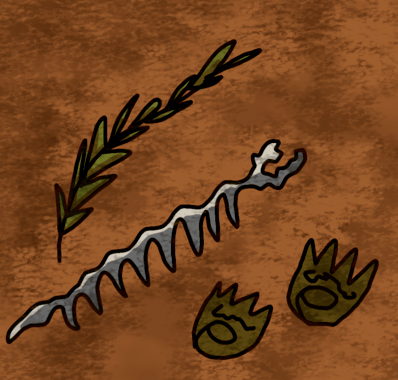
Image source: By Sarah Morgan
While fossils only represent a small slice of all the organisms that have been on Earth, they offer many insights about evolutionary history. Take a look at the image below showing layers of rocks and the fossils buried in them.
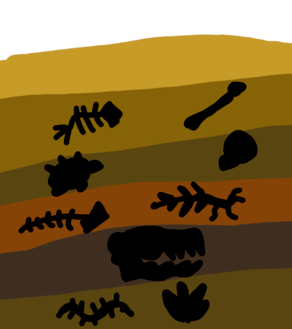
Image source: By Sarah Morgan
The placement of a fossil in the earth can tell you roughly how old the fossil is. This is because layers of rock built upon each other. If you find a fossil near the surface, it is relatively new. The deeper down you find it, the older it is. You can track the changes in an organism over the course of geologic time by comparing old and new fossils. For example, by comparing fossils you can see how the ancestors of whales and dolphins slowly lost their limbs as they adapted to living in water.
Video
by Teacher's Pet

Fossils can be used to support the theory of evolution by showing common ancestors of modern organisms and their relative age through fossil dating. By looking at a fossil's position in the earth and using more advanced methods like carbon dating, scientists can figure out the relative age of a fossil.
In this video, Teacher's Pet talks about the fossil evidence of evolution.